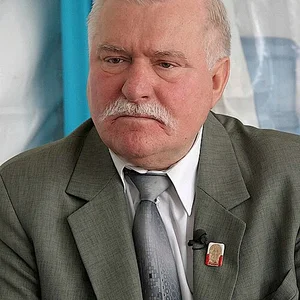

An electrician at the Gdańsk shipyards who became the leader of the independent trade union Solidarność, the first free trade union in the Soviet bloc. A major figure in the fall of communism in Poland, he was elected the first president of the Polish Republic by universal suffrage (1990-1995).
Lech Wałęsa(1943 — ?)
Lech Wałęsa
Pologne
6 min read
Frequently asked questions
Key Facts
- 1980: founds and leads the independent trade union Solidarność after the strikes at the Gdańsk shipyards
- 1981: is arrested and interned when martial law is imposed by General Jaruzelski
- 1983: receives the Nobel Peace Prize
- 1989: the Round Table Agreements pave the way for the semi-free elections won by Solidarność
- 1990-1995: becomes the first president of Poland elected by direct universal suffrage
Works & Achievements
The first free and independent trade union in the Soviet bloc, which gathered up to ten million members and shook the communist regime.
A historic agreement wresting from the authorities the right to strike and trade union freedom, the first major crack in the communist system.
An award honoring his non-violent struggle for workers' rights and freedom, which brought the Polish cause to international attention.
Talks between Solidarność and the authorities leading to semi-free elections and the peaceful end of the communist monopoly.
The first Polish president elected by direct universal suffrage, he guided the country's democratic and economic transition.
An account of his life and his struggle, translated into many languages, which made his journey known across the world.
A foundation dedicated to promoting democracy, human rights, and the memory of Solidarność.
Anecdotes
In December 1970, during the Gdańsk workers' riots that were brutally crushed, the young electrician Lech Wałęsa cut his teeth as a leader. Ten years later, in August 1980, he became famous by climbing over the wall of the Lenin Shipyard to join the strikers and take the head of the movement.
Wałęsa used to sign official documents with a giant pen bearing the likeness of Pope John Paul II. A devout Catholic, he often wore a badge depicting the Black Madonna of Częstochowa on his jacket lapel, thereby displaying the bond between Solidarność and the Polish Church.
In 1983, he was awarded the Nobel Peace Prize, but, fearing that the communist regime would prevent him from returning to Poland, he did not dare travel to Oslo. It was his wife Danuta who went to collect the award in his place.
When the regime imposed a state of war (martial law) in December 1981, Wałęsa was arrested and interned for eleven months. Far from breaking him, this detention strengthened his status as a symbol of peaceful resistance in the eyes of Poles and the entire world.
In 1990, the electrician with no university degree became President of the Republic of Poland. He liked to repeat with humor that he had never sought power, but that History had pushed him out of his repair workshop.
Primary Sources
The government recognizes the right of workers to form free and independent trade unions, as well as the right to strike.
We desire peace, and that is why we have never resorted to physical violence.
We the people want to be the masters of our own destiny.
Key Places
Wałęsa's workplace and the birthplace of Solidarność. It was here that the strikes of August 1980 broke out, changing the course of Polish history.
A major Baltic port city where Wałęsa lived and was an activist. It remains inseparable from the Polish workers' movement.
A village in northern Poland where Lech Wałęsa was born in 1943, into a family of peasant farmers.
Site of the 1983 Nobel Peace Prize ceremony, where Danuta Wałęsa represented her absent husband.
Seat of the Polish presidency that Wałęsa held from 1990 to 1995, the first freely elected head of state since before the war.
A church closely tied to Solidarność, where the movement found refuge and spiritual support during the repression.
Typical Objects

Small religious insignia that Wałęsa wore on the lapel of his jacket. It symbolized the alliance between the Solidarność workers' movement and the Polish Catholic Church.

Enormous souvenir pen with which Wałęsa publicly signed the Gdańsk Agreements in 1980. It became an icon of the strikers' victory.

Red banner bearing the handwritten “Solidarność” logo, raised during strikes and demonstrations. The word, written like a tightly packed crowd, became the emblem of the democratic struggle.

Worker's overalls and helmet that Wałęsa wore at the Lenin Shipyard in Gdańsk. This work garment recalled his proletarian origins at the heart of a workers' union.

Honor awarded to Wałęsa in 1983 for his nonviolent struggle. His wife Danuta went to collect it in Oslo, as he feared he might not be allowed back into Poland.

Receiver used to listen to Radio Free Europe and to spread information censored by the regime. An essential tool for circulating information during martial law.
School Curriculum
Vocabulary & Tags
Key Vocabulary
Daily Life
Morning
In the 1970s, Wałęsa began his day early to reach the Gdańsk shipyard, where he repaired the electrical systems of the ships. The alarm rang before dawn in a modest apartment shared with his large family.
Afternoon
The afternoon passed amid the din of the workshops, but also in clandestine discussions with other discontented workers. During the strikes of 1980, his days were swallowed up by meetings of the strike committee and by negotiations.
Evening
In the evening, he was reunited with his wife Danuta and their eight children, sharing a simple meal. A practicing Catholic, he devoted time to prayer and often secretly listened to Western radio stations.
Food
The diet of Polish workers in the 1980s was frugal and shaped by shortages and rationing. Black bread, soups, potatoes, sauerkraut and cured meats made up everyday fare, with meat being scarce and expensive.
Clothing
At work, Wałęsa wore the overalls and helmet of the shipyard electrician. In public, he sported a thick moustache that became famous and a jacket often adorned with the badge of the Black Madonna.
Housing
Like most working-class families, the Wałęsas lived in a cramped apartment in one of the large concrete housing blocks typical of communist urban planning. Space was tight for a family of ten.
Historical Timeline
Period Vocabulary
Liens externes & ressources
Références
Œuvres
Fondation du syndicat Solidarność
1980
Signature des accords de Gdańsk
31 août 1980
Prix Nobel de la paix
1983
Négociations de la Table ronde
1989
Présidence de la République de Pologne
1990-1995
Autobiographie « Un chemin d'espoir »
1987
Création de l'Institut Lech Wałęsa
1995