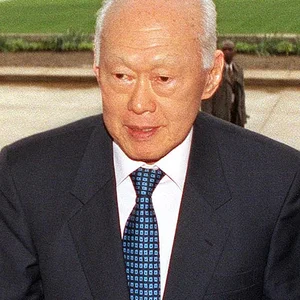

Singaporean statesman, Prime Minister of Singapore from 1959 to 1990. The founder of modern Singapore, he transformed a small, poor city-state into one of the most prosperous economies in Asia.
Lee Kuan Yew(1923 — 2015)
Lee Kuan Yew
Singapour
5 min read
Frequently asked questions
Key Facts
- Born in 1923 in Singapore, then a British colony, died in 2015
- Co-founded the People's Action Party (PAP) in 1954
- Became the first Prime Minister of self-governing Singapore in 1959
- Led the separation from the Federation of Malaysia and Singapore's independence in 1965
- Governed the country until 1990, turning Singapore into a major financial and industrial hub
Works & Achievements
The political party he created and led, which dominated Singapore's political life for decades.
A policy of large-scale housing construction that made it possible to house the vast majority of Singaporeans and to build a nation.
A strategy of attracting foreign investment and creating jobs that transformed the island's economy.
English as the common and working language, with the mother tongue preserved: a pillar of cohesion in a multi-ethnic society.
A systematic greening campaign that turned Singapore into a green and clean metropolis, a model of urban planning.
A two-volume autobiography recounting the birth of modern Singapore, a reference work on the nation's development.
Anecdotes
In 1965, Singapore was expelled from the Federation of Malaysia. At the press conference announcing the forced independence, Lee Kuan Yew broke down in tears in front of the cameras: “All my life, I believed in the merger of the two territories.” This moment of public vulnerability remained etched in Singaporean memory.
Born into an English-speaking Chinese family, the young Lee spoke mainly English. As an adult, he learned Mandarin and Malay to campaign and reach all voters; he considered himself an “uprooted Chinese” who had to win back his own culture.
Nicknamed “Harry Lee” during his studies at Cambridge, he earned a double law degree with first-class honours (a “double first”), an exceptional result for a student from a colony.
Obsessed with cleanliness and order, Lee launched national campaigns against spitting, littering, and even the sale of chewing gum, which was banned in Singapore in 1992 to keep public transport clean.
During the Japanese occupation of Singapore (1942-1945), the young Lee worked for a time as an English translator for Japanese propaganda. He would later say that this brutal period taught him that “whoever holds power decides what is right.”
Primary Sources
For me, it is a moment of anguish. All my adult life, I have believed in the merger and unity of the two territories.
We had inherited the island without its hinterland, a heart without a body. We had to survive on our wits alone.
How could a small country with no natural resources survive? Our only asset was our people, their education and their discipline.
What interests me is whether a policy works. If it doesn't work, we throw it out and try another one.
Key Places
Birthplace, home, and field of action of Lee Kuan Yew, who transformed it from a poor colonial port into a prosperous metropolis.
Lee studied law here and earned a double first-class degree, an experience that shaped his worldview.
The seat of power where Lee served as Prime Minister from 1959 to 1990 and shaped the nation's institutions.
A historic open field where major political rallies and the proclamation of independence took place.
Opened in 1981, this aviation hub became a worldwide symbol of the Singaporean efficiency that Lee championed.
Typical Objects

Immaculate white outfit, symbol of the People's Action Party and its ideal of integrity and cleanliness in politics. Lee and his officials wore it during election campaigns.

Tool of the great popular rallies where Lee harangued the crowds in several languages. His mastery of eloquence made it a major political weapon.

Planning documents for public housing (HDB) and the redevelopment of the city-state. They embody the methodical transformation of Singapore into a modern metropolis.

Two-volume autobiography recounting the founding of modern Singapore. It became a key reference on the development of Asian nations.

Each year Lee launched tree-planting campaigns to turn Singapore into a “garden city.” Planting a tree became a political gesture symbolizing green progress.

Posters and regulations banning the sale of chewing gum from 1992 onward, a symbol of Singapore's policy of cleanliness and civic discipline.
School Curriculum
Vocabulary & Tags
Key Vocabulary
Daily Life
Morning
Lee Kuan Yew started his day early, with exercise — swimming, stationary cycling, or walking — convinced that physical discipline supported mental discipline. He would then read the international press and reports from his ministries.
Afternoon
His afternoons were devoted to government meetings, economic and urban affairs, and receiving foreign leaders. He demanded concise notes and precise data from his staff.
Evening
In the evening, he studied files, met with experts, or continued learning Mandarin with a tutor. He placed great importance on reading and strategic reflection.
Food
Frugal and health-conscious, he ate moderately, favoring simple, balanced food. He watched his weight and avoided excess, out of concern for longevity and productivity.
Clothing
He wore plain clothes: a white shirt, sometimes the PAP's white jacket during campaigns, or a classic suit for official meetings. His attire reflected his taste for order and integrity.
Housing
He lived for a long time in a modest family house on Oxley Road, refusing ostentation. This home became a symbol of his preference for simplicity, and he asked that it be demolished after his death.
Historical Timeline
Period Vocabulary
Liens externes & ressources
Références
Œuvres
Fondation du People's Action Party (PAP)
1954
Programme de logement public (HDB)
à partir de 1960
Industrialisation et zone de Jurong
années 1960-1970
Politique du bilinguisme
années 1960-1980
Vision de la « ville-jardin »
à partir de 1967
The Singapore Story (mémoires)
1998-2000