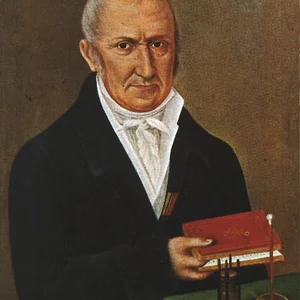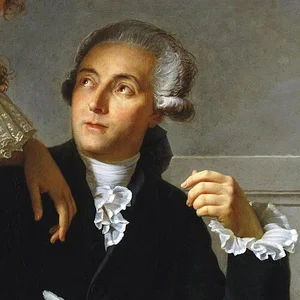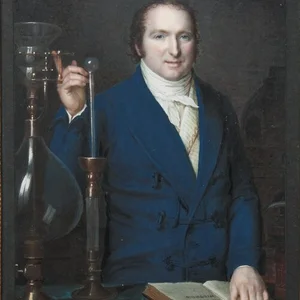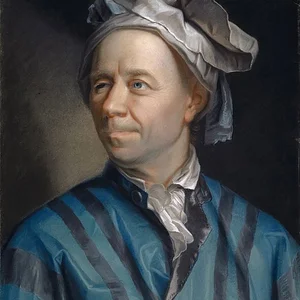

Swiss mathematician, physicist, and engineer (1707–1783), Euler is one of the greatest scientists of the 18th century. Prolific and innovative, he contributed to nearly every field of mathematics and physics, despite the blindness that affected him from 1738 onward.
Leonhard Euler(1707 — 1783)
Leonhard Euler
royaume de Prusse, Empire russe, ancienne Confédération suisse
7 min read
Frequently asked questions
Key Facts
- 1727: Joins the Saint Petersburg Academy of Sciences at the invitation of Bernoulli
- 1735: Solves the Seven Bridges of Königsberg problem, founding graph theory
- 1738: Gradually loses his sight, but continues his work with the help of collaborators
- 1755–1771: Produces his major works in analysis, differential and integral calculus
- 1783: Dies in Saint Petersburg having published more than 800 scientific papers
Works & Achievements
Foundational work that established the bases of modern analysis and introduced the exponential notation e^x. This treatise revolutionized the way infinitesimal functions are studied.
Famous equation linking exponential functions, trigonometric functions, and complex numbers. It is one of the most beautiful mathematical formulas, unifying several branches of mathematics.
Founding work of the calculus of variations that solves the brachistochrone problem and develops methods for finding optimal curves.
Solution to the famous problem that laid the foundations of graph theory. Euler proves that it is impossible to cross all seven bridges exactly once, thereby creating a new mathematical field.
Euler considerably deepened number theory, establishing results on prime numbers, Euler's totient function φ, and the properties of congruences.
Work on the geometry of solids that introduces the Euler-Descartes characteristic (V - E + F = 2), a fundamental formula in topology.
Euler develops the equations of fluid mechanics, the theory of elasticity, and solves numerous problems in applied mechanics, enriching mathematical physics.
Anecdotes
Euler lost vision in his right eye in 1738, likely due to an infection, but continued working with remarkable productivity. After becoming completely blind in 1766, he dictated his discoveries to his assistants and produced nearly half of his scientific works during this period of total blindness, demonstrating extraordinary determination.
Euler was so prolific that he published on average one scientific paper every three days throughout his life. The Saint Petersburg Academy of Sciences had to continue publishing his memoirs for thirteen years after his death, so vast was his catalogue of works.
In 1735, Euler solved the famous Seven Bridges of Königsberg problem in a matter of days, thereby laying the foundations of graph theory. This elegant solution demonstrated how mathematics could solve concrete practical problems, revolutionizing the scientific approach of the era.
Euler had 13 children with his first wife Katerina, and led a very active family life while pursuing his intense mathematical research. He would jokingly remark that some of his best ideas came to him while playing with his children or walking in the academy gardens.
In 1761, Euler predicted the transit of Venus across the Sun with remarkable precision, demonstrating the power of his astronomical calculations. This prediction helped establish the precise distances between the planets and the Sun, a major breakthrough for the astronomy of his time.
Primary Sources
A function is an analytical expression composed in any way from this variable and numbers or constants.
Since the nature of the universe is most perfect and nothing happens without reason, it is extremely probable that everything occurs in such a way that some quantity always remains a maximum or minimum.
I am ceaselessly occupied with finding new properties of curves and deepening the mysteries of infinitesimal calculus.
The solution of this problem has no relation to ordinary geometry, but seems to belong to a new branch of geometry, which Leibniz once called geometry of position.
Mathematics is the science of magnitudes and numbers, and all natural phenomena can be reduced to relationships of magnitudes.
Key Places
Euler's birthplace on April 15, 1707. Basel is a major city in German-speaking Switzerland where he grew up and received his first mathematical training from his father Paul Euler.
Euler's main place of activity from 1727 to 1741 and from 1766 to 1783. It was in Saint Petersburg that he produced a large part of his prolific mathematical work, despite his progressive blindness.
Euler worked there from 1741 to 1766 as director of the mathematics section under the reign of Frederick II. This period was highly productive for his research in analysis and number theory.
Euler's initial place of study, where he studied mathematics and theology. The university played a foundational role in the intellectual development of the young scholar.
Royal residence of Frederick II where Euler spent time during his stay in Prussia. The Berlin Academy, where he conducted his scientific work, was located nearby.
Typical Objects

Essential tools of Euler's work, who wrote thousands of pages of mathematics and physics. Despite his progressive blindness, he continued to produce works by dictating to assistants, using these instruments until the end of his life.

Teaching instruments used by Euler during his lectures in Switzerland, Russia, and Prussia. They represent his role as a professor and his part in transmitting mathematical knowledge in the 18th century.

Everyday objects of the 18th century, symbolizing Euler's struggle against poor eyesight and then blindness. Despite this disability from 1738 onwards, he never ceased his remarkable scientific research.

Fundamental geometric tools for mathematicians of the early modern period, indispensable for the geometric drawings and proofs that Euler carried out.

Euler published more than 500 works and memoirs. These volumes represent his immense intellectual legacy and his major contribution to the building of modern mathematics (algebra, analysis, number theory).

Symbols of 18th-century science and Euler's interests in physics, astronomy, and celestial mechanics. They illustrate the broad and empirical approach of Enlightenment scholars.

Euler was a prolific letter writer, exchanging with the greatest scholars in Europe. These letters bear witness to the intense intellectual life of scientific networks in the Age of Enlightenment.
School Curriculum
Vocabulary & Tags
Key Vocabulary
Daily Life
Morning
Euler rises early, as was customary in the 18th century. Despite his progressive and then total blindness from 1738 onward, he begins his day by dictating his mathematical observations to his assistants or his sons. He has a light breakfast of bread, cheese, and herbal tea before immersing himself in his work.
Afternoon
The afternoon is devoted to intensive sessions of intellectual work: mental calculations, dictating scientific memoirs to secretaries, and correspondence with other European scholars. Euler maintains remarkable productivity by relying on his prodigious memory and his collaborators as interlocutors, discussing complex mathematical problems.
Evening
In the evening, Euler may receive other scholars or academy members for scientific discussions, or enjoy time with his family. He goes to bed relatively early to preserve his energy, as the intense intellectual work and his physical condition require regular rest.
Food
As a member of the scientific elite of 18th-century Northern Europe, Euler consumes rye or wheat bread, local cheeses, fish, and butcher's meat. His diet includes seasonal fruits and vegetables, as well as wine or beer, common beverages of the era across all social classes.
Clothing
Euler wears the typical attire of an 18th-century scholar: a dark-colored coat, breeches, woolen stockings, and buckled shoes. With age and especially after losing his sight, he adopts a simpler and more comfortable style, with little concern for fashion, favoring practicality.
Housing
Euler lives in residences befitting his academic standing, notably in Saint Petersburg (1727–1741), then Berlin (1741–1766), and finally Saint Petersburg again (1766–1783). These homes provide dedicated spaces for intellectual work, a library, and the reception of scientific peers, characteristic of the households of prestigious academicians.
Historical Timeline
Period Vocabulary
Visual Style
Un style d'illustration scientifique du XVIIIe siècle inspiré des gravures de l'Époque des Lumières, combinant la précision mathématique avec la chaleur baroque, entre lumière de chandelle et obscurité, reflétant le génie créatif d'Euler malgré sa cécité tardive.
Sound Ambience
Une ambiance sonore immersive du cabinet d'étude d'un savant du XVIIIe siècle, mêlant les bruits de la composition mathématique (grattement de plume, froissement de parchemin) aux sons discrets de l'environnement européen de l'époque, créant une atmosphère de concentration intellectuelle et de découverte scientifique.
Liens externes & ressources
Références
Œuvres
Introductio in analysin infinitorum
1748
Formule d'Euler (e^(ix) = cos(x) + i*sin(x))
1748
Methodus inveniendi lineas curvas
1744
Théorie des graphes - Problème des sept ponts de Königsberg
1736
Contributions à la théorie des nombres
1770s
Elementa doctrinae solidorum
1758
Contributions à la mécanique et la physique
1736-1760