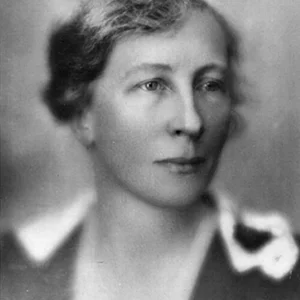

American engineer, psychologist, and pioneer of scientific management. The first woman member of the American Society of Mechanical Engineers, she brought the human dimension into the study of industrial efficiency.
Lillian Gilbreth
Lillian Evelyn Moller Gilbreth
7 min read
Frequently asked questions
Key Facts
- Born on May 24, 1878, in Oakland, California; died on January 2, 1972, in Phoenix, Arizona
- Earned a doctorate in psychology from Brown University in 1915, one of the first in industrial psychology
- Developed time and motion study with her husband Frank Gilbreth to optimize work
- First woman admitted as a member of the American Society of Mechanical Engineers (1926)
- Mother of twelve children, her family life inspired the book and film “Cheaper by the Dozen”
Works & Achievements
A foundational work, drawn from her doctoral research, that introduced psychology and the human factor into the scientific study of work.
A method that filmed and broke down workers' gestures to eliminate unnecessary movements, the basis of modern ergonomics.
A book devoted to reducing fatigue at work through better tools, postures, and conditions, rather than through pace alone.
Pioneering work adapting motion study to people with disabilities and war casualties so that they could work.
An application of scientific management to the household, treating domestic work as a profession that can be made more efficient.
A model kitchen designed from her motion studies, popularizing the work triangle and built-in storage.
Principles behind the foot-pedal trash can and the shelves in the refrigerator door, which have become everyday standards.
The first woman professor of management at an American engineering school, training generations of students.
Anecdotes
Lillian and her husband Frank had twelve children, and they turned their large home into a true laboratory of efficiency: chore charts posted in the bathrooms, foreign-language records played during washing-up, and “family councils” to divide up the household tasks. Two of their children, Frank Jr. and Ernestine, recounted this extraordinary life in the bestselling book “Cheaper by the Dozen” (1948), adapted for film in 1950.
When Frank died suddenly of a heart attack in 1924, many clients no longer trusted the consulting firm because it was now run by a woman. Rather than give up, Lillian redirected her research toward the home and stores, and accepted a teaching position: she would become the first woman professor at an engineering school in the United States (Purdue).
In 1926, Lillian Gilbreth became the first woman admitted to the prestigious American Society of Mechanical Engineers, an almost exclusively male world. Forty years later, in 1966, she also became the first woman to receive the Hoover Medal, one of the highest honors in American engineering.
By scientifically studying the movements of homemakers, just as she had done for factory workers, Lillian rethought the kitchen to save time and energy. She is credited with ideas that have become commonplace today: the foot-pedal trash can you open without your hands, the shelves and egg racks in the refrigerator door, and the layout of the kitchen as a “work triangle.”
Recognized in her lifetime as “the mother of modern management,” Lillian Gilbreth received more than twenty honorary degrees. In 1984, twelve years after her death, the United States Postal Service honored her by printing her portrait on a stamp in the “Great Americans” series.
Primary Sources
“The psychology of management, as here used, means the effect of the mind that is directing work upon that work which is directed, and the effect of this directed and undirected work upon the mind of the worker.”
The subtitle announces the book's aim: “The Elimination of Humanity's Greatest Unnecessary Waste” — that is, the avoidable fatigue caused by poor movements and poor work tools.
Here Lillian argues that housework is a genuine profession that can be organized scientifically, in order to reduce fatigue and give free time back to those who run a household.
This autobiographical account, written by two of her children, describes how the parents applied their efficiency methods at home, turning the daily life of a family with twelve children into a living demonstration of organization.
Key Places
Lillian Moller's birthplace, where she grew up in a well-off family and was initially educated at home.
Where she studied literature, earning her bachelor's degree (1900) and then her master's, paving the way for an academic career.
The institution where she earned her doctorate in 1915; the family then settled in Providence, the base of their consulting firm.
The large family home where the brood of twelve children lived, the setting of “Cheaper by the Dozen” and a laboratory for domestic efficiency methods.
Where she taught management starting in the 1920s and, in 1935, became the first woman professor in an American engineering school.
The city where Lillian Gilbreth died in 1972, at the age of 93.
Typical Objects

A central instrument of the scientific organization of work, used to measure the precise duration of each of a worker's movements in order to spot wasted time.

A camera that, by attaching small lamps to workers' hands, recorded the luminous path of their movements on a single image. The Gilbreths used it to study and improve motions.

A chart breaking down any task into seventeen or eighteen elementary motions (grasp, search, transport…) called “therbligs,” the name Gilbreth spelled almost backwards. It was used to analyze and simplify each task.

A trash can whose lid opens by means of a foot pedal, allowing waste to be thrown away without getting dirty or bending down. Its principle comes from Lillian Gilbreth's studies of everyday motions.

Compartments and racks (for eggs, butter, bottles) set into the refrigerator door, the result of studying the cook's movements to reduce unnecessary gestures.

A carefully thought-out kitchen layout linking the sink, the stove, and storage to limit steps and fatigue. Lillian Gilbreth laid down its principles by timing meal preparation.
School Curriculum
Vocabulary & Tags
Key Vocabulary
Tags
Daily Life
Morning
A mother of twelve and a well-respected professional, Lillian organized her mornings with almost military precision: waking, washing, and breakfast all followed task charts posted around the house. Once the children had left, she turned her attention to correspondence and her clients' files.
Afternoon
The afternoon was devoted to her work as a consulting engineer: factory visits, analyzing motion-study films, writing reports, or teaching at the university. She alternated between business trips and long hours in her design office.
Evening
Evenings brought the whole family together for dinner, sometimes followed by a “family council” where everyone voted on chores and shared projects. Lillian would read, grade papers, or prepare her upcoming lectures.
Food
Their diet was that of the early-twentieth-century American middle class: meats, vegetables, dairy, and bread, served in large quantities to feed a big family. Even meal planning was governed by principles of efficiency.
Clothing
As a professional woman of her time, she wore understated, well-kept dresses and suits—long skirts at first, then more practical outfits as the decades passed—in line with the serious image expected of an academic and lecturer.
Housing
The family lived in spacious homes, notably a large house in Montclair, New Jersey, conceived as a genuine testing ground for domestic organization, with posting systems and optimized equipment.
Historical Timeline
Period Vocabulary
Liens externes & ressources
Références
Œuvres
The Psychology of Management
1914
Fatigue Study
1916
Motion Study for the Handicapped
1920
The Home-Maker and Her Job
1927
La « Kitchen Practical » (cuisine ergonomique)
1929-1930
Innovations domestiques
années 1920-1930