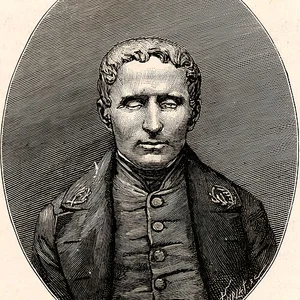

Louis Braille (1809–1852) was a French teacher who lost his sight at the age of three and invented, at 15, the tactile writing system that bears his name. His raised-dot alphabet revolutionized access to reading and writing for blind people around the world.
Louis Braille(1809 — 1852)
Louis Braille
France
9 min read
Frequently asked questions
Famous Quotes
« Access to communication in the fullest sense is what makes the difference between someone who is just physically blind and someone who is truly blind.»
Key Facts
- Born on January 4, 1809, in Coupvray (Seine-et-Marne)
- Lost his sight at age 3 following an accident in his father's workshop
- Enrolled at the National Institute for Blind Youth in Paris in 1819
- Invented the braille system at the age of 15, in 1824
- Died on January 6, 1852; his system was officially adopted in France in 1854, two years after his death
Works & Achievements
The first printed treatise describing the Braille system, aimed at blind individuals and their educators. It laid the foundations of a universal six-dot alphabet destined to spread throughout the world.
The definitive version of the system, including a completely redesigned musical notation. This edition represents the mature form of Braille as it would be disseminated internationally after its author's death.
An extension of the dot system to the transcription of musical scores, enabling blind musicians to read compositions by touch. This Braille music code remains the global standard for scores intended for the visually impaired.
As a full-time teacher for nearly twenty years, Louis Braille trained generations of blind students and future advocates of his tactile writing system.
Anecdotes
At the age of three, Louis Braille was playing in his father's saddlery workshop in Coupvray when he accidentally drove an awl into his eye. The infection spread, and by the age of five, Louis was completely blind. The very tool that had robbed him of his sight would paradoxically become the symbol of his invention: a similar awl is used to punch the raised dots of his future alphabet.
In 1821, a French army officer, Charles Barbier de la Serre, presented to the Institut des jeunes aveugles a raised-dot system called *night writing*, designed to allow soldiers to read messages without light. Young Louis Braille, then twelve years old, immediately recognized the potential of this invention — but also its flaws. He spent three years refining it into a simple and complete alphabet.
Louis Braille developed his system at just fifteen years old, in 1824, using six dots arranged in two columns. This six-dot cell allows for 64 different combinations — more than enough for the alphabet, punctuation, numerals, and even music. The blind student had just invented what his sighted teachers had failed to create.
Although Braille taught his system to his students as early as the 1830s, the Institut National des Jeunes Aveugles long refused to adopt it officially, preferring other methods considered more accessible to sighted teachers. Louis Braille died in January 1852 without seeing his invention recognized by the very institution that had housed him since childhood. France officially adopted it two years after his death.
As well as being a teacher, Louis Braille was a talented organist, highly regarded at several Parisian churches. He adapted his dot system to notate music, enabling blind musicians to read scores by touch. This musical extension of braille is still used today by thousands of visually impaired musicians around the world.
Primary Sources
This work presents a new process for writing words, music, and plainchant using raised dots, for the use of the blind. This process, invented by Louis Braille, a pupil at the Royal Institution for Blind Youth, has been approved by that institution.
The system presented here constitutes a revision and improvement of the process published in 1829. Louis Braille simplified and completed his dot alphabet to make it applicable to all forms of writing and musical notation.
Braille was of uncommon gentleness and modesty; no one who saw him ever suspected the immense service he had just rendered to his fellow human beings, and he himself seemed to attach no importance to it.
The commission acknowledges that the process devised by Mr. Braille offers genuine convenience for writing and reading among the blind, and that the pupils who have used it are greatly satisfied with it.
Key Places
Louis Braille's birthplace, where his father worked as a harness maker. The family home is now a museum dedicated to his life and invention. It was here that the accident occurred which left him blind at the age of three.
Institution founded by Valentin Haüy where Louis Braille enrolled as a student in 1819 and later became a teacher in 1833. It was here that he invented and taught his tactile writing system; the school still exists today.
Republican mausoleum where Louis Braille's remains were transferred in 1952, on the centenary of his death, in recognition of his universal contribution. His hands, symbols of his tactile work, were preserved in his childhood home in Coupvray.
One of the Parisian parishes where Louis Braille served as an organist, earning a reputation as a first-rate musician. His musical mastery gained him recognition entirely on its own merits, independent of his visual impairment.
Liens externes & ressources
Références
Œuvres
Procédé pour écrire les paroles, la musique et le plain-chant au moyen de points
1829
Système Braille — édition révisée et complétée
1837
Notation musicale en braille
1829-1837
Enseignement à l'Institut des Jeunes Aveugles (grammaire, géographie, musique)
1833-1852