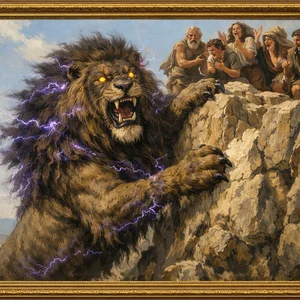

A monstrous creature of Greek mythology, the Nemean Lion terrorized the region of Nemea in Argolis. Its hide was said to be impenetrable by any weapon. Heracles strangled it with his bare hands during the first of his twelve labors, then wore its skin as armor.
Nemean Lion
Nemean Lion
8 min read
Frequently asked questions
Key Facts
- First of the twelve labors imposed on Heracles by King Eurystheus
- Its hide was invulnerable to any weapon — arrows, spears, and swords could not pierce it
- Heracles strangled it with his bare hands after cornering it in its den
- The lion's skin, stripped using its own claws, became the iconic attribute of Heracles
- According to some sources, it was the offspring of Typhon and Echidna, or a descendant of the Moon
Works & Achievements
The victory over the Nemean Lion is the first and most famous of Heracles' twelve labors. It establishes the hero as a tamer of monstrous forces and sets the model of the civilizing hero in Greek mythology.
Zeus immortalized the Lion by setting it in the heavens as the constellation Leo. This catasterism makes the lion a permanent cosmic landmark, associated with the Sun in summer in the Greek astrological tradition.
The death of the Nemean Lion is the founding event of the Nemean Games, a Panhellenic competition held every two years. These games celebrated the victory of the civilizing hero over monstrous chaos.
The lion's skin, worn as armor by Heracles, is one of the most frequently depicted attributes in Greek and Roman art. It symbolizes strength, invulnerability, and the transformation of danger into protection.
Anecdotes
The Nemean Lion was said to be invulnerable to any weapon forged by human hands: Heracles' arrows bounced off its hide like stone, and his sword bent uselessly against it. Faced with this obstacle, the hero had to devise another strategy and chose to strangle the beast with his bare hands — a feat that would become the emblem of his superhuman strength.
After killing the lion, Heracles wanted to skin the carcass to claim its impenetrable hide. But no blade could cut through it. It was by using the animal's own claws that he managed to skin it, turning the beast into a natural armor he wore for the rest of his life.
According to some mythographers such as Hesiod, the Nemean Lion was no ordinary wild animal: it was the offspring of the monsters Typhon and Echidna, or sometimes of Orthrus (the two-headed dog). It therefore represented a cosmic force of chaos, predating the Olympian order, that heroes had to subdue for civilization to take hold.
After the lion's death, Zeus placed it among the stars to commemorate the event, and it became the constellation Leo, visible each summer in the Mediterranean sky. This celestial transformation speaks to the creature's mythological importance: even in defeat, it remained immortal in the cosmos.
The victory over the Nemean Lion gave rise to the Nemean Games, one of the four great Panhellenic competitions alongside the Olympic, Pythian, and Isthmian Games. Held every two years, these games reminded the Greeks of Heracles' triumph over monstrous chaos.
Primary Sources
Echidna bore Orthrus to Geryon, and also Cerberus of the cruel heart... and she bore a third monster, invincible, the Nemean Lion, whom Hera, wife of lord Zeus, raised and settled in the hills of Nemea, a bane to mankind.
Eurystheus first commanded him to bring back the skin of the Nemean Lion. This lion, sired by Typhon, was ravaging the region of Nemea and Cleonae. Heracles went to Nemea and tracked the lion. He first shot arrows at it, but realizing the beast was invulnerable, he set aside his bow, seized his club, and entered the cave.
He first faced the lion of Nemea in its valley and slew the fearsome beast.
The hero recounted how he had lain in wait for the beast at the entrance to its den, how his weapons had proved useless, and how he had been forced to wrap his powerful arms around it and strangle it, enduring its bites and claws until life left the creature.
The Nemean Games were founded by Heracles after he slew the lion that had been devastating the flocks and people of the Argolid.
Key Places
A fertile valley in the Peloponnese where the Nemean Lion spread terror. It was here that Heracles confronted and killed it, and where the Nemean Games were founded in commemoration — one of the four great Panhellenic competitions.
Hills overlooking the valley of Nemea where the Lion's cave was located — its natural lair with two entrances. It was in this mountain pass between Cleonae and Nemea that the lion lay in wait for its prey.
A sacred site dedicated to Nemean Zeus, founded in memory of Heracles' victory over the lion. The ruins of the Doric temple (4th century BC) are still visible today, bearing witness to the importance of the cult surrounding this feat.
The Mycenaean city from which King Eurystheus sent Heracles to complete his twelve labors, the first of which was against the Nemean Lion. Eurystheus received the lion's hide in his fortified palace.
After its defeat, the Lion was placed by Zeus in the starry sky in the form of the constellation Leo. Visible each summer in the northern hemisphere, Leo counts Regulus as its brightest star and remains one of the twelve constellations of the Zodiac.
Typical Objects

The lion's impenetrable hide, worn by Heracles as armor after he slew it. The leontê, with the lion's head serving as a helmet, became the hero's primary iconographic attribute, recognizable in all ancient depictions.

The hero's weapon of choice, used in his confrontation with the lion. The club, a symbol of raw and primitive strength, proved ineffective against the invulnerable hide, forcing Heracles to rely on his bare hands alone.

Heracles first attempted to wound the lion with his arrows, dipped in the venomous blood of the Lernaean Hydra. They bounced off without effect, demonstrating the creature's supernatural and divine nature.

The lair of the Nemean Lion, a cave with two entrances in the hills overlooking the valley of Nemea. Heracles blocked one exit to force the beast into a fight with no escape.

A leafy garland awarded to the victors of the Nemean Games, an institution founded after Heracles' victory over the lion. Wild celery, a funerary plant in ancient Greece, symbolically recalled the monster's death and the region's original mourning.

After its death, the Nemean Lion was immortalized by Zeus as a constellation. Leo is one of the twelve constellations of the Zodiac, and the Greeks associated it directly with Heracles' first labor.
School Curriculum
Vocabulary & Tags
Key Vocabulary
Daily Life
Morning
In mythical accounts, the Nemean Lion emerges from its cave at dawn to hunt. It roams the hills of the Argolid in search of herds and unwary travelers, leaving behind devastated carcasses that shepherds discover at sunrise.
Afternoon
In the middle of the day, the creature retreats to its lair on Mount Tretos to rest. The inhabitants of Nemea and neighboring villages avoid the mountain roads after morning, knowing the lion can spring from the rocks at any moment.
Evening
At dusk, the Lion resumes its deadly rounds. Villagers throughout the region barricade their sheepfolds and lock themselves indoors at sunset. Fires lit at their doorways serve as warning beacons against the supernatural predator.
Food
The Nemean Lion feeds primarily on livestock — cattle, sheep, goats — and humans, particularly isolated shepherds and travelers. Its impenetrable skin renders it immune to any counterattack, making it an unrivaled predator throughout the Argolid region.
Clothing
The Nemean Lion is always depicted in its raw, monstrous nature, with no clothing or adornment. Its tawny golden hide, sometimes described as gleaming like gold, is itself a natural armor that even the gods cannot pierce.
Housing
The creature lives in a double-entrance cave carved into the slopes of Mount Tretos, overlooking the valley of Nemea. This dark lair, strewn with the bones of its victims, is described as an opening to the underworld — a space between the world of the living and that of primordial chaotic forces.
Historical Timeline
Period Vocabulary
Liens externes & ressources
Références
Œuvres
Premier travail d'Héraclès : la mise à mort du Lion
Temps mythiques
La constellation du Lion (Leo)
Temps mythiques (fixée par Zeus après sa mort)
Fondation des Jeux Néméens
573 av. J.-C. (date historique des premiers jeux attestés)
La léonté : l'armure vivante d'Héraclès
Temps mythiques