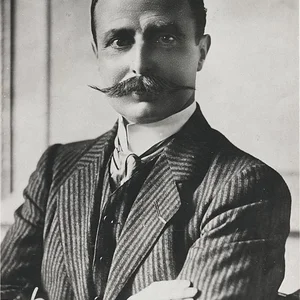

French engineer and aviator (1872–1936), Louis Blériot was the first person to cross the English Channel by aeroplane on 25 July 1909. A pioneer of aviation, he designed and flew his own aircraft, making a decisive contribution to the development of the aeronautical industry.
Louis Blériot(1872 — 1936)
Louis Blériot
France
7 min read
Frequently asked questions
Famous Quotes
« I took off. I arrived. That is all.»
« Aviation is the future of the world.»
Key Facts
- 1 July 1872: born in Cambrai
- 25 July 1909: first crossing of the English Channel by aeroplane (37 minutes), aboard his Blériot XI
- 1909: wins the £1,000 prize offered by the Daily Mail for this crossing
- From 1909 onwards: launches an aircraft manufacturing company that would equip numerous armies
- 1 August 1936: dies in Paris
Works & Achievements
First powered flight from one shore of the English Channel to the other, covering 38 km in 36 minutes and 30 seconds. A world-renowned feat hailed as both a technical and geopolitical revolution, proving that the sea no longer shielded islands from the air.
A monoplane designed and built by Blériot, the first aircraft to be mass-produced (over 900 units). It was used as a reconnaissance aircraft during the First World War by several armies.
A series of technical inventions in the field of automotive lighting that provided Blériot with the financial means to fund his aeronautical research for over a decade.
Ten successive prototypes, most of which crashed or failed, allowing Blériot to accumulate unparalleled experience as both builder and pilot. Each failure informed the next, embodying the empirical method of aviation's pioneers.
Founding of a pilot training school in Étampes and Pau to train the first French and foreign civilian and military aviators, helping to professionalize the discipline.
Anecdotes
On July 25, 1909, Blériot took off at dawn from Les Baraques, near Calais, with no compass and only a rough map. For around thirty minutes, he flew over the English Channel through thick fog, guided by the sight of a French destroyer. When he spotted the white cliffs of Dover, he tried to reach a French journalist who was waving to him from a meadow — he landed hard in a field, snapping his undercarriage, but safe and sound.
Just a few days before the historic crossing, Blériot had badly burned his foot in a previous aviation accident. He made his Channel crossing on crutches, unable to walk normally. The injury did not stop him: he took off anyway, convinced this was his one chance to win the £1,000 prize offered by the Daily Mail.
Louis Blériot had funded all his aeronautical experiments through the manufacture and sale of acetylene headlamps for automobiles. His family reproached him for squandering his fortune on what they considered foolhardy schemes. Between 1900 and 1909, he built no fewer than eleven different aircraft, surviving many crashes before hitting upon the winning formula of the Blériot XI.
On his arrival in Dover, British customs officers came to check his papers and stamp his passport — as they would for any traveler entering the United Kingdom — a gesture that was both comic and symbolic for a man who had just crossed the Channel without a boat. Back in Paris, he was welcomed as a hero: thousands of people gave him a standing ovation, and all of France celebrated the achievement as a national victory.
Primary Sources
Around four thirty in the morning, I left the ground. Ten minutes after departure, I had lost sight of the destroyer and was alone, absolutely alone, above this sea which nothing disturbed. I had neither compass nor any other navigational instrument.
Mr. Louis Blériot, piloting a Blériot monoplane, crossed the English Channel from a point near Calais to a point near Dover on July 25th, 1909, thus winning the prize of £1,000 offered by the Daily Mail.
The Blériot XI, powered by a 25-horsepower Anzani engine, covered approximately 38 kilometres in 36 minutes and 30 seconds. It is the first time the sea has been crossed by aeroplane.
I was waving the tricolour flag to show him the landing area. He flew over the cliffs at low altitude and landed hard in the meadow at Northfall Meadow, breaking his undercarriage. He climbed out of the aircraft unaided, limping slightly.
Key Places
Birthplace of Louis Blériot, born on 1 July 1872. The city paid tribute to him following his crossing of the English Channel.
Departure point for the historic Channel crossing on 25 July 1909. Blériot set up camp there in the days leading up to the feat, waiting for clear weather.
Meadow near Dover Castle where Blériot landed at 5:17 a.m. on 25 July 1909, after 36 minutes of flight. A granite column today marks the exact landing spot.
Agricultural plain where Blériot carried out numerous flight tests between 1907 and 1909. The town became an important centre of early French aviation.
Parisian address of the Blériot Aéronautique company, founded after the success of 1909. Its workshops for mass production of the Blériot XI expanded rapidly to meet orders from around the world.
Typical Objects

A wood-and-canvas monoplane designed and piloted by Blériot himself for his 1909 crossing of the English Channel. Weighing just 23 kg empty and powered by a 25-horsepower Anzani engine, it became the most famous aircraft in the history of pioneer aviation and the first plane to be mass-produced.

A small 25-horsepower air-cooled engine fitted to the Blériot XI for the Channel crossing. Prone to overheating, it was providentially cooled by a rain shower during the flight, averting a potentially fatal engine failure over the sea.

The invention that made Blériot's fortune at the start of the twentieth century. These lamps, patented and sold by his company, allowed him to fund his aeronautical research for an entire decade.

An essential piece of equipment for the first aviators, goggles shielded the eyes from wind and rain during open-air flights. Blériot wore them on all his test flights and during the crossing of the English Channel.

At the time of his Channel crossing, Blériot was on crutches due to a foot burn sustained in an earlier flying accident. They became a symbol of his determination to achieve the feat at any cost.

Before the flight, Blériot had a simple hand-drawn map showing the French and English coasts. With no compass or sophisticated navigation instruments, he consulted it briefly before flying by sight.
School Curriculum
Vocabulary & Tags
Key Vocabulary
Daily Life
Morning
Blériot rises very early, at dawn, to take advantage of the calm morning winds essential for flight testing. He personally inspects his aircraft with his mechanics, checking the engine, cables, and lifting surfaces before each attempt.
Afternoon
Afternoons are devoted to repairs following the inevitable incidents and crashes. In his workshops, surrounded by skilled workers, Blériot sketches new parts, thinks through structural modifications, and plans the next round of trials.
Evening
In the evenings, Blériot meets with his engineers and partners to analyze the day's flights. He corresponds with suppliers, journalists, and investors, and reviews weather reports to decide whether conditions the following day will allow flying.
Food
Like most French bourgeois of the *Belle Époque*, Blériot eats hearty meals: bread, meat, cheese, and wine at the table. During intensive testing periods, his meals are often eaten on the go, close to the hangars.
Clothing
Away from flying, Blériot wears the dark three-piece suit and bowler hat standard for the engineer-entrepreneur of his era. At the controls, he puts on a thick leather suit, protective goggles, and a soft helmet to guard against the cold and wind.
Housing
Blériot lives in a bourgeois Parisian apartment with his family. During intensive testing periods, he stays in temporary lodgings close to the airfields — sometimes under canvas or at a village inn.
Historical Timeline
Period Vocabulary
Liens externes & ressources
Références
Œuvres
Traversée de la Manche en avion
25 juillet 1909
Blériot XI (monoplan)
1909
Brevets de phares à acétylène pour automobiles
1898-1905
Série des Blériot I à X (prototypes aéronautiques)
1900-1908
École d'aviation Blériot
1910