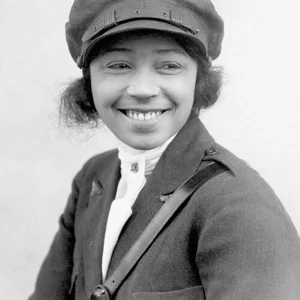

Bessie Coleman (1892–1926) was the first African American woman to earn a pilot's license, obtaining it in France in 1921 because no American school would accept her due to her race and gender. She became a celebrated stunt aviator before dying in a plane crash.
Bessie Coleman(1892 — 1926)
Bessie Coleman
États-Unis
9 min read
Frequently asked questions
Key Facts
- 1892: born in Atlanta, Texas, into a poor African American family
- 1921: earned an international pilot's license from the Fédération Aéronautique Internationale in France, the first Black woman to do so
- 1922: first public airshow in the United States performed before an African American audience
- Consistently refused to perform before segregated audiences
- 1926: died at age 34 in a plane crash in Jacksonville, Florida
Works & Achievements
Bessie Coleman's first major achievement: earning her FAI pilot's license in France after being turned away by every American flight school. This founding act made her the first African-American woman in history to hold an international pilot's license.
Bessie Coleman performed her first public stunt flying exhibition in America before thousands of spectators. The performance established her national reputation and officially launched her career as a traveling barnstormer.
For four years, Coleman traveled from city to city across the United States performing aerobatic stunt shows, using her earnings to raise awareness of aviation among African Americans and gather the funds needed for her planned school.
Alongside her airshows, Coleman gave numerous lectures at Black churches, schools, and associations to encourage young people to overcome racial discrimination. She was convinced that aviation could serve as a symbol of emancipation.
Bessie Coleman's great unfinished project: to establish the first flight school open to African Americans on American soil, so that no one would be forced to cross the Atlantic as she had been. Her accidental death prevented her from bringing it to fruition.
Anecdotes
Rejected by every American aviation school because of her race and gender, Bessie Coleman decided to learn French and crossed the Atlantic to train in Europe. In June 1921, at the Caudron brothers' aviation school in Le Crotoy, Normandy, she earned her international pilot's license issued by the Fédération Aéronautique Internationale, becoming the first African-American woman pilot in history.
Back in the United States, Bessie Coleman flatly refused to perform at air shows where Black and white audiences were segregated. If organizers maintained that policy, she would simply cancel her appearance — even at the cost of her fee — insisting that aviation should stand for equality, not division.
Nicknamed "Queen Bess" by the African-American press, she performed spectacular aerobatic displays across the United States to raise funds for a project she held dear: opening the first flight school for African-Americans, so that no one would ever have to cross the Atlantic just to learn how to fly.
On April 30, 1926, during an aerobatic rehearsal in Jacksonville, Florida, the plane she was in suddenly went into a spin. Bessie Coleman, who was not wearing a seatbelt so she could survey the terrain from the cockpit, was thrown from the aircraft at roughly five hundred meters altitude and died instantly. She was thirty-four years old.
Forgotten for decades, Bessie Coleman is today celebrated as a pioneer on two fronts. In 1995, the United States Postal Service honored her with a commemorative stamp, and several airports across the country bear her name or pay tribute to her legacy, making her an icon of the struggle for racial equality and women's emancipation.
Primary Sources
Official document issued on June 15, 1921 by the Fédération Aéronautique Internationale, certifying that Bessie Coleman had passed the theoretical and practical flying tests. This license, recognized in all FAI member countries, made her the first African-American woman to hold such a certificate.
The Chicago Defender, the leading African-American newspaper of the era, covered Bessie Coleman's return to Chicago in 1921 and reported her statements: she declared that her goal was to prove that African Americans could become pilots, and that she intended to open a flight school open to everyone, regardless of race.
Bessie Coleman stated: "I knew we needed Black aviatrices, and I knew that if it was to be done, I was the one to do it." She emphasized her determination to inspire African-American youth and to show that racial barriers could be overcome through hard work and perseverance.
The official report established that the Curtiss JN-4 aircraft piloted by William Wills suffered a loss of control due to a wrench jammed in the controls. Coleman, who was riding in the open rear cockpit without a seatbelt in order to survey the grounds for her upcoming performance, was thrown out at high altitude.
Key Places
Bessie Coleman's hometown, where she was born on January 26, 1892. She grew up there in a sharecropping family that faced poverty and the everyday racial segregation of the American South.
Bessie Coleman moved here around 1915 and worked as a manicurist. It was in this vibrant city — a hub of the African American press and culture — that she first heard about aviation and decided to learn French in order to train in France.
At the Caudron brothers' aviation school, on the shores of the Somme Bay, Bessie Coleman learned to fly in 1920–1921 and earned her international pilot's license, becoming the first African American woman pilot in history.
The site of Bessie Coleman's first public air show in the United States, on September 3, 1922. Her performance before a large crowd marked the official start of her career as a stunt aviator in America.
Bessie Coleman died here on April 30, 1926 during an aerobatic rehearsal over the city. Thrown from her Curtiss JN-4 biplane at approximately five hundred meters altitude, she was killed instantly.
Typical Objects

Bessie Coleman wore a fitted brown leather suit, essential equipment for withstanding the cold and wind in the open cockpits of the 1920s. Her polished, photogenic attire contributed to her star image and media visibility.

Essential in open-cockpit biplanes, these metal-framed goggles with tempered glass lenses protected the eyes from wind, insects, and debris. Bessie Coleman wore them consistently during her aerobatic flights, and they became one of the defining symbols of her identity as an aviatrix.

A two-seat open-cockpit biplane used extensively by the U.S. Army during World War I, then repurposed for civilian use. It was the aircraft of choice for barnstormers like Coleman for her aerobatic performances, and it was aboard a JN-4 that she met her death in 1926.

Pilot’s certificate No. 18310, issued by the FAI in 1921, is the most symbolic document of Coleman’s life. It represents her victory over the double discrimination — racial and gender-based — that had closed every door to her in the United States.

Navigation in the 1920s relied on annotated topographical maps that the pilot consulted in flight, orienting themselves visually by roads, rivers, and towns. Coleman used them to plan her demonstration circuits across the United States.

The close-fitting leather helmet, worn together with aviator goggles, was the standard protective equipment in civilian aviation of the 1920s. A powerful visual symbol of the era’s pilots, it nonetheless offered no protection against ejection at high altitude.
School Curriculum
Vocabulary & Tags
Key Vocabulary
Tags
Daily Life
Morning
On tour, Bessie Coleman's mornings began with a meticulous inspection of her aircraft alongside her mechanic. She checked the engine, the control surfaces, and the wing structure, well aware that the second-hand JN-4 biplanes bought surplus from the army were often in poor condition. She also consulted the scarce weather bulletins available, essential for low-altitude flight.
Afternoon
On air show days, afternoons were devoted entirely to aerial performances: low-level dives, barrel rolls, and tight turns that sent thrills through the crowd. Between passes, Coleman gave interviews to both Black and white journalists and signed autographs, as intent on spreading her message of racial equality as on entertaining the audience.
Evening
In the evenings, at each stop along the tour, Bessie Coleman often gave lectures at Black churches or community organizations to share her journey and inspire future aviators. She stayed in Black-owned boarding houses or with private families, as hotels routinely turned her away in states enforcing Jim Crow laws.
Food
Raised in a sharecropping family in Texas, Bessie Coleman had grown up on simple fare: corn, black-eyed peas, garden vegetables, and chicken. On the road, she relied on the hospitality of African American communities that welcomed her, often eating home-cooked meals prepared by Black families since segregated restaurants were closed to her across much of the country.
Clothing
For her performances, Coleman wore a complete and carefully put-together aviator's outfit: a brown leather flight suit, a close-fitting helmet, aviator goggles, and tall boots. This modern, striking silhouette stood in sharp contrast to conventional images of women of the era and earned her extensive photographic coverage in the press. Off the airfield, she dressed with equal care, mindful of her role as a role model for African American women.
Housing
During her barnstorming years, Bessie Coleman had no fixed residence, moving from state to state on the rhythm of her engagements. She was housed by Black families or in boarding houses in African American neighborhoods, as segregation barred her from most mainstream establishments. Chicago remained her anchor, where she returned to her family between tours.
Historical Timeline
Period Vocabulary
Liens externes & ressources
Références
Œuvres
Obtention du brevet de pilote international (FAI)
15 juin 1921
Premier meeting aérien aux États-Unis (Curtiss Field, Garden City)
3 septembre 1922
Tournées de voltige (barnstorming) à travers les États-Unis
1922-1926
Conférences dans les communautés afro-américaines
1922-1926
Projet d'école d'aviation pour les Afro-Américains
1925-1926