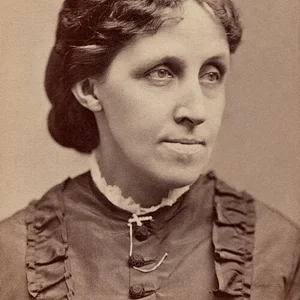

American novelist and short-story writer, famous for her novel *Little Women* (1868), largely inspired by her own childhood. A committed advocate for the abolition of slavery and women's rights, she served as a nurse during the Civil War.
Louisa May Alcott(1832 — 1888)
Louisa May Alcott
États-Unis
6 min read
Frequently asked questions
Famous Quotes
« I am not afraid of storms, for I am learning how to sail my ship.»
Key Facts
- Born in 1832 in Germantown (Pennsylvania), raised in the transcendentalist circles of New England
- Volunteer nurse at a Washington hospital during the Civil War (1862-1863)
- Published *Little Women* in 1868, an enormous success
- Activist for women's suffrage and the abolition of slavery
- Died in 1888 in Boston, two days after her father Amos Bronson Alcott
Works & Achievements
An account drawn from her experience as a nurse during the Civil War; this first success gave her confidence in her talent.
Her masterpiece, inspired by her childhood; it became a worldwide classic of children's literature.
The sequel to Little Women, recounting the coming of age of the March sisters.
A novel contrasting simple values with the frivolity of high society, championing the independence of women.
A sequel devoted to the school that Jo and her husband open for young boys.
A semi-autobiographical novel about a woman seeking to earn her independence through work.
The final installment of the March saga, bringing the family's story to a close.
Anecdotes
As a child, Louisa grew up in Concord, Massachusetts, surrounded by the greatest thinkers of her time: the philosopher Ralph Waldo Emerson lent her books, and Henry David Thoreau took her and her sisters on walks in the woods to observe plants and animals. This extraordinary upbringing nourished the imagination of the future novelist.
Before becoming famous, Louisa secretly wrote sensational novels full of revenge and passion, which she signed with the pseudonym “A. M. Barnard.” These thrilling stories sold well and helped the often-poor family pay its bills.
In 1862, she volunteered as a nurse in a military hospital near Washington during the Civil War. There she contracted typhoid fever and was treated with calomel, a mercury-based medicine: her health remained permanently weakened as a result.
Her most famous novel, Little Women, was written in just a few weeks at her publisher's request. Louisa drew on her own family for inspiration: the character of Jo, the rebellious sister who dreams of becoming a writer, is largely a self-portrait.
A campaigner for women's right to vote, Louisa was the first woman to register on the electoral rolls in Concord in 1879, in order to take part in the school board election. She died in 1888, just two days after her father, the philosopher Bronson Alcott.
Primary Sources
“I never began the year in a stranger manner than this; I am free to confess, having spent the first night of the New Year on duty, and bidden in to a hospital.”
“Christmas won't be Christmas without any presents, grumbled Jo, lying on the rug.”
“I had nothing but my own moral sense to guide me.” In them she records, day by day, her poverty, her relentless work as a writer, and her determination to support her family with her pen.
“I plod away, though I don't enjoy this sort of thing. Never liked girls or knew many, except my sisters; but our queer plays and experiences may prove interesting.”
Key Places
Birthplace of Louisa May Alcott in 1832, when her father was running a school there.
Family home where Louisa lived for many years and wrote Little Women. Today a museum.
Utopian community founded by her father in 1843; the experiment failed after a few months of hardship.
Military hospital where Louisa served as a nurse in 1862 and fell gravely ill.
City where Louisa died in 1888; she had also pursued part of her literary career there.
Typical Objects

Louisa wrote her manuscripts by hand, with a quill dipped in ink, sometimes for whole days until her hand was paralyzed. She taught herself to write with both hands so she could keep going despite the pain.

Her father built her a small wall-mounted desk in her room at Orchard House. It was there that she wrote Little Women.

During her service at the military hospital, Louisa wore the plain, long uniform of the Union's volunteer nurses. The work there was exhausting and unsanitary.

A bound edition of the 1868 novel, which was an immediate success and was reprinted again and again. The book made Louisa's literary fortune.

A widespread 19th-century remedy made from mercury chloride, used to treat Louisa's typhoid fever. Toxic, it left her with lasting after-effects.

A common household light source that allowed Louisa to write late into the night, before electricity became widespread. Its flickering glow accompanied her long working sessions.
School Curriculum
Vocabulary & Tags
Key Vocabulary
Tags
Daily Life
Morning
Louisa rose early, especially during her periods of intense writing when she could work several days in a row. The morning was devoted to writing, at her small desk, when her mind was at its sharpest.
Afternoon
In the afternoon, she helped with household chores in the often-poor home and took on small jobs (sewing, teaching, governess work) to support her family. She also cared for her sisters and her mother.
Evening
In the evening, by the light of an oil lamp, she read, revised her manuscripts, or answered her abundant correspondence. The Alcott family also loved to put on little homemade theatrical plays.
Food
Raised in a family that embraced her father's ideas, Louisa knew a simple and often vegetarian diet, sometimes marked by scarcity, particularly at Fruitlands where meat, milk, and products derived from animal exploitation were banned.
Clothing
She wore the long, plain dresses typical of nineteenth-century New England women, without luxury. Little attached to fashion, she preferred practical outfits over vanity.
Housing
The family moved often, living in modest houses in Massachusetts. The most famous, Orchard House in Concord, was a wooden dwelling where Louisa had her own bedroom and a built-in wall desk.
Historical Timeline
Period Vocabulary
Liens externes & ressources
Références
Œuvres
Hospital Sketches (Croquis d'hôpital)
1863
Les Quatre Filles du docteur March (Little Women)
1868
Good Wives (Le Docteur March marie ses filles)
1869
An Old-Fashioned Girl (Une vieille fille à la mode)
1870
Little Men (Le Rêve de Jo)
1871
Work: A Story of Experience
1873
Jo's Boys (Les Petits Hommes deviennent grands)
1886