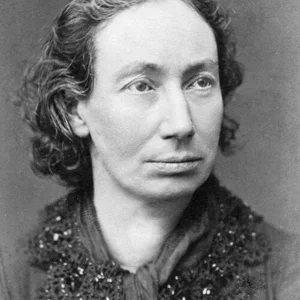

Teacher and leading figure of the French anarchist movement (1830–1905), Louise Michel dedicated herself to educating poor children before becoming one of the heroines of the Paris Commune. Exiled and imprisoned for her revolutionary actions, she devoted her life to the struggle for social equality and the emancipation of the oppressed.
Louise Michel(1830 — 1905)
Louise Michel
France
6 min read
Frequently asked questions
Famous Quotes
« I am an insurgent»
« One must be at once the most loving and the most implacable of beings»
Key Facts
- 1871: Active participation in the Paris Commune, notably in the formation of women's combat battalions
- 1873: Sentenced to deportation to New Caledonia for her role in the Commune
- 1880: Amnestied and returned to France, she continued her anarchist and educational activism
- 1883–1905: Traveled across France and Europe to promote anarchism and emancipatory education
- 1905: Died in Marseille, regarded as a martyr of the labor and anarchist movements
Works & Achievements
Major autobiography in which Louise Michel recounts her childhood, her revolutionary commitment and the Paris Commune. A primary historical source on the Communard movement.
Detailed account of the events of the Paris Commune, blending personal testimony and historical analysis. A reference work on this founding episode.
Collection of Kanak tales and oral traditions gathered during her deportation to New Caledonia. A valuable and pioneering ethnographic testimony.
Collection of educational texts intended for children, illustrating Louise Michel's innovative teaching methods.
Social novel depicting workers' struggles and revolutionary aspirations, reflecting her anarchist convictions.
Social and political novel denouncing the injustices of bourgeois society and the exploitation of the poorest.
Anecdotes
During her trial after the Paris Commune in December 1871, Louise Michel declared to the judges: "If you are not cowards, kill me!" This famous phrase illustrates her courage and her refusal to beg for mercy. She was sentenced to deportation to New Caledonia rather than death.
In New Caledonia, Louise Michel was one of the rare Communards to support the Kanak revolt of 1878. She gave them her red Commune scarf as a sign of solidarity, while most of the deported refused to ally themselves with the indigenous insurgents.
A passionate teacher, Louise Michel had been teaching before the Commune in free schools she had helped found. She welcomed the poorest children there and used innovative pedagogical methods, including nature observation, while refusing corporal punishment.
On January 9, 1882, during a meeting in Le Havre, a man named Pierre Lucas shot Louise Michel and wounded her in the head. Not only did she refuse to press charges, but she asked for clemency for her attacker, claiming he had been manipulated by her political opponents.
Louise Michel was a passionate naturalist. During her deportation to New Caledonia, she collected plant and animal specimens which she sent to the Muséum National d'Histoire Naturelle in Paris. Several species were described thanks to her shipments.
Primary Sources
I am ambitious for humanity; I would like everyone to be an artist, poet enough that human vanity would disappear.
What I demand of you is the firing post at Satory where our brothers have already fallen. I must be cut from society; you are told to do it; well, the commissioner of the Republic is right. Since it seems that every heart that beats for freedom is entitled only to a little lead, I claim my share!
The Commune, surrounded on all sides, had no choice but to conquer or die. The old world was crumbling beneath it; its crime was to desire justice.
For as long as I can remember, the horizon has always seemed narrow to me. I have always had an immense desire for freedom.
Key Places
The neighbourhood where Louise Michel taught and lived before the Commune. It was on the Montmartre hill that the insurrection broke out on 18 March 1871 with the affair of the cannons.
Louise Michel's birthplace, where she grew up at the Demahis family château. A house-museum there keeps her memory alive today.
The place of Louise Michel's deportation from 1873 to 1880. There she developed her interest in natural sciences and formed bonds with the Kanak people.
The prison where Louise Michel was incarcerated from 1883 to 1886 following her conviction for leading a demonstration of unemployed workers.
Louise Michel's burial place. Her funeral in January 1905 drew more than one hundred thousand people into the streets of Paris.
Typical Objects

Symbol of the Paris Commune, Louise Michel wore this scarf during the fighting on the barricades. She gave hers to the Kanak insurgents in New Caledonia.

Weapon used by the National Guard during the Commune. Louise Michel handled this rifle during the defense of Montmartre and on the barricades.

Daily tools of Louise Michel the schoolteacher, symbols of her commitment to popular education and the instruction of poor children.

In New Caledonia, Louise Michel kept notebooks in which she recorded her observations on the local fauna and flora.

Essential writing instruments for this prolific author who wrote memoirs, poems, novels, and an abundant correspondence.

Characteristic garment of Louise Michel, who almost always wore black. This cape became a recognizable element of her silhouette during her lectures.
School Curriculum
Vocabulary & Tags
Key Vocabulary
Tags
Concept
Mouvement
Daily Life
Morning
Louise Michel rose early, often at dawn. During her years as a schoolteacher in Montmartre, she prepared her lessons and welcomed the children from morning onward in her small school. She also devoted time to reading newspapers and tending to her activist correspondence.
Afternoon
The afternoon was dedicated to teaching or to political meetings in the neighborhood's clubs and vigilance committees. Louise Michel actively participated in debates and spoke at gatherings to defend the rights of workers and women.
Evening
In the evenings, Louise Michel wrote: poems, articles, letters to her comrades in struggle or to Victor Hugo, whom she greatly admired. She also attended late-night meetings of revolutionary clubs where strategies for social action were discussed.
Food
Louise Michel ate very frugally, like most of Paris's working classes at the time: bread, soup, vegetables, and rarely meat. During the Siege of Paris in 1870–1871, food became extremely scarce and the population was forced to subsist on rats and horses.
Clothing
Louise Michel dressed almost exclusively in black, in an austere and practical manner. She wore a long dark dress, a black cape, and a simple bonnet or hat. Her attire reflected her rejection of bourgeois vanity and her solidarity with the working classes.
Housing
In Montmartre, Louise Michel lived in modest, often cramped lodgings, which she sometimes shared with her mother. Her apartment also served as a classroom for the poor children of the neighborhood. The furnishings were sparse: a bed, a table, and books everywhere.
Historical Timeline
Period Vocabulary
Visual Style
Un style visuel dramatique inspiré de la lithographie française du XIXe siècle et de l'art révolutionnaire, avec de forts contrastes entre noir profond et rouge cramoisi, évoquant à la fois les barricades de la Commune et l'austérité du Paris populaire.
Sound Ambience
L'ambiance sonore de Louise Michel mêle les bruits de la Commune insurgée — canons, barricades, chants révolutionnaires — aux sons plus intimes de la salle de classe où elle enseignait aux enfants des quartiers populaires de Montmartre.
Liens externes & ressources
Références
Œuvres
La Commune, histoire et souvenirs
1898
Légendes et chants de gestes canaques
1885
Le Livre du jour de l'an
1872
Prise de possession
1890
Les Microbes humains
1886