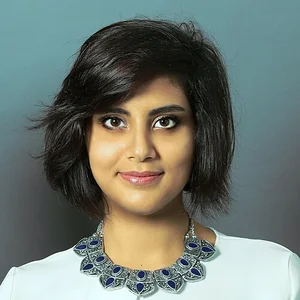

Saudi women's rights activist, imprisoned from 2018 to 2021 for demanding the right to drive and gender equality. Her struggle contributed to lifting the driving ban for women in Saudi Arabia.
Loujain al-Hathloul(1989 — ?)
Loujain Al-Hathloul
Arabie saoudite
9 min read
Frequently asked questions
Key Facts
- 2013: Arrested for the first time while attempting to cross the United Arab Emirates border driving a car
- 2018: Arrested along with other activists shortly before the lifting of the driving ban for women
- 2018: Lifting of the ban on women driving in Saudi Arabia, a central demand of her activism
- 2018–2021: Detained without trial, accused of threatening national security
- 2021: Released under conditions after more than two years in detention
Works & Achievements
Loujain actively takes part in this campaign encouraging Saudi women to drive and film their actions to share on YouTube and Twitter. This massive digital mobilization helps bring the debate on women's rights in Saudi Arabia to an international audience.
By attempting to cross the border behind the wheel of her car, Loujain turns an individual act into a global symbol of resistance. Her 73-day detention draws the attention of international media and makes her the most prominent figure of the movement.
Beyond the right to drive, Loujain campaigns against the male guardianship system that requires women to obtain permission from a father, husband, or brother to travel or work. This structural struggle goes far beyond the symbolic demand of the right to drive.
Loujain applies for a position at a UN agency focused on women's rights — a move that is later cited in her indictment as evidence of the supposed "threat to national security" she allegedly represents.
Her family, in particular her sister Lina Al-Hathloul, leads a global campaign documenting the conditions of her detention and the alleged torture she endured. This collective effort pressures several Western governments to officially call for her release.
Anecdotes
In November 2014, Loujain Al-Hathloul attempted to cross the border between the United Arab Emirates and Saudi Arabia driving her own car. Saudi authorities detained her for 73 days at the border crossing, refusing to let her enter the country in her vehicle. This deliberate act of civil disobedience made her famous on Arab and international social media.
In May 2018, Loujain was arrested along with other women's rights activists just a few weeks before the Saudi government officially announced the lifting of the driving ban in June 2018. The timing shocked world opinion: the women who had led the fight found themselves in prison at the very moment of their victory.
According to testimonies from her family and several NGOs, Loujain allegedly suffered torture during her detention, including electric shocks and waterboarding. The Saudi government denied these allegations, but Amnesty International and Human Rights Watch documented them and called for an independent investigation.
Loujain studied French literature at the University of Ottawa in Canada, which allowed her to master several languages and bring her cause to an international audience. This education gave her a cross-cultural perspective that she used to argue that gender equality was not incompatible with Islamic values.
Released in February 2021 after two years and nine months in detention, Loujain remains subject to a travel ban preventing her from leaving Saudi Arabia. Her release came just days after the inauguration of U.S. President Joe Biden, who had pressed for her freedom — illustrating how her fate had become an international diplomatic issue.
Primary Sources
Loujain al-Hathloul and other detained women human rights defenders have been subjected to torture and other ill-treatment, including electric shocks and waterboarding, as well as sexual harassment during interrogation sessions.
UN human rights experts expressed deep concern over the prolonged detention of Loujain Al-Hathloul and other women's rights defenders in Saudi Arabia, calling for their immediate and unconditional release.
Saudi authorities arrested at least seven prominent women's rights activists, including Loujain al-Hathloul, who had campaigned for the right to drive and against the male guardianship system.
My sister Loujain has been transferred to Dhahban prison. She has had no access to a lawyer since her arrest. She is being held for defending women's rights.
Loujain Al-Hathloul is charged, among other counts, with communicating with foreign journalists and diplomats, seeking a position at the UN, and campaigning for women's rights.
Key Places
Capital of Saudi Arabia where Loujain Al-Hathloul grew up and carried out most of her activism. It is here that she was arrested in May 2018 and where she has resided since her conditional release in 2021.
Detention facility located north of Jeddah where Loujain Al-Hathloul was imprisoned from 2018 to 2021. Testimonies collected by NGOs report acts of torture and prolonged solitary confinement during this period.
The border where Loujain was held for 73 days in 2014 after attempting to cross into Saudi Arabia by driving her own car from the United Arab Emirates. This act of symbolic resistance catapulted her onto the international activist stage.
City where Loujain studied French literature at the University of Ottawa. Her time in Canada exposed her to a society where equal rights are guaranteed by law, deepening her activist convictions.
A tribunal originally established to try terrorism cases, used by the Saudi government to prosecute Loujain and other women activists in 2020. The use of this court against peaceful activists has been universally condemned by human rights organizations.
Typical Objects

The central symbol of Loujain's fight, the steering wheel represents the ban on Saudi women driving that remained in place until 2018. In 2014, she got behind the wheel to cross the border from the UAE into Saudi Arabia, turning an ordinary act into a gesture of political resistance.

Loujain's primary activism tool, the smartphone allowed her to film her actions, broadcast her messages on Twitter and YouTube, and mobilize an international community. It was through social media that her struggle went global and that she found ways around Saudi media censorship.

A long garment covering the body, required of women in public spaces in Saudi Arabia until the 2018–2019 reforms. The *abaya* is both a symbol of the restrictions Loujain fought against and a garment she wore throughout her public life in Saudi Arabia.

A document Loujain was denied for years: after her release in 2021, she remained subject to a travel ban. The passport symbolizes the freedom of movement she demanded for all women — a freedom the male guardianship system denied her.

Loujain and her fellow activists used online petition platforms to gather signatures from around the world in support of abolishing the male guardianship system and winning the right to drive, ultimately reaching millions of signatories.

Loujain studied French literature at the University of Ottawa. Her grounding in international law and the philosophy of human rights sharpened her arguments and gave her the authority to advocate effectively before an international audience.
School Curriculum
Vocabulary & Tags
Key Vocabulary
Tags
Daily Life
Morning
In the years before her arrest, Loujain begins her day early, as is common in Saudi Arabia where the dawn prayer (fajr) marks the start of the day. She checks social media to follow developments in women's rights and respond to messages from activists around the world.
Afternoon
Her afternoons are often devoted to coordinating with international NGOs and foreign journalists, to whom she passes on information about the situation of women in Saudi Arabia. She drafts press releases, takes part in online interviews, and works on digital petitions.
Evening
Evenings are a time for family and reflection. Loujain shares family meals — a central part of Saudi culture — and discusses her activism with her loved ones. She also dedicates her evenings to reading and writing, preparing her next actions.
Food
Loujain's daily diet follows Saudi culinary tradition: kabsa rice with spices and lamb, harisah, fresh or dried dates, khobz bread, and Arabic coffee (qahwa) flavored with cardamom. According to testimonies, her food conditions during detention were precarious.
Clothing
In Saudi public spaces, Loujain wears the black abaya and hijab, which were mandatory at the time. In private and abroad during her studies in Canada, she adopts a more Western style of dress, reflecting her cosmopolitan personality and her convictions about individual freedom.
Housing
Loujain lives in a family home in Riyadh, in an upper-middle-class residential neighborhood. Affluent Saudi homes are typically organized around a closed inner courtyard (haush), strictly separating private space from the outside world — which symbolically contrasts with Loujain's fight to break down the boundaries imposed on women.
Historical Timeline
Period Vocabulary
Liens externes & ressources
Références
Œuvres
Action de désobéissance civile à la frontière UAE-Arabie Saoudite
Novembre 2014
Campagne pour l'abolition de la tutelle masculine (nizam al-mahram)
2016-2018
Candidature à un poste aux Nations Unies
2017
Campagne internationale pour sa libération
2018-2021