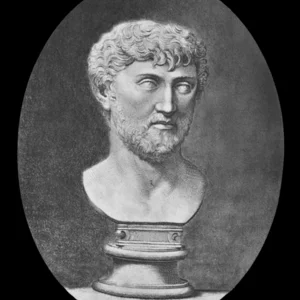

Lucretius was a Latin Epicurean poet and philosopher of the 1st century BC. He is the author of De rerum natura, a sweeping poem in six books expounding the philosophy of Epicurus and the atomism of Democritus. His work seeks to free humanity from the fear of the gods and of death.
Lucretius(93 av. J.-C. — 54 av. J.-C.)
Lucretius
Rome antique
7 min read
Frequently asked questions
Famous Quotes
« Nil posse creari de nihilo. (Nothing can be created from nothing.)»
« Tantum religio potuit suadere malorum. (To such heights of evil are men driven by religion.)»
Key Facts
- Born around 98–93 BC, died around 55–54 BC
- Composed De rerum natura, a philosophical poem in six books written in Latin verse
- Expounds and popularizes the philosophy of Epicurus and the atomism of Democritus
- His manuscript was rediscovered in the 15th century by Poggio Bracciolini, profoundly influencing the Renaissance
- A contemporary of Cicero, who mentions his work in his personal correspondence
Works & Achievements
A philosophical poem in six books and 7,400 hexameter verses, it is the only known work of Lucretius. In it, he expounds the atomism of Epicurus and Democritus to free humanity from the fear of gods and death, laying the foundation for a materialist and rationalist vision of the world.
Anecdotes
Lucretius's De rerum natura was rediscovered in 1417 by the humanist Poggio Bracciolini in a German monastery. This manuscript, lost for centuries, would go on to transform European thought and inspire philosophers such as Giordano Bruno and Spinoza. Without this providential discovery, the entire work might have vanished forever.
Lucretius argues in his poem that the soul is mortal and composed of atoms, just like the body. This idea was scandalous to the Romans of his day, as it meant there was neither heaven nor hell: death is nothing, for 'where death is, I am not.' This phrase, borrowed from Epicurus, is still quoted today in philosophical debates.
Saint Jerome, writing in the 4th century, reports that Lucretius was driven mad by a love potion, composed his poem during intervals of sanity, and then took his own life at the age of 43. Most modern historians regard this account as apocryphal — invented to discredit an author deemed too dangerous to the Christian faith.
Cicero, a contemporary of Lucretius, mentions in a letter to his brother Quintus that he had read De rerum natura and praises its 'many flashes of genius.' This is one of the few surviving contemporary references to Lucretius, as the poet appears to have lived apart from Roman public life, far from the political circles that were shaking the Republic in the age of Caesar.
Primary Sources
Humana ante oculos foede cum vita iaceret in terris oppressa gravi sub religione… Tantum religio potuit suadere malorum. (When human life lay foul before our eyes, crushed down to earth beneath the weight of oppressive religion… So great were the evils to which religion could prompt men.)
Nil igitur mors est ad nos neque pertinet hilum, quandoquidem natura animi mortalis habetur. (Death therefore is nothing to us and concerns us not one jot, since the nature of mind is found to be mortal.)
Lucreti poemata, ut scribis, ita sunt : multis luminibus ingeni, multae tamen artis. (The poems of Lucretius are, as you write, marked by many flashes of genius, yet show great craftsmanship.)
Suave, mari magno turbantibus aequora ventis, e terra magnum alterius spectare laborem… (Pleasant it is, when winds whip up the waters of the vast sea, to watch from shore the great struggle of another…)
Key Places
Lucretius's presumed birthplace, Rome was in the grip of a severe republican crisis, and the atmosphere of violence and instability fueled the poet's philosophical quest for inner peace and freedom from fear.
Although Lucretius probably never visited it, the garden where Epicurus taught in the 4th century BCE is the direct philosophical source of De rerum natura. Lucretius celebrates it as a place where the light of reason shines.
This Roman villa, buried under the ashes of Vesuvius in 79 CE, yielded hundreds of Epicurean scrolls, attesting to the spread of the philosophy that Lucretius championed among the educated circles of his time.
It was in this Benedictine monastery that the manuscript of De rerum natura survived the Middle Ages, before being discovered in 1417 by Poggio Bracciolini, ensuring that Lucretius's work has endured to this day.
Typical Objects

The main writing medium in Roman antiquity, Lucretius composed and circulated his poem on these fragile scrolls. The De rerum natura was spread across six separate volumina.

The calamus, a reed sharpened to a point, was the writing instrument of the Roman world. Lucretius used it to compose his dactylic hexameters, the epic meter of Virgil and Homer.

A common drafting tool among Roman scholars, these tablets allowed writing with a stylus and easy erasure. Lucretius would have used them to work out his philosophical arguments before committing them to papyrus.

Lucretius's atomism rests on the countless combinations of particles — a way of thinking closely tied to the counting and calculation practices that defined Roman intellectual culture.

Paradoxically, Lucretius describes Roman religious rites in his poem precisely to demonstrate their futility. The patera, used in offerings to the gods, symbolizes the religion he sought to dismantle through philosophy.

Epicurus philosophized in his garden in Athens, far from political turmoil. True to this tradition, Lucretius champions scholarly retreat and contemplation of nature as the path to ataraxia.
School Curriculum
Vocabulary & Tags
Key Vocabulary
Daily Life
Morning
Lucretius rose at dawn, as any educated Roman would, to take advantage of the cool hours favorable to reflection. He devoted his first hours to reading and poetic composition, consulting his notes on wax tablets before transcribing them onto papyrus.
Afternoon
In the afternoon, he would withdraw to his garden or library to meditate on the texts of Epicurus that he sought to render into Latin verse. The political turmoil of the Republic — civil wars, proscriptions, violence — reinforced his choice of philosophical retreat.
Evening
In the evening, Lucretius took the main meal of the day (cena) with restraint, true to the Epicurean ideal that values simplicity and modest pleasures. He would perhaps reread his verses by the light of an oil lamp, seeking to perfect the musicality of his hexameters.
Food
In keeping with the Epicurean ideal he championed, Lucretius favored a frugal diet: bread, vegetables, olives, cheese, and seasonal fruit. Wine was consumed in moderation, diluted with water as Roman custom dictated.
Clothing
Lucretius wore the white toga virilis, the emblematic garment of the free Roman citizen, along with a tunic (tunica) of wool or linen underneath. At home, he likely made do with a simple tunic, as the toga was only required in public spaces.
Housing
As a man of comfortable means, Lucretius most likely lived in a Roman domus with an atrium, impluvium, and peristyle. His personal library, the central room of intellectual life, was furnished with wooden niches (armaria) housing his precious volumina.
Historical Timeline
Period Vocabulary
Visual Style
Atmosphère de la Rome républicaine tardive : fresques ocre et rouge pompéien, rouleaux de papyrus, lumière ambrée de lampes à huile, jardins philosophiques et bustes de marbre blanc.
Sound Ambience
Les sons du quotidien romain tardif : l'effervescence du Forum, le calme studieux d'un jardin épicurien, et le crépitement de la lampe à huile éclairant la rédaction du poème.
Liens externes & ressources
Références
Œuvres
De rerum natura (De la nature des choses)
vers 55 av. J.-C.
See also
Related Characters
Alexander II of Macedon
Anaxagoras of Clazomenae
499 av. J.-C. — 427 av. J.-C.
Anaximander
609 av. J.-C. — 545 av. J.-C.
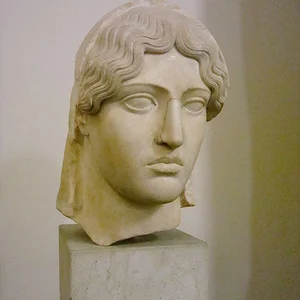
Aspasia
469 av. J.-C. — 399 av. J.-C.
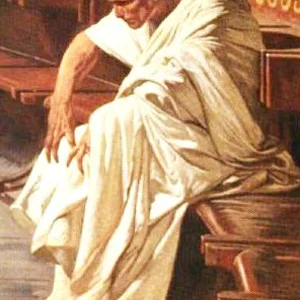
Catiline
107 av. J.-C. — 61 av. J.-C.
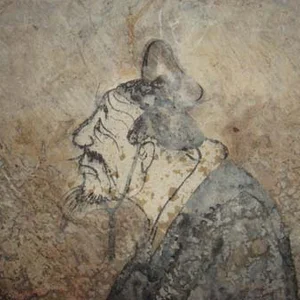
Confucius
550 av. J.-C. — 478 av. J.-C.