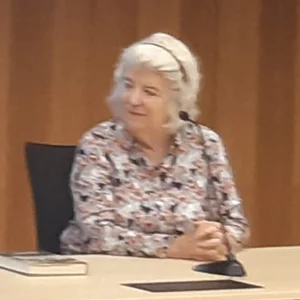

Lucy Durán is a British ethnomusicologist, producer and radio presenter, a specialist in the music of West Africa, particularly Mali. Her work is authoritative on the Mande griots and singers such as Siramori Diabaté.
Lucy Durán
Lucy Durán
Royaume-Uni
6 min read
Frequently asked questions
Key Facts
- A recognized specialist in the Mande music of West Africa, particularly Mali
- Teacher of ethnomusicology at SOAS (School of Oriental and African Studies), University of London
- Producer and presenter of the radio programme 'World Routes' on BBC Radio 3
- Her research is a reference source on the Malian singer Siramori Diabaté
Works & Achievements
Album recorded in Bamako bringing together guitar and kora, awarded a Grammy Award in 2006 and now a landmark of Malian music.
Second duo album, acclaimed by critics, extending the encounter between two masters of West African music.
Radio programme presented by Lucy Durán that introduced world music to a wide British audience.
Pioneering study of Wassoulou music and the place of women in the popular music of southern Mali.
A collection of films documenting how music is passed on to children in Mali, Guinea, Cuba and elsewhere, without the use of written notation.
Authoritative articles and lectures on the jeli (griots), the jelimusow and the history of the kora in West Africa.
Anecdotes
Lucy Durán is the daughter of Gustavo Durán, a Spanish composer who fought in the Spanish Civil War before going into exile. Growing up in a family of musicians and travellers nourished her passion for music from faraway places at a very early age.
As a producer, she brought together in a Bamako studio two Malian legends, the kora player Toumani Diabaté and the guitarist Ali Farka Touré. The album that emerged, *In the Heart of the Moon* (2005), won a Grammy Award, making Mande music known throughout the world.
For years, she presented the programme *World Routes* on BBC Radio 3, taking her British listeners to meet the griots of Mali, the women singers of the Sahel or the balafon players, microphone in hand, right there in the field.
Lucy Durán devoted great attention to the *jelimusow*, the women griots of Mali such as Siramori Diabaté, whose powerful voice could make an entire village weep or dance. She showed that these singers were guardians of the memory and history of their people.
With her project *Growing into Music*, she filmed over many years how the children of Mali learn music not at school, but by imitating their elders from the youngest age, passing down knowledge from generation to generation without written scores.
Primary Sources
Academic article in which Lucy Durán analyses the Wassoulou music of southern Mali and the way its female singers express a form of freedom through it, particularly on the themes of love and the condition of women.
Study by Lucy Durán exploring the connections between the music of the Bambara jeli (griots) of Mali and the blues, and the circulation of musical forms between West Africa and the wider world.
As producer, Lucy Durán introduces the encounter between Toumani Diabaté's kora and Ali Farka Touré's guitar, recorded in Bamako.
Series of radio programmes presented by Lucy Durán, devoted to the traditional and popular music of the world, featuring many reports recorded in Mali and West Africa.
Key Places
School of Oriental and African Studies where Lucy Durán teaches ethnomusicology and conducts her research on the music of West Africa.
Capital of Mali and heart of the Mande music scene, where Lucy Durán carried out her fieldwork and produced several albums.
Headquarters of British radio, from which Lucy Durán presented the programme “World Routes” on BBC Radio 3.
Rural region of southern Mali whose popular music and women singers Lucy Durán studied in her article “Birds of Wasulu”.
Birthplace of the kora tradition along the Gambia River, a research ground for the study of Mande griots.
Typical Objects

West African 21-string harp-lute with a body made from half a calabash gourd, the emblematic instrument of the Mandinka griots studied by Lucy Durán.

Small plucked-string lute with a wooden neck and a skin-covered body, thought to be an ancestor of the banjo and central to Bambara music.

African xylophone whose wooden bars rest on calabash gourds that act as resonating chambers, an ancient instrument of the Mandinka people.

Equipment used by the ethnomusicologist to capture and preserve music on site, during field reports and research.

Camera used in the “Growing into Music” project to film children in Mali and elsewhere learning music.

Equipment of the Bamako studios where Lucy Durán produced albums bringing together the greatest Malian musicians.
School Curriculum
Vocabulary & Tags
Key Vocabulary
Tags
Daily Life
Morning
On a day in London, Lucy Durán prepares her classes and grades her students' work at SOAS. She reviews her field notes and listens to recordings brought back from Mali.
Afternoon
The afternoon is spent teaching ethnomusicology, in research meetings, or editing radio programmes. During her stays in Mali, she instead conducts interviews with griots and attends rehearsals.
Evening
In the evening, she attends concerts or records musicians in a studio in Bamako. Back in London, she finalizes the mixing of an album or prepares a programme for the BBC.
Food
In London, her diet is that of a contemporary British academic. During her stays in Mali, she shares the local meals, based on rice, millet, and sauces, often served in a communal dish.
Clothing
She wears practical Western clothing for work and travel. In a Malian context, she sometimes adopts outfits that respect local customs, such as wraps made of colorful fabric.
Housing
She lives in London, near her university. In Mali, she stays with her hosts, in the homes of families of musicians or griots, as close as possible to the lives of the artists she studies.