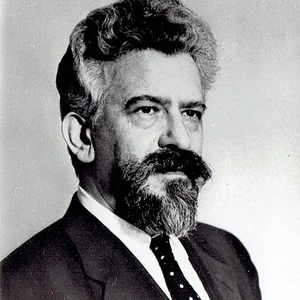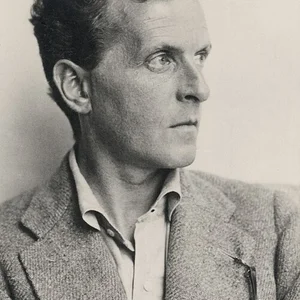

Austrian, then British, philosopher and logician, a major figure of 20th-century analytic philosophy. He profoundly transformed thinking about language, logic, and meaning, first with the Tractatus and later with his Philosophical Investigations.
Ludwig Wittgenstein(1889 — 1951)
Ludwig Wittgenstein
Autriche, Royaume-Uni
6 min read
Frequently asked questions
Famous Quotes
« Whereof one cannot speak, thereof one must be silent.»
« The limits of my language mean the limits of my world.»
Key Facts
- Born in 1889 in Vienna into a wealthy Austrian industrial family
- Published the Tractatus Logico-Philosophicus in 1921, the central work of his early philosophy
- Taught philosophy at the University of Cambridge from 1929 onward
- Developed the notion of language-games in the Philosophical Investigations (published in 1953, after his death)
- Died in 1951 in Cambridge
Works & Achievements
The foundational work of his early philosophy, which puts forward a theory of language as a “picture” of reality and sets the limits of what can be said.
A short text in which he argues that ethical values and the meaning of life lie beyond the factual, descriptive language of facts.
Notes dictated to his students that begin the turn toward his later philosophy, centred on the ordinary use of language.
His posthumous masterpiece, introducing the notions of “language-games” and use, which criticises his own early philosophy.
Posthumous reflections on doubt, knowledge and the certainties that form the background of all thought.
Posthumous notes questioning the nature of rules, proof and necessity in mathematics.
A modernist house he designed for his sister, illustrating his pursuit of rigour and austerity applied to architecture.
Anecdotes
Born into one of the wealthiest families in Austria, Wittgenstein inherited an immense fortune when his father died in 1913. After the First World War, he decided to give it all away — notably to his already wealthy brothers and sisters — in order to live simply and no longer depend on money.
During the First World War, he volunteered for the Austro-Hungarian army and wrote much of his first great book, the *Tractatus logico-philosophicus*, in the trenches and even in captivity as a prisoner of war in Italy.
Convinced after the *Tractatus* that he had solved the essential problems of philosophy, Wittgenstein abandoned the discipline and became a schoolteacher in remote Austrian villages between 1920 and 1926. He even wrote a spelling dictionary for his pupils.
An amateur architect, he designed a modernist house in Vienna for his sister Margaret together with the architect Paul Engelmann between 1926 and 1928, attending to every detail, from the door handles to the radiators, with almost obsessive rigour.
At Cambridge, his lectures were famous: he taught without notes, seated on a plain folding chair in an almost empty room, thinking aloud in front of his students at the cost of long silences and visible effort.
Primary Sources
Whereof one cannot speak, thereof one must be silent.
The limits of my language mean the limits of my world.
For a large class of cases in which we employ the word “meaning” — though not for all — this word can be defined thus: the meaning of a word is its use in the language.
Tell them I've had a wonderful life.
Key Places
Wittgenstein's birthplace, a cultural capital where his family hosted a salon frequented by artists such as Brahms and Mahler.
Where he studied under Russell and later taught as a professor of philosophy; the center of his intellectual life.
The city where he studied aeronautical engineering before turning to logic and the foundations of mathematics.
Hamlets where he worked as a schoolteacher in the 1920s, after giving up philosophy.
A remote village on a fjord where he had a hut built to work alone, far from all distraction, at several points in his life.
He died there of cancer in 1951, in his doctor's house, uttering his famous last words.
Typical Objects

Wittgenstein wrote constantly in notebooks, accumulating remarks, aphorisms and drafts that make up the bulk of his work, often published posthumously.

During his lectures at Cambridge, he would sit on a plain folding chair in the middle of a bare room, thinking aloud in front of his students.

A short treatise numbered in hierarchically ordered propositions, the only philosophy book published during his lifetime, which sets the limits of what can be said meaningfully.

As a young engineer in Manchester, he filed a patent for an aircraft propeller driven by jets at the blade tips, before logic absorbed him completely.

The object of a famous dispute in 1946 when, during a heated debate at Cambridge, Wittgenstein is said to have brandished a poker at Karl Popper.

The plans and details of the modernist villa he designed for his sister in Vienna, reflecting his demand for geometric purity applied to architecture.
School Curriculum
Vocabulary & Tags
Key Vocabulary
Tags
Daily Life
Morning
Wittgenstein often began his day early, in great austerity. Whether in Cambridge or in his Norwegian cabin, he devoted his mornings to intense thought, tirelessly writing and rewriting his remarks in notebooks.
Afternoon
His afternoons might be taken up by his lectures, given without notes and with long silences, or by long solitary walks he considered necessary for reflection. He also loved manual work and total concentration on a single task.
Evening
In the evening, he enjoyed the company of a few rare close friends, demanding conversations, and sometimes the cinema, especially American westerns, which gave him relief from philosophical effort.
Food
Indifferent to refinement, he ate in a simple and repetitive way, declaring that he cared little about what he ate as long as it was always the same thing. Bread, cheese, and frugal meals were enough for him.
Clothing
He dressed with great simplicity, refusing tie and starched collar, in plain and functional clothes that reflected his rejection of luxury despite his wealthy origins.
Housing
He often chose bare, almost monastic lodgings: empty rooms in Cambridge, an isolated cabin in Norway, fleeing bourgeois comfort in favor of spaces conducive to concentration.
Historical Timeline
Period Vocabulary
Liens externes & ressources
Références
Œuvres
Tractatus logico-philosophicus
1921
Conférence sur l'éthique
1929
Le Cahier bleu et le Cahier brun
1933-1935
Recherches philosophiques
1953
De la certitude
1969
Remarques sur les fondements des mathématiques
1956
Maison Stonborough (villa viennoise)
1926-1928