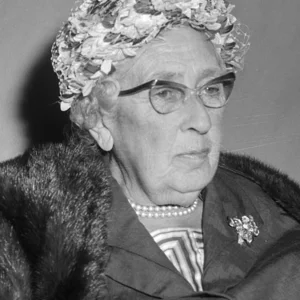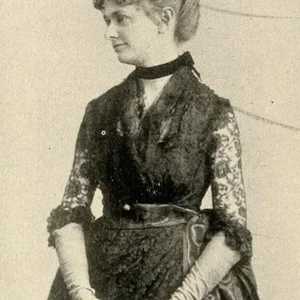

An American editor and writer, she was the first to edit and publish Emily Dickinson's poems after the poet's death, playing a decisive role in introducing one of the greatest voices in American poetry.
Mabel Loomis Todd(1856 — 1932)
Mabel Loomis Todd
États-Unis
6 min read
Frequently asked questions
Key Facts
- Born in 1856 in Cambridge, Massachusetts, she moved in the cultivated circles of New England
- Beginning in 1890, she edited and published, together with Thomas Wentworth Higginson, the first collection of Emily Dickinson's poems
- She deciphered and transcribed hundreds of Dickinson's unpublished manuscripts, until then unknown to the public
- A lecturer and author, she notably took part in expeditions to observe solar eclipses
- She died in 1932, leaving behind an editorial body of work that established Dickinson's posthumous reputation
Works & Achievements
Dickinson's first collection of poems, edited with Higginson; an immediate success that introduced the poet to the public.
A second collection continuing the publication of Dickinson's verse, confirming her literary importance.
A two-volume edition of the poet's correspondence, invaluable for understanding her life and work.
A third collection of poems, the last one published by Mabel before the interruption caused by the conflict with the Dickinson family.
A work of popular science about eclipses, drawn from her travels with her astronomer husband.
An account of an eclipse-observing expedition to Japan, blending travel diary and science.
A colossal effort of deciphering and copying nearly 1,800 poems, the foundation of all future editions of Dickinson.
Anecdotes
When Emily Dickinson died in 1886, her sister Lavinia discovered nearly 1,800 handwritten poems hidden in a chest. Determined to see them published, she entrusted these sheets to Mabel Loomis Todd, who spent years deciphering them and typing them out, one poem after another.
Emily Dickinson's handwriting was so peculiar, full of dashes and hard-to-read words, that Mabel Loomis Todd had to learn to make sense of her scrawl. She worked with the critic Thomas Wentworth Higginson to prepare the first collection, published in 1890, which was an immediate success and reprinted eleven times in less than a year.
Mabel Loomis Todd never met Emily Dickinson in person, even though she lived in the same small town of Amherst. The reclusive poet sometimes spoke to her through a door and sent her notes and flowers, but never showed herself.
The wife of an astronomer, David Peck Todd, Mabel accompanied him on far-flung expeditions to observe solar eclipses, as far as Japan and Africa. She later wrote popular science books about eclipses, blending her literary talent with her husband's science.
A quarrel over a plot of land given by the Dickinson family set Mabel against Lavinia and brought her editing work to a dead stop for decades. The manuscripts she held remained locked in a chest, and it was only after her death that her daughter, Millicent Todd Bingham, took up the torch.
Primary Sources
These verses were scribbled on old envelopes and scraps of paper; they were never meant for publication, yet they carry within them a singular and unexpected power.
Gathering and ordering these letters was a delicate task, for each one seemed written for a single reader and to guard a secret.
To see the Sun vanish in broad daylight is an experience one never forgets; all of nature seems to hold its breath.
I spent the day copying Miss Dickinson's poems; her handwriting is a challenge, but every line deciphered is a reward.
Key Places
Mabel Loomis's birthplace, in a lettered New England milieu.
The small town where Mabel settled, where Emily Dickinson lived, and where she carried out the bulk of her editorial work.
Emily Dickinson's family home, the source of the manuscripts entrusted to Mabel.
The institution where David Peck Todd, Mabel's husband, taught, and a center of local intellectual life.
An island that Mabel helped preserve as a nature sanctuary, a testament to her commitment beyond literature.
The destination of one of the solar eclipse observation expeditions that she recounted in her writings.
Typical Objects

The chest in which Lavinia Dickinson had stored the thousands of pages written by her sister, and which Mabel received in order to draw the poems from it.

The tool with which Mabel patiently copied out Emily Dickinson's handwritten poems to make them legible for the printer.

The makeshift supports on which Emily Dickinson had jotted down her verses, which Mabel had to decipher one by one.

The editor's writing instruments, used for her correspondence and her own works.

An astronomical instrument taken along on the eclipse-observation voyages with her husband David Peck Todd.

Emily Dickinson's first book of poems, the fruit of Mabel's editorial work, which revealed the poet to the general public.
School Curriculum
Vocabulary & Tags
Key Vocabulary
Tags
Daily Life
Morning
Mabel often began her day with correspondence and reading, the tasks of a cultivated New England woman. Part of the morning was devoted to deciphering and copying out the manuscript sheets of Emily Dickinson, painstaking work that demanded patience and concentration.
Afternoon
In the afternoon, she received visitors, took part in the literary and cultural clubs she led, or gave lectures. She also worked on her own writings and on the volumes of poems intended for the publisher.
Evening
In the evening, in a lamp-lit house, she read, played the piano, or painted, for she was also a musician and an amateur artist. Evenings might be devoted to the social life of Amherst or to writing in her private diary.
Food
Her diet followed the habits of the New England middle class: bread, vegetables from the garden, fruit, meat and fish, tea and coffee. Meals were a moment of sociability where guests were gladly welcomed.
Clothing
Mabel wore the elegant dresses of the late nineteenth century: corsets, long pleated skirts, intricate sleeves, and hats. Mindful of her appearance, she loved the refined outfits proper to ladies of good society.
Housing
She lived in Amherst in a comfortable wooden house typical of New England, surrounded by a garden. The tastefully furnished interior held books, a piano, and objects brought back from her travels.
Historical Timeline
Period Vocabulary
Liens externes & ressources
Références
Œuvres
Poems by Emily Dickinson (Première série)
1890
Poems, Second Series
1891
Letters of Emily Dickinson
1894
Poems, Third Series
1896
Total Eclipses of the Sun
1894
Corona and Coronet
1898
Transcription des manuscrits de Dickinson
1887-1896