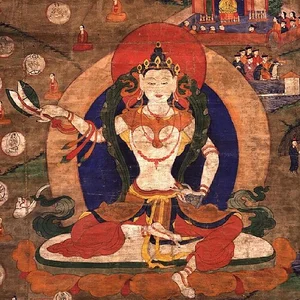

Machig Labdrön was a Tibetan Buddhist mystic and master of the 11th–12th centuries. She is the founder of the practice of Chöd, a ritual for cutting through attachment to the ego, and one of the few women to have founded a spiritual lineage in Tibet.
Machig Labdrön(1055 — 1149)
Machik Labdrön
6 min read
Frequently asked questions
Key Facts
- Born around 1055 in the central Tibet region (Labrang)
- Develops and systematizes the practice of Chöd (“to cut”), a ritual of detachment from the ego
- Founds a spiritual lineage, a rare achievement for a woman in the Tibet of her time
- Regarded as an emanation of the Great Mother (Prajnaparamita) and of Yeshe Tsogyal
- Dies around 1149, after a life devoted to teaching and transmission
Works & Achievements
A meditation system in which one symbolically “offers” one's own body to sever attachment to the ego. It is the only body of Buddhist teaching reputed to have originated in Tibet itself.
A central text of the Chöd tradition transmitted under her name, explaining the offering of the body as a means of liberation.
A structured transmission of a teaching that spread into all the major schools of Tibetan Buddhism.
A fusion of the “emptiness” philosophy of the Perfection of Wisdom with tantric ritual techniques, the theoretical basis of Chöd.
She passed her teaching on to her own children and to many disciples, ensuring the survival of her lineage to this day.
Anecdotes
According to tradition, Machig Labdrön could read extraordinarily fast. As a teenager, she is said to have been employed as a reciter in monasteries: she would race through the volumes of the Prajnaparamita (the “Perfection of Wisdom”) so quickly that people claimed she read the equivalent of several readers combined.
The practice she founded, Chöd (“to cut”), traditionally takes place in frightening locations: cemeteries, charnel grounds, haunted mountain passes. The aim was not to provoke fear for its own sake, but to confront one's own terrors in order to “cut” attachment to the self.
Machig Labdrön is one of the few women in the history of Tibetan Buddhism to have founded a lineage of teaching. Remarkably, tradition holds that this transmission then traveled back from Tibet to India, whereas teachings usually traveled in the opposite direction.
Before becoming a spiritual teacher, she is said to have met an Indian yogi named Töpa Bhadra, with whom she had children. At a time when a religious woman was expected to remain a nun, this choice caused a scandal, but Machig stayed her course and became one of the great spiritual figures of her time.
The Chöd ritual is accompanied by striking instruments: a double-sided drum (the damaru) and a trumpet carved from a human femur (the kangling). These objects, drawn from the confrontation with death, remind the practitioner that everything is impermanent.
Primary Sources
Wherever attachment to a "self" arises, that is exactly where it must be cut; offering one's own body means severing the very root of egoistic grasping.
She read the scriptures of the Great Mother, the Prajnaparamita, with a speed that no one could match, grasping the meaning at the very moment she spoke the words.
The demoness you fear outside is nothing other than the fixation of your own mind; recognize her, and the terrifying appearances liberate themselves on their own.
Key Places
Region where tradition places the birth of Machig Labdrön, at the heart of the Tibet of the second diffusion of Buddhism.
A hermitage perched above the Tsangpo River that became Machig's principal seat and the center from which her Chöd teaching spread.
Places where, as a young girl, she was employed as a rapid reciter of the scriptures of the “Perfection of Wisdom.”
Places where the dead were laid out, reputed to be haunted, where Chöd was practiced to confront fear and attachment to the body. Sites both real and laden with symbolism.
Wild, lofty places traversed by Chöd practitioners in search of solitude and confrontation with their inner forces.
Typical Objects

Small ritual drum with two heads that is sounded by a twist of the wrist. In the Chöd, its rhythm accompanies the chants and invites the spirits to the “banquet” of the offering.

Trumpet traditionally carved from a human thighbone. Its shrill call symbolizes courage in the face of death and summons the forces that the practitioner must confront.

The bell and the ritual scepter (dorje, or diamond-thunderbolt) held together represent the union of wisdom and skillful means in tantric Buddhism.

Long scriptures of the “Perfection of Wisdom,” copied onto elongated folios. Machig recited them with legendary speed and drew from them the heart of her teaching.

Rosary of 108 beads used to count recitations of mantras. An everyday tool of Tibetan meditative practice.

The khatvanga is a ritual staff adorned with skulls, an attribute of yogis and yoginis. Associated with retreats in wild places, it marks the status of an advanced adept of the tantra.
School Curriculum
Vocabulary & Tags
Key Vocabulary
Daily Life
Morning
Before dawn, Machig rises to meditate and recite mantras with the help of her prayer beads. The first hours are devoted to silent practice and to reading the scriptures of the Prajnaparamita.
Afternoon
In the afternoon, she teaches her disciples, who sometimes come from afar, answering their questions about the nature of the mind and guiding their meditation exercises.
Evening
At nightfall, and sometimes in the dead of night, she practices Chöd in wild places or charnel grounds, sounding her drum and her femur trumpet to confront her fears.
Food
Like Tibetan ascetics, she eats simply: tsampa (roasted barley flour) mixed with salty butter tea, sometimes a little dried cheese or soup. Periods of retreat often call for fasting.
Clothing
She wears the layered robes of thick wool worn by Tibetan monastics, in dark or reddish tones, suited to the cold of the high plateaus. As a yogini, she may display ritual bone ornaments.
Housing
She lives in stone hermitages and fitted-out caves, notably at Zangri Kharmar, perched above the valley. The furnishings are minimal: a meditation cushion, texts, and her ritual instruments.
Historical Timeline
Period Vocabulary
Liens externes & ressources
Références
Œuvres
Fondation de la pratique du Chöd
vers 1090
Le Phung po gzan skyur (« Jeter le corps en nourriture »)
XIe-XIIe siècle
Création de la lignée du Chöd
vers 1110-1149
Synthèse Prajnaparamita et tantra
vers 1090-1120
Formation de disciples et d'héritiers spirituels
XIIe siècle