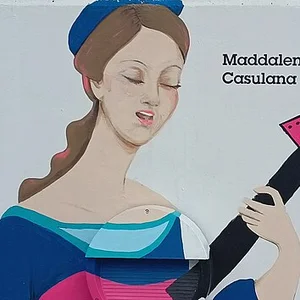

Maddalena Casulana (c. 1544 – c. 1590) was the first female composer to have her musical works published, notably two books of madrigals in 1568 and 1570. An Italian composer and singer, she explicitly asserted the artistic value of women in musical creation.
Maddalena Casulana(1544 — 1590)
Maddalena Casulana
8 min read
Frequently asked questions
Famous Quotes
« “I want to show the world […] that women can do as much as men in the matter of the arts.”»
Key Facts
- c. 1544: presumed birth in Italy (exact location unknown)
- 1568: publication of the first book of four-voice madrigals, the first collection published by a woman
- 1570: publication of the second book of madrigals
- Dedicated her works to aristocratic patrons, including Isabella de' Medici
- c. 1590: presumed date of death
Works & Achievements
First book of madrigals for four voices, published in Venice by Girolamo Scotto. It is the first commercial musical publication signed by a woman in the history of Western music, accompanied by a dedication to Isabella de' Medici asserting the artistic rights of women.
Second collection of madrigals for four voices, confirming Casulana's mastery of polyphony and her recognition within Italian musical circles in Venice and Florence.
Book of madrigals for five voices dedicated to Antonio Londonio in Milan, reflecting the evolution of her writing toward denser and more expressive textures, in keeping with the trends of the late madrigal.
Madrigal for four voices from the first book, often cited as representative of her style: expressive melodic line, use of chromaticism, and careful treatment of Petrarchan poetic texts.
Several of Casulana's madrigals were included in collective anthologies (collections featuring multiple composers), a common practice in the Renaissance that allowed her works to circulate alongside those of Lasso, Wert, and other masters of the madrigal.
Anecdotes
When Maddalena Casulana dedicated her first book of madrigals to Isabella de' Medici in 1568, she wrote in her preface that she wished to “show the world the vain error of men who believe themselves to be the sole possessors of the gifts of intelligence and the arts.” It was the first time a female composer publicly claimed, in writing and in print, the creative equality of women — an act of remarkable boldness for the era.
In 1568, Venetian printer Girolamo Scotto published Casulana's first book of madrigals: it was the very first time in history that a woman's musical compositions were edited and distributed commercially. Before her, even the rare recognized female musicians remained confined to manuscripts and oral tradition.
Casulana was also an admired singer in Italian aristocratic circles. She performed at the court of Florence, and her madrigals were featured at festivities organized by the Medici — notably at princely weddings — earning her a reputation that spread far beyond her hometown.
In 1583, a third book of madrigals was attributed to her — published when she was approaching forty — testament to a long and recognized career in a musical world that was almost exclusively male. Her works circulated throughout northern Italy and were copied into anthologies alongside celebrated male composers.
Little is known about the end of Casulana's life, a sign that even the most remarkable women of the Italian Renaissance quickly disappeared from official records. That silence itself has become a symbol: twentieth-century scholars had to reconstruct her biography from dedications, printer contracts, and rare mentions in court correspondence.
Primary Sources
«…per far conoscere al mondo l'errore degli uomini, tanto vano in se stesso, di credere d'essere loro soli i padroni de' doni dell'intelletto e dell'arte…»
Collection of four-voice madrigals, the first book of music printed and commercially published by a woman composer in Western history.
Second collection of four-voice madrigals, confirming Casulana's recognition within the Venetian and Florentine musical world.
Polyphonic piece for four voices illustrating the mastery of counterpoint and expressive chromaticism characteristic of the late Renaissance madrigal.
Book of five-voice madrigals dedicated to Antonio Londonio, attesting to the expansion of her polyphonic writing and her network of patrons.
Key Places
The probable birthplace of Maddalena Casulana, from which she took her name. A small Tuscan locality in the contado of Siena, where she is believed to have received her earliest musical training in a milieu that remains poorly documented.
The city of the Medici, where Casulana performed at court and dedicated her first book to Isabella de' Medici. In the sixteenth century, Florence was one of the most vibrant centers of Italian secular music.
The capital of European music publishing, where the printer Girolamo Scotto issued her first two books of madrigals in 1568 and 1570. Without Venice and its presses, Casulana's work would not have survived to us.
Casulana spent time in Milan, where she enjoyed the patronage of Antonio Londonio, to whom she dedicated her 1583 book of madrigals for five voices. Milan was an active musical court under Spanish rule.
Typical Objects

The printed collection, in oblong quarto format, was the primary means of distribution for Renaissance composers. For Casulana, publishing with Scotto in Venice meant reaching the European music market and securing her place in posterity.

The quintessential plucked string instrument of the Italian Renaissance, used to accompany singers or explore harmonies during composition. Casulana, as both a singer and composer, most likely used it to work out her melodic lines.

A keyboard instrument found in Italian aristocratic households, indispensable for testing the voices and chords of a polyphonic composition before entrusting it to copyists.

A tablet or hand-ruled paper notebook on which the composer would set down musical ideas before having them copied out by a professional scribe for submission to the printer.

In the sixteenth century, polyphonic music was printed in separate parts (one booklet per voice), not in a vertical score. Each singer read their own part without seeing those of the others.

The handwritten or printed dedication, addressed to a patron, was a crucial social and commercial act: it established a bond of patronage and could secure protection and income. Casulana's dedication to Isabella de' Medici has remained famous for its remarkably proto-feminist message.
School Curriculum
Vocabulary & Tags
Key Vocabulary
Daily Life
Morning
A court musician's day began early with vocal exercises and vocalises, an essential daily practice to keep the voice in condition. Casulana likely devoted the quiet morning hours to composition: jotting ideas in manuscript notebooks, testing melodic lines on the lute or spinet, searching for the right treatment of the poetic text.
Afternoon
The afternoon was often dedicated to music lessons for young aristocrats or to rehearsals with other musicians from the academy or court. Casulana also had to maintain her relationships with patrons, respond to correspondence, and negotiate with printers or copyists for the publication of her works.
Evening
Evenings at the Italian Renaissance court were marked by private concerts, banquets, and musical interludes. Casulana performed there as a singer, interpreting her own madrigals or those of her contemporaries before a select audience of aristocrats, in the ornate halls of Florentine or Venetian palaces, by candlelight.
Food
The diet of a court musician followed the habits of the Italian Renaissance upper classes: white bread, roasted meats, fish on the lean days prescribed by the Church, legumes, Tuscan cheeses, and local wines. Meals at court could be lavish during major festivities, with spiced dishes, pastries, and candied fruits, all accompanied by music.
Clothing
Court musicians wore gowns with fitted bodices and full skirts, with slashed sleeves revealing the fine chemise beneath — a characteristic Italian fashion of the 16th century. Fabrics (silk, velvet, brocade) varied according to the occasion and the degree of patronage: when performing at the Medici court, Casulana likely wore garments gifted by her patron, a visual symbol of his protection.
Housing
In Florence or Venice, a recognized musician like Casulana most likely resided in an apartment within or near an aristocratic palace, under the protection of a patron. A Renaissance dwelling of this level included a main room, a bedroom, and perhaps a small workroom, modestly furnished — a keyboard instrument, a table for writing music, a few volumes of Petrarchan poetry.