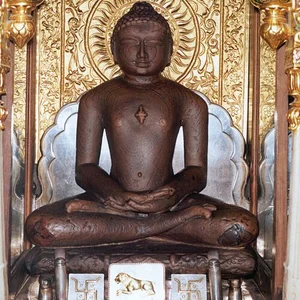

Mahāvīra is the twenty-fourth and last tīrthankara of Jainism, regarded as the major reformer of this Indian tradition. Renouncing his princely life, he preached asceticism, non-violence, and the liberation of the soul.
Mahavira(598 av. J.-C. — 526 av. J.-C.)
Mahāvīra
Videha
6 min read
Frequently asked questions
Famous Quotes
« All life is sacred; no one should harm any living being.»
« Do not injure, abuse, oppress, enslave, insult, torment, torture, or kill any living creature.»
Key Facts
- Born around 599 BCE into a princely family of the Jñātrika clan, near Vaishali (Bihar)
- Renounced the world around the age of 30 to lead the life of a wandering ascetic
- Attained omniscience (kevala jnana) after twelve years of rigorous asceticism
- Twenty-fourth and last tīrthankara, he structured and spread the Jain doctrine
- Died (liberation, moksha) around 527 BCE at Pavapuri
Works & Achievements
Mahāvīra established respect for all forms of life as the supreme principle, lastingly shaping Indian thought, all the way down to Gandhi.
Non-violence, truth, non-stealing, chastity and non-possession: the code of conduct he laid down for Jain monks.
The teaching that truth is complex and relative to the perspective adopted; a genuine invitation to intellectual tolerance.
Mahāvīra structured the community into four orders (monks, nuns, laymen, laywomen), ensuring the lasting transmission of his tradition.
As the twenty-fourth and last tīrthankara, he renewed and codified the teaching handed down by his predecessors, including Pārśva.
His discourses, memorized by his disciples, form the bedrock of the Jain sacred texts written down several centuries later.
Anecdotes
According to Jain tradition, Vardhamāna was given the title "Mahāvīra
which means "great hero
not for feats of war but for the complete mastery he attained over his passions and his fears.
Born a prince in the Jñātrika clan, near Vaishali, he is said to have waited until his parents' death before renouncing the world, out of filial respect, before giving everything up around the age of thirty.
The texts recount that, after his renunciation, Mahāvīra practiced twelve years of extreme asceticism, meditating motionless and silently enduring insults and blows, until he attained kevala jñāna, absolute knowledge.
His doctrine of ahimsā (non-violence) was so rigorous that Jain monks would sweep the ground before their steps and filter their water so as to kill no living being, however tiny.
Tradition holds that Mahāvīra attained liberation (moksha) at Pāvāpurī; on the night of his death, the kings lit lamps in his honor, the legendary origin associated with the festival of Dīpāvalī (Diwali) among the Jains.
Primary Sources
“All beings love life, seek pleasure, recoil from pain, shun destruction, love to live, long to live. To all, life is dear.”
“The venerable ascetic Mahāvīra belonged to the Kāśyapa clan. He is known by three names: Vardhamāna, given by his parents; Śramaṇa, because he endured all hardships; and Mahāvīra, the great hero, the name given by the gods.”
“One who regards all the creatures of the world as his own self, and who beholds the great peril of violence, that one is a sage who harms no one.”
“Through self-control and austerity, the soul frees itself from karma; like gold purified by fire, it shines forth.”
Key Places
Traditional birthplace of Mahāvīra, a suburb of the city of Vaishali, capital of the Vajji confederacy, in present-day Bihar.
A great republican city on the Ganges where Mahāvīra spent his princely youth; a major hub of the spiritual currents of the age.
According to tradition, it was near this river, beneath a śāla tree, that Mahāvīra attained kevala jñāna, omniscient knowledge.
A powerful kingdom in north-eastern India where Mahāvīra preached at length and mingled with the rulers of the age.
Site of Mahāvīra's death and liberation (moksha); today a major Jain pilgrimage centre, marked by the Jal Mandir temple set in the middle of a lotus lake.
Typical Objects

A small broom of fibers or wool that Jain monks use to gently sweep aside insects before sitting down or walking. It embodies non-violence taken to its furthest extreme.

A piece of white cloth placed in front of the mouth by some Jain monks to avoid inhaling or harming the tiny organisms present in the air.

A vessel of wood or gourd used to collect water and food received as alms. The Jain monk owns almost nothing, in keeping with the vow of aparigraha (non-possession).

An emblem associated with Mahāvīra as the twenty-fourth tīrthankara; each liberating Jain master has a distinctive sign, and the lion is his.

A sacred four-armed sign representing the four states of rebirth; it adorns Jain temples and rituals as a symbol of good fortune and of the cycle of existences.

A garment of white cotton worn by some Jain monks, while the other branch, the Digambara, practice total nudity as a sign of absolute detachment.
School Curriculum
Vocabulary & Tags
Key Vocabulary
Daily Life
Morning
Before dawn, the ascetic **Mahāvīra** would rise to meditate, motionless and silent, seeking to master his passions and thoughts. He walked slowly, eyes fixed on the ground so as not to tread on any living being.
Afternoon
The day was devoted to wandering from village to village and to preaching. To feed himself, he begged for his meal, accepting only what was offered to him spontaneously, never demanding or storing anything.
Evening
In the evening came self-examination and prolonged meditation. **Mahāvīra** practiced long fasts and vigils, enduring cold, heat, and discomfort as so many trials on the path to liberation.
Food
Strictly vegetarian and frugal, he rejected any food that involved the death of a living being, even roots and bulbs, so as not to destroy the whole plant. Prolonged fasting was part of his ascetic discipline.
Clothing
Tradition differs: the *Digambara* claim that he lived entirely naked, a sign of total detachment from possessions, while the *Śvetāmbara* depict him clothed in a simple white cloth.
Housing
A wandering renunciant, he had no fixed dwelling: he slept outdoors, in forests, caves, or makeshift shelters, refusing any material attachment in keeping with his vow of non-possession.
Historical Timeline
Period Vocabulary
Liens externes & ressources
Références
Œuvres
Doctrine de l'ahimsā (non-violence absolue)
VIe-Ve s. av. J.-C.
Les cinq grands vœux (mahāvrata)
VIe-Ve s. av. J.-C.
L'anekāntavāda (doctrine des points de vue multiples)
VIe-Ve s. av. J.-C.
Organisation du sangha jaïn
VIe-Ve s. av. J.-C.
Réforme de la tradition des tīrthankara
VIe-Ve s. av. J.-C.
Enseignements à la base du canon (Āgama)
transmis oralement, fixés v. IVe-IIIe s. av. J.-C.