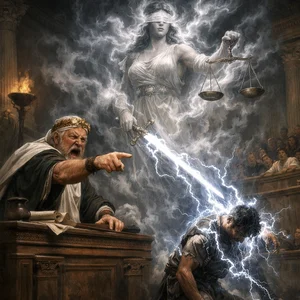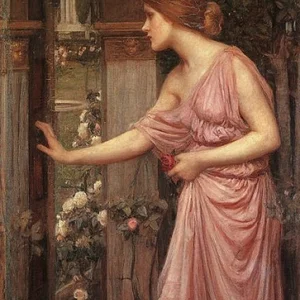

Greek goddess of divine vengeance and just retribution, Nemesis punishes hubris — the arrogance and excess of mortals who rise above their station. She embodies cosmic balance and immanent justice in the tradition of Greek mythology.
Nemesis
Nemesis
8 min read
Frequently asked questions
Famous Quotes
« "No mortal can escape Nemesis.»
« (Greek oral tradition attributed to the tragedians)»
Key Facts
- Mentioned by Hesiod in the Theogony (c. 700 BCE) as a daughter of Night (Nyx)
- Associated with Rhamnous in Attica, where a celebrated temple was dedicated to her (5th century BCE)
- Personification of divine retribution against pride and excess (hubris)
- Depicted with a wheel, scales, or sword — symbols of impartial justice
- Her name is the origin of the common word "nemesis
- meaning an inescapable enemy or punishment
Works & Achievements
Hesiod's cosmogonic poem in which Nemesis appears for the first time in written Greek literature as a daughter of Night. This foundational text establishes the goddess within the divine genealogy and grants her the status of a primordial power.
A sculptural masterpiece by Agoracritus, a pupil of Phidias, carved from marble brought by the Persians. Fragments preserved in the National Archaeological Museum of Athens make it one of the most important representations of the goddess.
A liturgical poem from Orphic circles, describing Nemesis as the impartial judge of mortals, endowed with wings and a set of scales. This text profoundly influenced the iconography and theology of the goddess in late Antiquity.
A travel account offering the most complete description of the sanctuary and statue of Nemesis at Rhamnous. A major historical source for understanding the cult of the goddess and her iconography in Antiquity.
A play by the Athenian comic poet Cratinus dealing with the myth of Zeus and Nemesis. Though lost, it attests to the importance of the character in the classical Greek dramatic culture of the age of Pericles.
Anecdotes
Nemesis is at the origin of the myth of Narcissus: this young man of exceptional beauty arrogantly rejected the love of all who approached him. To punish this hubris, Nemesis condemned him to fall hopelessly in love with his own reflection in a spring. Unable to tear himself away from this illusory image, Narcissus wasted away and died, transformed according to legend into the flower that bears his name.
According to a tradition reported by several ancient authors, Zeus himself fell in love with Nemesis and pursued her across the entire world. The goddess took on many animal forms in succession to escape him, but Zeus transformed himself into a swan and had his way. From their union was born an egg from which Helen of Troy emerged — whose beauty would go on to spark the most famous war of Antiquity.
Before the Battle of Marathon in 490 BC, the Persians, certain of their victory, had brought an enormous block of white marble to carve a trophy celebrating their anticipated triumph. After their crushing defeat, the Athenians recovered this block and entrusted it to the sculptor Agoracritus to create the statue of Nemesis at Rhamnous: the marble of Persian pride thus became the very material of the goddess who punishes that pride.
The Greeks believed that Nemesis kept constant watch over the balance between happiness and misfortune. If a mortal accumulated too much success, wealth, or glory, the goddess would intervene to restore the cosmic balance. This is why the Greeks ostentatiously avoided boasting about their good fortune: they feared attracting the attention of Nemesis and provoking her righteous anger.
In several ancient traditions, Nemesis was identified with Adrasteia — literally “she from whom there is no escape” — a deity of Phrygian origin linked to inescapable fate. This fusion of two distinct divine figures shows that the idea of inevitable cosmic justice transcended the cultural boundaries of the ancient Mediterranean world and corresponded to a deeply human intuition.
Primary Sources
"And Night bore hateful Nemesis, a plague to mortal men." Hesiod presents Nemesis as a daughter of Night (Nyx), a primordial deity, underscoring her dark and inescapable nature.
Hesiod describes how Nemesis and Aidos (Shame) will one day abandon the earth when mortals have grown too corrupt, signaling the end of all human justice and leaving mankind to its own unbridled excess.
"Nemesis, great-winged goddess, who hold the scales of mortal life, you observe all things with your unerring eyes and pass judgment on the deeds of men." This text describes her symbolic attributes: wings, scales, and all-seeing gaze.
"At Rhamnous stands the statue of Nemesis, the largest marble statue I have ever seen. It is the work of Agoracritus, a pupil of Phidias. The goddess holds a cup on which Ethiopians are carved."
Apollodorus records the tradition according to which Zeus pursued Nemesis, who transformed herself into many animals to escape him, and whose union with Zeus gave birth to Helen of Troy.
Key Places
The main sanctuary of Nemesis in the ancient Greek world, located on the northeastern coast of Attica. The temple housed the famous statue by Agorakritos, carved from marble brought by the Persians before the Battle of Marathon.
The mythological home of the immortal gods, where Nemesis sits among the divine powers that govern the cosmos and watch from the heavenly heights over the actions of mortals on earth.
A Greek city in Asia Minor renowned for its especially developed cult of Nemesis: two statues of the goddess were venerated there, the Nemeses of Smyrna, attesting to the exceptional scale of the cult in this region.
A region of Asia Minor where the goddess Adrasteia, "she from whom there is no escape," was venerated — a divine figure equated with Nemesis in several ancient traditions, reflecting the pan-Hellenic reach of the cult.
Typical Objects

A symbol of the turning wheel of fate, the wheel is one of Nemesis's most characteristic attributes. It serves as a reminder that fortune is cyclical and that no one can maintain a position of dominance forever without facing the inevitable return of fate.

The quintessential instrument of measurement and justice, the scales symbolize Nemesis's ability to impartially evaluate the deeds of mortals and precisely weigh what is deserved or excessive.

Instruments of divine punishment, the sword and the whip represent the inexorable sanction inflicted on those guilty of hubris. Nemesis strikes with precision those who have overstepped the boundaries permitted to mortals.

Frequently depicted with griffin or eagle wings, Nemesis signals through this attribute that no mortal can escape her: she always catches those who have shown excess, no matter how far they flee.

A characteristic attribute of Nemesis, the cubit is the instrument of just measure. It symbolizes the goddess's ability to evaluate exactly what is owed to each person — neither too much nor too little.

According to Pausanias, the statue of Nemesis at Rhamnous held a cup decorated with figures of Ethiopians. This attribute evokes the universality of divine law: the justice of Nemesis applies to all peoples, regardless of their origin.
School Curriculum
Vocabulary & Tags
Key Vocabulary
Tags
Daily Life
Morning
At dawn, Nemesis traverses the heavens and observes the actions of mortals on earth. She carefully notes those who, through arrogance or excess, rise above their human condition and defy divine laws by challenging the cosmic order.
Afternoon
Throughout the day, Nemesis deliberates and measures the deeds of mortals using her scales and cubit-rod. With implacable justice, she determines what punishment befits each excess, ensuring that the sanction is always strictly proportionate to the offense committed.
Evening
At dusk, Nemesis carries out her judgments: she sends deserved misfortune upon those who have shown hubris, thereby restoring the cosmic balance. Winged and swift as lightning, she catches even those who believe they have escaped divine justice.
Food
Like all Greek deities, Nemesis sustains herself on ambrosia and nectar, the divine foods that confer immortality and supernatural power. She has no need of mortal food, as her existence is entirely divine and immortal in nature.
Clothing
Nemesis is depicted wearing a dark peplos or chiton, evoking her nocturnal origin as a daughter of Night. Her great griffin or eagle wings allow her to move through the cosmos to carry out her implacable justice.
Housing
Nemesis dwells on Olympus, the eternal home of the immortal gods, which she shares with the other divine powers. Her main sanctuary on earth is located at Rhamnus, in Attica, where mortals came to pay her homage and implore her clemency.
Historical Timeline
Period Vocabulary
Liens externes & ressources
Références
Œuvres
Théogonie
~700 av. J.-C.
Statue de Némésis de Rhamnonte
~430 av. J.-C.
Hymne orphique à Némésis
IIIe-IVe siècle av. J.-C.
Description de la Grèce (Livre I), Pausanias
IIe siècle ap. J.-C.
Nemesis (tragédie perdue), Cratinos
Ve siècle av. J.-C.