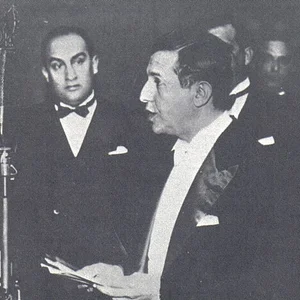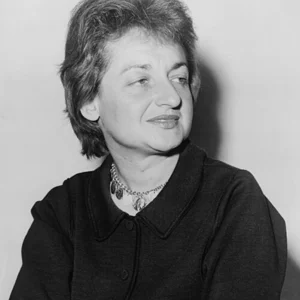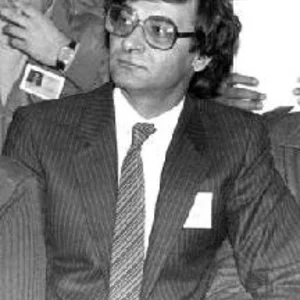

Mahmoud Darwish (1941-2008) was a Palestinian poet regarded as the national voice of his people. A major figure of contemporary Arabic poetry, he made exile, the loss of one's land and Palestinian identity the great themes of his work.
Mahmoud Darwish(1941 — 2008)
Mahmoud Darwish
État de Palestine
7 min read
Frequently asked questions
Famous Quotes
« Write down: I am an Arab»
« We have on this earth what makes life worth living»
Key Facts
- Born in 1941 in al-Birwa, a village in Galilee destroyed in 1948 during the creation of Israel
- Published the poem ‘Identity Card’ (Bitaqat hawiyya) in 1964, which made him famous throughout the Arab world
- Joined the Palestine Liberation Organization (PLO) in 1973 and sat on its executive committee until 1993
- Wrote the Declaration of Independence of the State of Palestine in 1988, proclaimed by Yasser Arafat
- Died in 2008 in the United States; his funeral in Ramallah prompted a Palestinian national period of mourning
Works & Achievements
First major collection, which contains “Identity Card” and establishes Darwish as the voice of a Palestinian youth.
Collection in which love for a woman and love for the land merge, setting one of the great motifs of his work.
Poetic prose narrative about the 1982 siege of Beirut, considered one of his major texts.
Founding text proclaimed in Algiers, written by Darwish: poetry in the service of a historic political act.
Intimate collection in which the poet looks back on his childhood, his father, and the lost village.
Long meditative poem written after a serious illness, in which Darwish converses with death and eternity.
Poem written during the reoccupation of Ramallah, a meditation on daily life under occupation and the longing for peace.
Anecdotes
In 1948, when Mahmoud Darwish was seven years old, his native village of al-Birwa, in Galilee, was razed during the war that followed the creation of Israel. His family fled to Lebanon, then returned secretly a few months later. But the census had already been taken: in the eyes of the Israeli administration, Mahmoud was now a “present-absentee,” present on the land but absent from the records. This paradox would mark his entire body of work.
At twenty-three, Darwish published the poem “Identity Card,” which begins with this cry: “Write down! I am an Arab.” Recited and sung throughout the Arab world, the poem became a true anthem. The young poet, unknown until then, woke up famous—but also watched by the authorities.
During the 1960s, because of his poems and his activism, Darwish was arrested several times and placed under house arrest: he was forbidden to leave Haifa without permission. It was partly to escape this surveillance that he left the country in 1970, beginning a long life of exile between Moscow, Cairo, Beirut, Tunis, and Paris.
In 2000, the Israeli Minister of Education proposed adding a few of Darwish's poems to the high school curriculum. The controversy was so heated that it threatened to bring down the government—proof that a poet, through his verses alone, could shake a national debate.
When he died in 2008, following heart surgery in Houston, the Palestinian president declared three days of national mourning. Tens of thousands of people attended his funeral in Ramallah—a popular tribute on a scale rarely seen for a poet.
Primary Sources
Record! I am an Arab. My identity card number is fifty thousand. I have eight children, and the ninth will come after the summer. Does this make you angry?
On this earth there is what makes life worth living: April's hesitation, the aroma of bread at dawn, a woman's thoughts about men, the writings of Aeschylus, the beginning of love.
I want the aroma of coffee. I want nothing but the aroma of coffee. I want five minutes. I want a five-minute truce for the sake of coffee.
The Palestinian National Council proclaims, in the name of God and in the name of the Palestinian Arab people, the establishment of the State of Palestine on our Palestinian land, with Jerusalem as its capital.
Here, on the slopes of the hills, facing the dusk and the cannon of time, near the gardens of broken shadows, we do what prisoners do, what the unemployed do: we cultivate hope.
Key Places
Darwish's native village, destroyed in 1948 and replaced by Israeli settlements. In his work it becomes the symbol of paradise lost and of confiscated land.
The city where the young Darwish worked as a journalist for the leftist press and was a political activist. It was there that he was placed under surveillance and house arrest in the 1960s.
The Lebanese capital where Darwish settled with the PLO in the 1970s. There he lived through the 1982 siege, which inspired his prose work *Memory for Forgetfulness*.
One of the major stages of his exile, where he lived and wrote during the 1980s and 1990s and edited the literary journal *Al-Karmel*.
The West Bank city where Darwish returned to settle in 1996. He is buried there on the hill of al-Rabweh, where a memorial and a museum are dedicated to him.
The American city where Darwish died in 2008 following heart surgery, far from the land whose absence he had sung of his entire life.
Typical Objects

An administrative document imposed on Palestinians, stamped with a number and the label “Arab.” For Darwish, it becomes the symbol of an identity that is denied and reclaimed, at the heart of his most famous poem.

Many refugees from 1948 kept the key to the home they had fled. For Darwish, it embodies the dream of return and the memory of destroyed villages like al-Birwa.

In Memory for Forgetfulness, Darwish tells of wanting to make his coffee under the bombs falling on Beirut in 1982. The everyday gesture becomes an act of resistance and dignity in the face of war.

The olive tree, emblematic of Palestine, gives its name to the collection Olive Branches (1964). It symbolizes rootedness in the land, peace, and peasant resistance.

Darwish's everyday working tools; he wrote his poetry by hand before reading it aloud in public. They are the instrument through which exile and loss are transformed into shared words.

A black-and-white checkered scarf traditionally worn in Palestine. In the 20th century, it became an emblem of Palestinian identity and the national struggle that Darwish sang of so often.
School Curriculum
Vocabulary & Tags
Key Vocabulary
Tags
Daily Life
Morning
Darwich liked to start his day slowly, with a coffee he made himself: an almost sacred ritual he describes in his writings. Mornings were often devoted to reading the newspapers and to writing, at the hour when the mind is clearest.
Afternoon
Afternoons were divided between composing his poems, correspondence, and editorial work for the literary magazines he directed. He also welcomed writers, friends, and journalists who came to discuss literature and politics.
Evening
In the evening, Darwich took part in literary gatherings, public readings, or discussions among intellectuals in exile. His recitals drew immense crowds, turning poetry into a collective event.
Food
His diet was that of the eastern Mediterranean: bread, olive oil, olives, cheeses, vegetables, mezze, and tea. Coffee, which he evokes as an essential ritual, held a special place in his habits.
Clothing
An elegant and well-groomed man, Darwich most often wore understated suits and city shirts, in keeping with the cosmopolitan intellectual he had become over the course of his exiles.
Housing
His life in exile led him to live in a succession of apartments in Moscow, Cairo, Beirut, Tunis, Paris, and finally Ramallah. These temporary homes reflect an existence marked by uprooting and the wait for return.
Historical Timeline
Period Vocabulary
Liens externes & ressources
Références
Œuvres
Rameaux d'olivier (Awraq al-Zaytoun)
1964
Un amant de Palestine (Ashiq min Filastin)
1966
Une mémoire pour l'oubli (Dhakira li-l-nisyan)
1987
Déclaration d'indépendance de l'État de Palestine
1988
Pourquoi as-tu laissé le cheval à sa solitude ?
1995
Murale (Jidariyya)
2000
État de siège (Halat Hisar)
2002