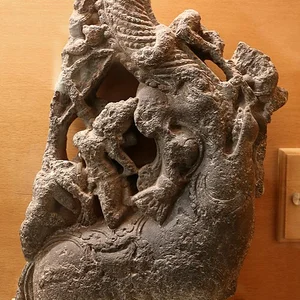

The makara is a hybrid aquatic creature from Hindu mythology, blending features of a crocodile, an elephant and a fish. It serves as the mount (vahana) of the deities Varuna, god of the waters, and Ganga, goddess of the Ganges.
Makara
Makara
5 min read
Frequently asked questions
Key Facts
- The makara is a hybrid creature combining crocodile, elephant and fish in Hindu iconography
- It is the mount (vahana) of Varuna, god of the waters, and of Ganga, goddess of the river Ganges
- It is the Hindu astrological sign corresponding to Capricorn (Makara rashi)
- Its motif frequently adorns temple gateways (makara-torana) in India and Southeast Asia
- It appears in Buddhist and Hindu art from antiquity onward, spreading as far as Southeast Asia
Works & Achievements
The makara defines the iconography of these two water deities: recognizing the creature makes it possible to identify the goddess Ganga in a sculpture.
The makara names the sign corresponding to Capricorn in Indian astrology (jyotisha), associated with the winter solstice.
Harvest festival marking the Sun's entry into the sign of Makara and the return of longer days.
Model of an ornamental arch that frames the entrance of Hindu temples, from India to Southeast Asia.
The makara adorns the banner of the god of love, becoming a literary and poetic symbol of desire.
Anecdotes
The makara serves as the mount (vahana) of two major deities: Varuna, the god of the waters and of cosmic order, and Ganga, the goddess who personifies the sacred river Ganges. When you see a goddess riding this creature in an Indian sculpture, it is almost always Ganga.
The makara gave its name to a sign of the Indian zodiac: Makara Rashi corresponds to the Western Capricorn, which is likewise depicted as a half-animal, half-fish creature. Every year, the festival of Makara Sankranti (around January 14) celebrates the Sun's entry into this sign and marks the end of winter.
Kamadeva, the god of love and desire, carries a banner adorned with a makara: for this reason he is called Makaradhvaja, “the one whose banner bears the makara.” Here the aquatic creature symbolizes the irresistible power of feelings.
In the architecture of Hindu temples, the makara decorates the monumental arches called makara-torana, where two creatures spew forth garlands or foliage. It also serves as a gargoyle: the waters used in rituals often flow out through a sculpted makara mouth (the praṇāla).
The makara is an assemblage of several animals: depending on the era, it is given a crocodile's jaw, an elephant's trunk, scales and a fish's tail, and sometimes a feline's paws. This hybrid nature illustrates the idea that it belongs to the mysterious and fertile world of the waters.
Primary Sources
Varuna is celebrated as the sovereign of the waters and of cosmic order (rita), master of the rivers and oceans whose makara would later become his mount.
This encyclopedic treatise describes the rules of Indian iconography and astrology, including the sign of Makara (Capricorn) and the conventions for depicting divine mounts.
The Puranas detail the attributes and vehicles (vahana) of the deities, associating the river Ganga and the waters with the makara creature.
On the carved gateways of the great stupa, makaras appear spewing foliage and framing scenes, among the oldest known depictions of the creature.
Key Places
Sacred site where the descent of the Ganges to Earth is said to have occurred; Ganga, goddess of the river, is depicted there riding a makara.
Holy city devoted to the worship of the river, where imagery of Ganga and her makara mount is omnipresent on the temples and ghats.
Buddhist site in Madhya Pradesh whose carved gateways feature some of the oldest known depictions of the makara.
Group of medieval temples adorned with remarkable, finely carved makara-torana arches.
Khmer temple-city where the makara decorates lintels and balustrades, testifying to the spread of the motif across Southeast Asia.
Large Javanese Hindu complex where the makara appears carved on the stairways and entrances of the shrines.
Typical Objects

Standard of the love god Kamadeva, adorned with a makara. It symbolizes the irresistible force of desire.

Large temple arch framed by two makara spewing foliage and garlands. It marks the passage into the sacred space.

Sculpted spout through which the lustral waters poured over the divine statues drain away. The makara's mouth symbolically purifies the water.

Makara-shaped ear pendants worn by certain deities, including Vishnu and Shiva. They display divine rank and prosperity.

Slip noose held by Varuna, the lord of the waters whose mount is the makara. It is used to capture those who transgress the cosmic order.
School Curriculum
Vocabulary & Tags
Key Vocabulary
Daily Life
Morning
A creature of the waters, the makara is said to haunt the depths of rivers, lakes and the cosmic ocean. In the dawn of myth, it is imagined gliding through the sacred currents of the Ganges, carried by the very waters it embodies.
Afternoon
The makara appears above all as a mount: on its back it carries the goddess Ganga or the god Varuna as they roam their watery domains. Its role is to link the world of the gods with the liquid element from which life springs forth.
Evening
Carved on temples, the makara watches over thresholds, its jaws agape, pouring forth waters and garlands. In this way it stands a symbolic guard, protecting the sacred space from harmful influences.
Food
As a mythical being, the makara does not feed like an ordinary animal; it merges with the fertile waters it symbolizes. The texts present it as a guardian of the aquatic world rather than as a predator.
Clothing
The makara is not clothed but adorned: it is covered with scales, plant motifs and carved jewels. In art, its teeth, its trunk and its leafy mane serve as its characteristic ornaments.
Housing
Its dwelling is the watery element itself: the cosmic ocean, the sacred rivers and the springs. In temples, it “inhabits” the arches, the lintels and the waterspouts where craftsmen have frozen it in stone.
Historical Timeline
Period Vocabulary
Liens externes & ressources
Références
Œuvres
Monture (vahana) de Varuna et de Ganga
Antiquité et période classique
Makara Rashi, signe du zodiaque
Astrologie védique classique
Fête de Makara Sankranti
Célébrée chaque année (vers le 14 janvier)
Motif de la makara-torana
Période classique et médiévale
Emblème de Kamadeva (Makaradhvaja)
Période classique de l'hindouisme