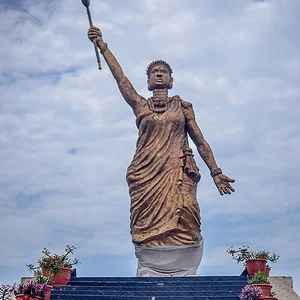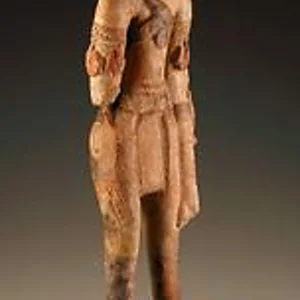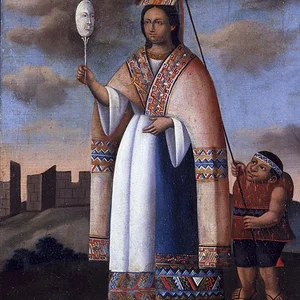

Founding goddess of Inca civilization, according to Quechua oral tradition. Wife of Manco Cápac, she is said to have emerged from Lake Titicaca and taught women the art of weaving and domestic skills, thereby establishing the Inca social order.
Mama Ocllo(1197 — 1230)
Mama Ocllo
Empire inca
8 min read
Frequently asked questions
Key Facts
- According to Inca oral tradition, Mama Ocllo and Manco Cápac emerged from Lake Titicaca, sent by the sun god Inti
- She is credited with teaching women weaving, a central activity in Inca economy and culture
- Her name roughly means 'Noble Mother' or 'Pure Mother' in Quechua
- Spanish colonial chronicles (16th century) are the earliest written sources on her myth, recording oral traditions
- She is considered the mythical ancestor of the Incas and co-founder of Cuzco
Works & Achievements
Mama Ocllo is the legendary co-founder of Cusco, capital of the Inca Empire. This founding act, passed down through oral tradition, forms the original story of the entire Tawantinsuyu civilization.
Mama Ocllo is said to have introduced the women of the Andes to the art of weaving, transforming the practice into a cornerstone of Inca economy and culture. Inca textiles rank among the most sophisticated of any pre-colonial civilization.
As the first Coya, Mama Ocllo established the role of queen-goddess in Inca society. This model was followed by every subsequent Inca queen, each of whom claimed descent from her divine lineage.
The story of Mama Ocllo's journey carrying the vara de oro was passed down from generation to generation by the amautas (keepers of oral memory). It stands as one of the foundational mythological texts of the Andes.
The model established by Mama Ocllo — of women dedicated to ceremonial weaving and religious rites — gave rise to the acllahuasis. These institutions trained noblewomen to carry on the arts and rituals founded by the goddess.
Anecdotes
According to Quechua oral tradition, Mama Ocllo and her husband Manco Cápac emerged from the waters of Lake Titicaca, sent by the sun god Inti to bring civilization to the peoples of the Andes. They carried with them a sacred golden rod, meant to mark the spot where they would found their capital city.
Mama Ocllo is credited with teaching Andean women the art of weaving, a highly valued activity in Inca society. Textiles were far more than clothing: they served as currency, tribute, and coded messages conveying social status and clan identity.
Her name literally means 'Noble Mother' or 'Fertile Mother' in Quechua. She was venerated as the founding mother of the Inca royal lineage — the Sapa Inca all claimed descent from her divine bloodline to legitimize their rule.
In some versions of the myth, Mama Ocllo and Manco Cápac were both siblings and spouses — a union that Inca rulers perpetuated to preserve the purity of the royal bloodline. This practice, known as royal endogamous marriage, deeply shocked Spanish chroniclers.
Celebrations in honor of Mama Ocllo took place during the festival of the moon (Quilla Raymi), as she was associated with the moon goddess. Noble women of Cuzco would offer her libations of chicha and finely crafted textiles.
Primary Sources
Inca Manco Cápac and his sister and wife Mama Ocllo Huaco, children of the Sun and the Moon, emerged from the lake known as Titicaca... She taught women to spin and weave wool and cotton.
Mama Ocllo Coya, first queen of the Inca, was a great lady and mother of the entire Inca nation; she taught women the arts of weaving and household governance.
And so Manco Cápac and Mama Ocllo emerged from Lake Titicaca, bearing with them the golden staff; and as they journeyed across the land, in the place where the staff sank into the earth, they founded the city of Cuzco.
Mama Ocllo was revered as a goddess among the Inca, wife and equal in divinity to Manco Cápac; the women of Cuzco venerated her as their mother and patron.
Key Places
The mythical place of emergence of Mama Ocllo and Manco Cápac according to Inca cosmogony. The lake, situated at 12,507 feet (3,812 m) above sea level, was venerated as the cradle of civilization and a major sanctuary of the Andean world.
The sacred capital of the Inca Empire, founded according to legend by Mama Ocllo and Manco Cápac. The Qorikancha, the main temple, also housed a chapel dedicated to the Moon, associated with Mama Ocllo.
An island dedicated to the lunar goddess, directly linked to the cult of Mama Ocllo. The acllas (priestesses of the sun and moon) lived there and carried on the textile traditions inherited from the founding goddess.
According to one version of the myth, Mama Ocllo and Manco Cápac emerged from the cave of Tambo Toco at Pacariqtambo. This site was venerated as a place of pilgrimage by the Inca.
Typical Objects

A fundamental tool of Andean weaving, the pushka symbolizes Mama Ocllo's teachings to Inca women. It was carried at the belt and used while walking, with thread regarded as a metaphor for life and social bonds.

Ceremonial textiles adorned with codified geometric patterns, tocapus constituted a true Inca visual language. Mama Ocllo is credited with introducing these sophisticated textile arts into Inca society.

According to myth, Mama Ocllo and Manco Cápac carried a golden staff given to them by Inti to mark the site where Cuzco was to be founded. Where it sank into the earth in a single thrust, the sacred city was to be built.

A wooden or gold goblet used during ritual libations to the moon and the sun. Mama Ocllo, associated with the lunar cult, received offerings of chicha poured into these cups during royal festivals.

A system of knotted cords used to record numerical data and historical narratives in Inca society. Noble women connected to the cult of Mama Ocllo were entrusted with preserving the quipus that traced the royal genealogy.

The coya (Inca queen) wore a distinctive headdress adorned with colorful feathers and a crown symbolizing her divine status, inherited from Mama Ocllo. These royal insignia set apart the women of the founding lineage.
School Curriculum
Vocabulary & Tags
Key Vocabulary
Tags
Daily Life
Morning
As divine Coya, Mama Ocllo begins each day with offering rites at sunrise. She places chicha and coca leaves in a sacred brazier, reciting prayers in Quechua to honor Inti and Quilla. Her day opens under the sign of mediation between the world of the gods and that of humans.
Afternoon
The afternoon is devoted to teaching: Mama Ocllo oversees the women of the ayllu gathered to weave ceremonial textiles. She passes on the complex tocapu patterns that encode clan identity and sacred narratives. Weaving is not a simple domestic task but a foundational political and spiritual act.
Evening
At dusk, the Coya presides over royal family council meetings, settling disputes and passing down oral histories to the amautas. The gathering takes place around a fire of dried quinoa stalks, accompanied by ritual songs and libations to the rising moon — protector of women and agricultural cycles.
Food
The diet rests on three Andean pillars: maize (sara), potato (papa), and quinoa, supplemented by dried llama meat (charqui) during festivals. Fermented maize chicha plays a central role, both as an everyday drink and as a ritual offering to the deities. Food consumed by royalty came from the finest terraced farmlands.
Clothing
Mama Ocllo wears the anacu, a long robe of finely woven alpaca wool held in place by large silver pins called tupus. Her garment is adorned with multicolored tocapu borders indicating her divine rank. Over her shoulders she wears the lliclla, a square shawl fastened by a central golden tupu — a symbol of her sovereignty.
Housing
The Coya resides in the royal enclosures (kancha) of Cusco, a complex of finely cut stone buildings arranged around interior courtyards. The walls are lined with gold and silver panels that reflect sunlight. The rooms are furnished simply: wall niches for idols, earthen floors covered with textiles, and a central hearth providing both warmth and sacred presence.
Historical Timeline
Period Vocabulary
Visual Style
Style inspiré des textiles incas et de la peinture coloniale andine : composition hiératique, motifs tocapu géométriques, palette solaire et lunaire mêlant terres chaudes, or et turquoise du lac Titicaca.
Sound Ambience
Ambiance des hautes terres andines au bord du lac Titicaca : vent d'altitude, flûtes de roseau, métier à tisser et chants cérémoniels quechuas au lever du jour.
Liens externes & ressources
Références
Œuvres
Fondation de Cuzco (Qusqu)
~1200
Enseignement du tissage aux femmes andines
~1200
Institution du rôle de Coya (reine inca)
~1200
Mythe de la tige d'or — transmission orale quechua
tradition continue
Organisation des acllahuasis (maisons des femmes choisies)
~1200 — tradition perpétuée jusqu'en 1532