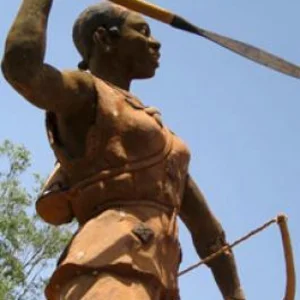

A central figure in the Mande epic tradition preserved by griots, Sogolon Kondé is the mother of Sundiata Keita, founder of the Mali Empire in the 13th century. Said to be ugly yet endowed with supernatural powers, she embodies hidden strength and maternal dignity in the oral tradition of the Mande peoples.
Sogolon Kondé
Sogolon Kondé
8 min read
Frequently asked questions
Famous Quotes
« "It is from me that Sundiata draws his strength." (words attributed by the griot tradition, unverifiable in writing)»
Key Facts
- Sogolon Kondé is known solely through the Mande oral tradition — no contemporary written source mentions her directly.
- She is presented as a woman of the Do people (in the region of present-day Mali and Guinea), gifted with mystical power (nyama) according to tradition.
- Her union with King Naré Maghann Konaté, as told in the epic, led to the birth of Sundiata Keita (around 1217–1255), founder of the Mali Empire.
- She endured humiliation and exile alongside her disabled son before he rose to become king — the central narrative arc of the epic.
- The Epic of Sundiata, in which she is a key character, has been inscribed on UNESCO's Intangible Cultural Heritage list since 2016.
Works & Achievements
A great epic narrative transmitted orally by Mande griots (djelis), in which Sogolon Kondé is one of the central characters. This epic is one of the most significant in sub-Saharan Africa, often compared to the Iliad for its narrative richness.
As the mother of Sundiata Keita, Sogolon is considered a symbolic co-founder of the Mali Empire. Her maternal lineage (from Dô) and her spiritual powers are portrayed as essential to her son's legitimacy and ultimate victory.
The first major written transcription of the epic, based on the accounts of griot Djeli Mamoudou Kouyaté. This work brought Sogolon and Sundiata to worldwide attention and is studied in secondary schools across Africa and France.
A Burkinabé film depicting the transmission of the Mande epic to a contemporary young boy. Sogolon is portrayed as an archetypal figure of the courageous mother, embodying the living memory of the Mande tradition.
Anecdotes
According to the Mande epic, Sogolon Kondé was nicknamed 'the buffalo woman' because her mystical double (her protective djinn) took the form of a buffalo. When she encountered the Traoré hunters sent by the king of Dô, she transformed into a wild buffalo to test their courage before accepting her fate.
The griots tell that Sogolon was considered ugly and hunchbacked, rejected by all men before being chosen as a wife by Naré Maghann Konaté, the king of Niani. This deceptive appearance concealed extraordinary spiritual power: her supernatural gifts shielded her son Sundiata from the assassination attempts ordered by King Soumaoro Kanté.
During the years of exile, Sogolon traveled with her children through neighboring kingdoms — Djedeba, Tabon, and then Mema — seeking refuge and protection for her crippled son, whom many despised. It was through her tenacity and diplomatic ties that Sundiata was able to grow up in safety until his triumphant return.
Oral tradition holds that Sogolon died shortly after Sundiata's victory at the Battle of Kirina (around 1235), as if her life's purpose had been fulfilled. Sundiata had a honored tomb erected for her in Niani, the capital of the nascent Mali Empire, and her name was sung by the griots as a symbol of the self-sacrificing mother.
Primary Sources
I am a griot. I am Djeli Mamoudou Kouyaté, son of Bintou Kouyaté and Djeli Kedian Kouyaté, master of the art of speech. Since time immemorial, the Kouyatés have been in the service of the Keïta princes of Manding.
Sogolon, the buffalo woman, carried within her the strength of the ancestors of Dô. Her son would be greater than all kings, for he was born of the blood of two powers: that of the lion and that of the buffalo.
Sogolon Kondé, you whose womb carried the Empire, you whom men scorned and whom God had chosen. Your ugliness was the cloak of your power.
The empire of Mali was founded by Mari Diata, son of a king and a woman from the land of Dô, whose renown stretched from the Atlantic to the banks of the Niger.
Key Places
The royal city of the Manding empire, residence of Naré Maghann Konaté and birthplace of Sundiata. It was here that Sogolon lived as a royal wife, endured the humiliations of court life, and raised her son before their exile.
The legendary kingdom from which Sogolon Kondé originated, located in present-day Guinea. It was there that the Traoré hunters encountered her, and where her mystical double — the buffalo — resides.
A Sahelian kingdom where Sogolon and her children found their longest and most stable refuge during their years of exile. The king of Mema welcomed Sundiata with honor, allowing him to grow into a skilled warrior.
The site of the Battle of Kirina (around 1235), where Sundiata defeated Soumaoro Kanté. Sogolon had most likely already passed by then, but her entire life had prepared the way for this historic moment.
Typical Objects

A versatile, ever-present container in Mandinka daily life, used to fetch water, serve food, and present offerings. As a mother and royal wife, Sogolon organized the household around these symbolic objects.

Traditional garment worn by Mandinka women in the 13th century, hand-woven and hand-dyed. Sogolon is often depicted draped in these deep-blue fabrics, which symbolized dignity and social standing.

Spiritual protection objects crafted by marabouts or diviners and worn on the body. Sogolon, renowned for her supernatural powers, used these talismans to shield her son Sundiata from the attacks of his enemies.

A central tool of Mandinka cooking, used to pound millet, sorghum, and spices. The mortar scene is iconic in the epic: Queen Sassouma refuses to lend hers to Sogolon — a humiliation that drives Sundiata to stand up for the very first time.

A 21-string plucked instrument, emblem of the Mandinka griot tradition. Though played by griots rather than by Sogolon herself, it is the instrument through which her story has been passed down and sung for centuries.

A tree revered in Mandinka beliefs, serving as a place for rituals and prayers to the ancestors. Legend holds that Sogolon prayed beneath a baobab before Sundiata's birth, calling upon the ancestral spirits for protection.
School Curriculum
Vocabulary & Tags
Key Vocabulary
Tags
Daily Life
Morning
Sogolon rose before dawn, performed her ritual ablutions, and prayed to the ancestral spirits protecting her family. She oversaw the preparation of the morning meal — millet or sorghum porridge — and organized the daily tasks of the women in the royal household.
Afternoon
The afternoon was devoted to caring for her children, managing the household provisions, and conversing with the other women of the court. During their time in exile, these hours were often shadowed by anxiety and vigilance, as she worked to shield Sundiata from hostile eyes.
Evening
In the evenings, Sogolon gathered her children around the fire and passed on the stories of their ancestors, Manding proverbs, and the values of their people. She performed protective rites — offerings and prayers — to ensure her son's safety through the night.
Food
The Manding diet of the 13th century was built around millet, sorghum, and red rice, prepared as porridge or fritters. Meals also included dried legumes, dried fish from the Niger River, and occasionally game or beef during royal feasts and ceremonies.
Clothing
Sogolon wore hand-woven cotton wraps dyed with indigo or kaolin, draped around the body in the traditional Manding style. Her bronze and copper jewelry — bracelets and necklaces — carried protective amulets sewn into leather pouches.
Housing
In Niani, Sogolon lived in a section of the royal adobe palace, a cluster of round thatched-roof huts arranged around a central courtyard. During exile, she lived in more modest circumstances, housed by allied kings in similar but unfamiliar court residences.
Historical Timeline
Period Vocabulary
Visual Style
Style pictural inspiré des textiles mandingues (bogolan, indigo), tons ocre, terre et or, architecture en banco, lumière chaude du Sahel, atmosphère à la fois réaliste et empreinte de spiritualité.
Sound Ambience
Ambiance sonore d'un village mandingue du XIIIe siècle au crépuscule : percussions de mortier, chants griotiques, kora et balafon, feux de bois et savane africaine.
Liens externes & ressources
Références
Œuvres
L'épopée mandingue (Sundiata Fasa)
XIIIe siècle — tradition orale perpétuée jusqu'à nos jours
Fondation symbolique de l'Empire du Mali
vers 1235
Soundjata ou l'épopée mandingue — Djibril Tamsir Niane (transcription)
1960