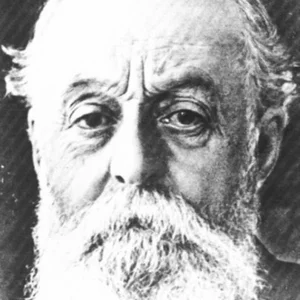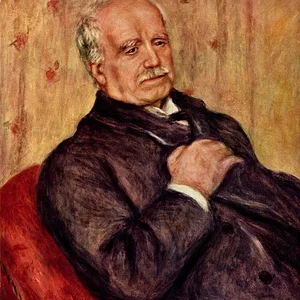

A 19th-century Catalan businessman, ceramic tile merchant and stockbroker, Manuel Vicens i Montaner is best known for commissioning Antoni Gaudí to build his summer home in Barcelona, the Casa Vicens (1883–1885), the architect's first major work.
Manuel Vicens
Manuel Vicens i Montaner
8 min read
Frequently asked questions
Key Facts
- Ceramic tile merchant and stockbroker in 19th-century Barcelona
- He commissioned Antoni Gaudí to build his summer residence around 1878; construction was carried out between 1883 and 1885
- The Casa Vicens, Gaudí's first masterpiece, was inscribed on the UNESCO World Heritage List in 2005
- His brief made extensive use of ceramic tiles from his own trade, blending Orientalism with Catalan tradition
Works & Achievements
Manuel Vicens entrusted Gaudí with the design of his summer home in Gràcia, giving him considerable creative freedom. This bold act of patronage was the founding moment of Gaudí's career and of Catalan Modernista architecture.
Vicens built a trading firm specializing in earthenware and glazed ceramic tiles, riding the wave of Orientalist decorative arts fashion and the growing demand from Catalonia's rising industrial bourgeoisie.
As a licensed financial intermediary, Vicens facilitated transactions in industrial securities during a period of intense speculation driven by the Catalan industrial revolution, combining artisanal trade with high finance.
Completion of Manuel Vicens's summer residence, which stands as his principal legacy to art history. With its colorful ceramic facades and exuberant decoration, the building embodies the meeting between Catalan bourgeois taste and Gaudí's visionary genius.
Anecdotes
When Antoni Gaudí received the commission from Manuel Vicens in 1883, he had been a qualified architect for only five years and had yet to complete any major building. Vicens, a ceramic tile merchant, entrusted his summer house to this young, still-unknown architect — an audacious gamble that would give rise to one of the first works of the Catalan genius.
To decorate the facade of Casa Vicens, Gaudí used tiles adorned with calendula flowers (marigolds), the plant that grew naturally on the site before construction began. Family tradition holds that these flowers directly inspired the ceramic motifs, produced in part by Vicens's own shop — meaning the patron was also, in a certain sense, the supplier of the materials.
Casa Vicens was built in the municipality of Gràcia, then an independent town separate from Barcelona, known for its craftsmen and rebellious spirit. It was not until 1897 that Gràcia was forcibly annexed by the city, against the wishes of its inhabitants. Vicens thus enjoyed the cool air of this leafy suburb, far from the heat of the industrial metropolis.
Manuel Vicens practised the dual trade of ceramics merchant and stockbroker at the Barcelona Stock Exchange. This combination perfectly embodies the figure of the 19th-century Catalan bourgeois: a pragmatic entrepreneur equally at home investing in artisanal commerce and in the stock speculation that accompanied Catalonia's industrial rise.
Inscribed on UNESCO's World Heritage List in 2005 as part of the “Works of Antoni Gaudí,” Casa Vicens only opened to the public as a museum in November 2017. For more than a century, this first house commissioned by Vicens remained in the shadow of Gaudí's later masterpieces, such as the Sagrada Família or Casa Batlló.
Primary Sources
Application filed in the name of Manuel Vicens i Montaner for the construction of a summer residence on Carrer de les Carolines, municipality of Gràcia. The architectural design is signed by Antoni Gaudí i Cornet, architect graduated from the Provincial School of Architecture of Barcelona.
M. Vicens i Montaner, resident of Barcelona, is registered as a dealer in earthenware and ceramic tiles, also acting as a stockbroker at the Barcelona Stock Exchange (Llotja de Mar).
Following the dispersal of the Vicens family, the property on Carrer de les Carolines was transferred to the Jover Serra family. The deed describes the building as remarkable for its original architecture and the richness of its ceramic cladding.
Among the exhibitors in the decorative arts section were several Catalan tile and earthenware trading companies, including those that supplied the celebrated cladding of M. Vicens's house, erected in the municipality of Gràcia to designs by the architect M. Gaudí.
Key Places
A holiday home built by Antoni Gaudí between 1883 and 1885 for Manuel Vicens. The architect's first recognized masterpiece, it has been listed as a UNESCO World Heritage Site since 2005 and has been open to the public as a museum since 2017.
A neoclassical building on the waterfront of Barcelona, which has served as the historic seat of the stock exchange and the Catalan chamber of commerce since the Middle Ages. This is where Manuel Vicens worked as a stockbroker, at the heart of Barcelona's financial world.
An independent municipality until 1897, Gràcia was a working-class artisan village on the outskirts of Barcelona, popular with the bourgeoisie as a summer retreat. It was here that Vicens had his summer house built in the 1880s.
Barcelona's urban expansion district, planned by engineer Ildefons Cerdà from 1860 onward, laid out as a regular grid of city blocks with chamfered corners. It became the prestigious residential quarter of Catalonia's industrial bourgeoisie, of which Vicens was a typical representative.
Typical Objects

Enamelled earthenware tile decorated with floral or geometric motifs of Oriental inspiration, used as wall or floor covering in Catalan architecture. This was the heart of Manuel Vicens's trade: he imported them or had them produced locally.

Bound register in which a merchant or stockbroker recorded day by day his transactions, purchases, sales, and outstanding debts. A fundamental tool of commercial bookkeeping, it was kept with great care under penalty of legal sanctions.

Paper document representing a share of capital in a limited company or a government bond, traded on the Barcelona Stock Exchange (Llotja de Mar). A stockbroker like Vicens served as the official intermediary between sellers and buyers of these securities.

Technical drawing made with pen and ink on paper or tracing cloth, showing the floor plans, sections, and elevations of a building. The original plan for Casa Vicens, signed by Gaudí, is the founding document of the building commissioned by Vicens.

Cylindrical black felt hat, the quintessential mark of the male bourgeoisie in the 19th century on formal occasions. It immediately signalled the social standing of its wearer in Barcelona society.

Printed brochure produced by ceramic trading houses to present their tile ranges to architect clients or wealthy private buyers. This type of commercial document circulated among merchants, architects, and patrons in the Barcelona of the Modernisme movement.
School Curriculum
Vocabulary & Tags
Key Vocabulary
Tags
Daily Life
Morning
Manuel Vicens started his day early, as befitted any active Barcelona merchant. After a simple breakfast — bread rubbed with tomato (*pa amb tomàquet*), coffee or hot chocolate — he would head to his ceramics shop to oversee orders and meet with suppliers, before making his way to the Llotja de Mar to follow the opening of the Stock Exchange.
Afternoon
The afternoon was devoted to stock market business and meetings in Barcelona's cafés and commercial circles. In summer, Vicens would join his family at their holiday home in Gràcia, where bourgeois families gathered in the shade of gardens to escape the stifling heat of the industrial city.
Evening
Evenings alternated between family dinners, outings to the Gran Teatre del Liceu (the temple of Barcelona's high society) and gatherings in economic circles. In summer at the Casa Vicens, cool evenings on the terrace brought together neighbors and friends for card games or conversation about business and the politics of the day.
Food
The table of a nineteenth-century Catalan bourgeois was generous: wheat bread, seasonal vegetables, fresh fish from the port of Barcelona, meat on feast days, all washed down with wine from the Penedès. Traditional Catalan cuisine — *escudella*, grilled *botifarra*, *fideus* — coexisted with French-style dishes, a mark of social distinction and modernity.
Clothing
Vicens wore, like any bourgeois of his standing, a three-piece suit in dark cloth, a white shirt with a stiff collar and a neatly knotted tie, topped with a top hat for official outings to the Stock Exchange. In summer in Gràcia, the attire was lighter: a pale linen jacket and a broad-brimmed straw hat.
Housing
In the city, Vicens most likely lived in a bourgeois apartment in a building in central Barcelona, with domestic staff, a reception room and a separate dining room, in keeping with the standards of his class. In summer, the whole family relocated to the Casa Vicens in Gràcia, a holiday residence surrounded by a garden with a fountain, designed by Gaudí to offer coolness and exoticism in what was still a semi-rural neighborhood.
Historical Timeline
Period Vocabulary
Liens externes & ressources
Références
Œuvres
Commande de la Casa Vicens à Antoni Gaudí
1883
Développement du négoce de carreaux de céramique à Barcelone
années 1870-1880
Activité d'agent de change à la Bourse de Barcelone
années 1870-1890
Achèvement et occupation de la Casa Vicens
1885