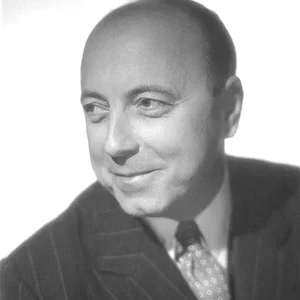

Marcel Carné was a French filmmaker and a major figure of the "poetic realism" movement of the 1930s and 1940s. With the poet-screenwriter Jacques Prévert, he made films that became classics of French cinema, including Children of Paradise.
Marcel Carné(1906 — 1996)
Marcel Carné
France
6 min read
Frequently asked questions
Key Facts
- Born in 1906 in Paris and died in 1996 in Clamart.
- Directed Port of Shadows (1938) and Daybreak (1939), iconic films of poetic realism.
- Filmed Children of Paradise (1943-1945), often cited as one of the greatest French films ever made.
- Worked closely with the poet and screenwriter Jacques Prévert.
- Elected to the Académie des Beaux-Arts in 1979.
Works & Achievements
A zany comedy starring Louis Jouvet and Michel Simon, the first major success of the Carné-Prévert duo in a burlesque vein.
A poetic-realist drama with Jean Gabin and Michèle Morgan that cemented Carné's atmospheric, fatalistic style.
A film set beside the Canal Saint-Martin in Paris, famous for the line “Atmosphère!” delivered by Arletty.
A high point of poetic realism: a factory worker besieged by the police relives his tragedy in flashback, an innovative narrative structure.
A medieval tale shot during the Occupation, whose allegory of the heart that keeps on beating was read as a symbol of resistance.
A sweeping portrait of nineteenth-century Parisian theatre, often hailed as the greatest French film of all time.
The last great film by the Carné-Prévert duo, set in the Paris of the Liberation, where the song “Les Feuilles mortes” (“Autumn Leaves”) rings out.
A modern adaptation of Émile Zola's novel, awarded the Silver Lion at the Venice Film Festival.
Anecdotes
To shoot *Children of Paradise* during the Occupation, Marcel Carné resorted to many tricks: he dragged out the filming to delay the release until the Liberation, and some Jewish collaborators, such as set designer Alexandre Trauner and composer Joseph Kosma, worked clandestinely, their names never appearing in the credits.
Before becoming a filmmaker, Carné was for a time a film critic. In 1933, he wrote a resounding article titled “When Will Cinema Take to the Streets?”, a true manifesto calling for the filming of real life and ordinary people, already foreshadowing his future “poetic realism.”
The shooting of *Port of Shadows* (1938) almost never happened: the German production company UFA rejected the screenplay, deeming it “decadent.” The film was ultimately shot in France and became one of the great successes of pre-war French cinema.
Carné and the poet Jacques Prévert formed one of the most famous duos in French cinema. Together they made seven films in about a decade, with Prévert writing dialogue so finely crafted that certain lines, such as “You have beautiful eyes, you know,” have remained part of the collective memory.
After the war, Carné was criticized by the young filmmakers of the New Wave, who saw in him the symbol of an academic “cinéma de papa.” Yet directors like François Truffaut would later acknowledge French cinema's debt to *Children of Paradise*.
Primary Sources
The crowd, the street, its spectacles, its daily incidents — there lies the great reservoir, the immense vein of ore that French cinema does not know how to exploit.
“You have beautiful eyes, you know.”
I wanted my films to have that particular tone where poetry is born from reality, where the humblest everyday moment becomes legend.
“Paris is so small for those who love each other with as great a love as ours.”
Key Places
Birthplace of Marcel Carné, where he grew up in modest surroundings. Paris, with its streets and its mists, would become the recurring backdrop of his cinema.
A major hub of French cinema where Carné shot several of his films on constructed sets. The studios in the Paris region made it possible to recreate entire worlds shielded from reality.
The Nice studios where most of *Children of Paradise* was filmed under the Occupation. It was here that the gigantic set of the Boulevard du Temple was built.
A port city in Normandy where the action of *Port of Shadows* takes place. Its harbour and its mists embody on screen the aesthetic of poetic realism.
A town in the Hauts-de-Seine department where Marcel Carné died in 1996, at the age of 90. He was later buried in the Saint-Vincent Cemetery in Montmartre.
Liens externes & ressources
Références
Œuvres
Drôle de drame
1937
Le Quai des brumes
1938
Le jour se lève
1939
Les Visiteurs du soir
1942