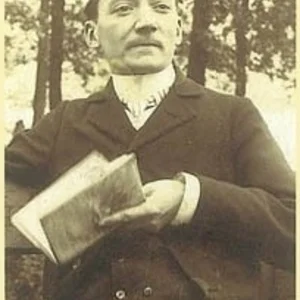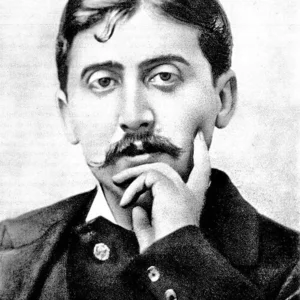

French writer, author of the monumental work “In Search of Lost Time.” A pioneer of the modern novel, he explored involuntary memory, time, and the society of the Belle Époque.
Marcel Proust(1871 — 1922)
Marcel Proust
France
6 min read
Frequently asked questions
Famous Quotes
« For a long time, I would go to bed early.»
« The real voyage of discovery consists not in seeking new landscapes, but in having new eyes.»
Key Facts
- Born on 10 July 1871 in Auteuil (Paris), died on 18 November 1922 in Paris
- Publication of “Swann's Way,” the first volume of “In Search of Lost Time,” in 1913 at his own expense after several rejections
- Prix Goncourt in 1919 for “In the Shadow of Young Girls in Flower”
- Wrote the bulk of his work as a recluse in his cork-lined bedroom, from 1909 until his death
- Posthumous publication of the final volumes, including “Time Regained” in 1927
Works & Achievements
Proust's first book, a collection of short stories, poems and portraits with a preface by Anatole France. It went almost unnoticed when it was published.
First volume of “In Search of Lost Time,” published at the author's own expense after several rejections. It contains the madeleine episode.
Second volume of the Search, awarded the Prix Goncourt, which established Proust's fame.
Third volume, which delves into the aristocratic world of the Faubourg Saint-Germain.
Fourth volume, the last published during Proust's lifetime, daring in its themes for the period.
Final volume of the Search, in which the narrator understands his vocation as a writer and the meaning of memory.
An unfinished essay in which Proust sets out his conception of literary creation, the matrix of his great novel.
Anecdotes
Asthmatic since the age of nine, Proust had the walls of his bedroom on the boulevard Haussmann lined with cork to muffle the noises of Paris. He lived there in reverse: sleeping by day, he wrote by night, bundled up in woollens, sometimes inhaling medicinal fumigations to relieve his attacks.
The famous episode of the madeleine dipped in tea, which opens *In Search of Lost Time*, illustrates what Proust calls involuntary memory: a taste or a smell brings an entire stretch of the past back to life. It has become the most celebrated image in all of twentieth-century French literature.
In 1919, Proust received the Prix Goncourt for *In the Shadow of Young Girls in Flower*. The choice caused a scandal: many found the author too worldly, too old and too rich when set against a young veteran of the war, Roland Dorgelès, who had been the favourite.
Proust never stopped correcting and lengthening his manuscripts by gluing together strips of paper called *paperoles*, which could unfold to more than a metre in length. He worked on his immense novel until his death, still dictating corrections a few days before he passed away.
In 1897, stung by the insinuations of the journalist Jean Lorrain, the young Proust challenged him to a pistol duel. Both men fired without wounding each other: the duel, still common in the Belle Époque, served above all to defend one's honour.
Primary Sources
For a long time I would go to bed early. Sometimes, the candle barely out, my eyes would close so quickly that I had not even time to say to myself: “I'm falling asleep.”
And suddenly the memory revealed itself. That taste was the taste of the little piece of madeleine that, on Sunday mornings at Combray, my aunt Léonie used to give me after dipping it in her infusion of tea or lime-blossom.
Real life, life at last laid bare and illuminated — the only life in consequence which can be said to be really lived — is literature.
I live in a room whose walls I have had lined with cork so that no noise from outside can get in.
Key Places
District where Proust was born in 1871, in his great-uncle's house. At the time it was a leafy suburb in the west of Paris.
Apartment where Proust lived from 1907 to 1919 and had his bedroom lined with cork. It was here that he wrote most of “In Search of Lost Time”.
Village where young Marcel spent his holidays at his aunt's house. It inspired the “Combray” of the novel, so much so that the town added this name to its own in 1971.
Seaside resort on the Normandy coast where Proust stayed at the Grand Hôtel. It served as the model for the “Balbec” of the Recherche.
School where Proust completed his secondary studies and formed friendships with future writers and artists.
Place where Proust was buried in the family vault after his death in 1922. His grave remains a site of pilgrimage for readers from all over the world.
Typical Objects

Small shell-shaped cake that the narrator dips into a cup of tea. Its flavour triggers the famous resurgence of childhood memories.

Warm infusion into which the madeleine is dipped. Aunt Léonie's cup of lime-blossom tea has become an icon of Proust's work.

Strips of paper that Proust glued to his notebooks to add corrections and entire passages. Some unfolded to more than a metre long.

Schoolboy notebooks and exercise books in which Proust wrote his novel in ink, at night, from his bed. They are now kept at the Bibliothèque nationale de France.

Fur-lined coat that Proust often kept on, even indoors, because of his sensitivity to cold and his asthma.

Cork panels with which Proust had the walls of his bedroom lined to shut out the noise and dust of Paris.

Horse-drawn hackney carriage used to get around Paris before the automobile. Proust used it for his nighttime outings and society visits.
School Curriculum
Vocabulary & Tags
Key Vocabulary
Daily Life
Morning
Proust slept during the day and often woke up in the late afternoon. Because of his asthma, he stayed in bed, in a room darkened by thick curtains and lined with cork.
Afternoon
In the afternoon, still bedridden, he read his mail, received the occasional visitor, or had news of the world brought to him. His devoted housekeeper Céleste Albaret attended to his every need.
Evening
It was at night that Proust wrote, piling up notebooks and *paperoles*. He sometimes went out late to check a detail or attend a society gathering, then came back to work until dawn.
Food
Eating little and at irregular hours, Proust often made do with café au lait, croissants, and a few light dishes. Fear of asthma attacks led him to avoid many foods.
Clothing
Sensitive to cold and frail, he readily wore several layers of wool and sometimes kept his fur-lined coat on indoors. In society, by contrast, he cultivated the elegance of a worldly dandy.
Housing
He lived mainly in an apartment on the Boulevard Haussmann, where his cork-lined bedroom shut out noise and dust. The space was cluttered with furniture, books, and manuscripts.
Historical Timeline
Period Vocabulary
Liens externes & ressources
Références
Œuvres
Les Plaisirs et les Jours
1896
Du côté de chez Swann
1913
À l'ombre des jeunes filles en fleurs
1919
Le Côté de Guermantes
1920-1921
Sodome et Gomorrhe
1921-1922
Le Temps retrouvé
1927 (posthume)
Contre Sainte-Beuve
1954 (posthume)