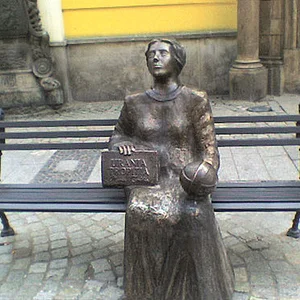

A Silesian astronomer of the 17th century, Maria Cunitz published Urania Propitia in 1650, a simplification of Kepler's tables written in both Latin and German. Considered the most remarkable female scholar of her time, she made Keplerian astronomy accessible to a wider audience.
Maria Cunitz(1607 — 1664)
Maria Cunitz
7 min read
Frequently asked questions
Key Facts
- Born around 1610 in Wohlau, Silesia (present-day Poland)
- Published Urania Propitia in 1650, simplifying Kepler's Rudolphine Tables
- Wrote her work in both Latin and German to reach a wider audience
- Mastered six languages including Latin, Greek, Polish, and Hebrew
- Died in 1664; nicknamed “the Silesian Pallas” by her contemporaries
Works & Achievements
Maria Cunitz's masterpiece and the only work published during her lifetime. It offers a simplification and correction of Kepler's Rudolphine Tables, written in Latin for scholars and in German for a wider audience: the first major bilingual astronomical treatise published by a woman in Europe.
Anecdotes
Maria Cunitz mastered at least six languages: Latin, German, Polish, Italian, French, and Hebrew. This exceptional polyglot was able to read the works of Europe's greatest scholars directly in the original, and chose to write her major work in two languages in order to reach both Latin-speaking scholars and a broader German-speaking readership.
During the Thirty Years' War, which ravaged Silesia, Maria Cunitz and her husband Élias von Löwen were forced to flee repeatedly before advancing armies. A fire destroyed part of their manuscripts and astronomical instruments, but she continued her work despite these losses, patiently reconstructing years' worth of calculations.
Her husband Élias von Löwen, a physician and amateur astronomer, was her most devoted supporter. In the preface to *Urania Propitia*, he publicly acknowledged that the calculations and ideas were entirely his wife's own, thereby refuting the insinuations of contemporaries who struggled to believe a woman could have produced such a scientific treatise on her own.
Kepler's Rudolphine Tables, published in 1627, were notorious for their daunting complexity: working astronomers rarely used them, so laborious were the required calculations. Maria Cunitz produced a simplified and corrected edition — noting several of Kepler's errors along the way — making Keplerian astronomy accessible to a far wider circle of educated readers.
Some contemporaries, unable to accept that a woman could master mathematical astronomy, insinuated that she had received supernatural assistance, or that it was in fact her husband who had written everything. These rumors were firmly refuted by Élias von Löwen himself in the preface to the work, where he attested that the science and the writing were entirely his wife's.
Primary Sources
Maria Cunitz sets out her approach: to simplify Kepler's tables, which she found overly laborious, by reducing the number of arithmetic operations needed to calculate planetary positions, so as to make the new astronomy accessible to those put off by the complexity of the Rudolphine Tables.
The work is dedicated to Holy Roman Emperor Ferdinand III, whose goodwill Maria Cunitz seeks for a work devoted to the glory of astronomy and the ease of its practitioners.
Elias von Löwen attests that the work is entirely his wife's own, that the calculations, tables, and explanations are hers alone — in hand and in mind — thereby refuting any notion that he might be its true author.
Several contemporary astronomers, including members of the nascent Académie des sciences, mentioned the publication of *Urania Propitia* in their correspondence and praised the clarity of the new tables, describing their author as the most remarkable learned woman of her century.
Key Places
Maria Cunitz's birthplace, in Silesia, then a province of the Holy Roman Empire. There she received an exceptional education from her father, a physician and man of science who introduced her to mathematics and astronomy.
The town where Maria Cunitz lived and worked for many years with her husband Elias von Löwen. It was here that she completed the bulk of the research that led to *Urania Propitia*.
The town where *Urania Propitia* was printed in 1650, under the patronage of the Duke of Silesia. Publication in this princely city lent official legitimacy to both the work and its author.
The imperial capital where Kepler worked as astronomer to Rudolf II, and where the *Rudolphine Tables* were born — the very tables Maria Cunitz set out to simplify and correct.
Typical Objects

A set of astronomical tables that Maria Cunitz spent years dissecting, correcting, and simplifying. They form the raw material of Urania Propitia.

A graduated brass measuring instrument used to determine the altitude of celestial bodies above the horizon. Maria Cunitz used it during her nightly observations to verify her theoretical calculations.

A sphere depicting the starry vault with constellations and the positions of fixed stars. An indispensable reference tool for teaching astronomy and locating planets in the sky.

The 1614 invention that transformed multiplications into additions, dramatically reducing calculation time. Maria Cunitz incorporated them into her method for simplifying the Keplerian tables.

Refined since Galileo's work in 1610, the telescope made it possible to observe planets and to compare observed positions with those calculated from the tables.

The everyday tools of a seventeenth-century scholar. Maria Cunitz wrote thousands of pages of calculations by hand and drew the geometric constructions required for elliptical orbits.

Astronomical observations and calculations often stretched well past midnight. A tallow or wax candle lit the calculation tables and manuscripts in her Silesian study.
School Curriculum
Vocabulary & Tags
Key Vocabulary
Daily Life
Morning
Maria Cunitz rose early, after nights often cut short by her observations. She would first attend to Lutheran devotions and household duties before retiring to her study to review the measurements taken the previous night and compare them against her theoretical calculations.
Afternoon
The afternoon was devoted to long calculation sessions: verifying the planetary positions predicted by Kepler's tables, correcting identified errors, and drafting new simplified tables. Elias sometimes joined in the discussions, contributing his perspective as a physician-mathematician.
Evening
After the family meal, Maria waited for a clear night to make her observations. In fine weather, she trained her quadrant or telescope on the planets, measured their altitudes, and meticulously recorded her readings in her notebooks for the following day's calculations.
Food
The diet of a Protestant bourgeois Silesian family centered on rye bread, grains, root vegetables, legumes, and pork and poultry. The years of the Thirty Years' War sometimes imposed severe hardships, with very meager meals during forced relocations.
Clothing
Maria Cunitz wore the modest dress of a Protestant lady of good family: a dark woolen gown with a laced bodice, immaculate white linen collar and cuffs, and a simple cap. For her nighttime observations outdoors in Silesia, she wrapped herself in a heavy wool cloak, as autumn and winter nights could be bitterly cold.
Housing
She lived in a bourgeois house in Pitschen with a study equipped with astronomical instruments and a library of scientific treatises. The house likely had a garden or an open terrace that allowed for nighttime observations unobstructed by neighboring rooftops.
Historical Timeline
Period Vocabulary
Visual Style
Portrait baroque silésien à la Vermeer : clair-obscur à la bougie, instruments astronomiques en laiton, ciel étoilé nocturne en fond, sobriété protestante dans le vêtement, intimité studieuse du cabinet d'étude.
Sound Ambience
Cabinet d'étude silésien du XVIIe siècle par une nuit froide : grattement de la plume sur le parchemin, cloches nocturnes, souffle du vent sur les vitres, crépitement des braises — le labeur solitaire d'une astronome à la bougie.
Liens externes & ressources
Références
Œuvres
Urania Propitia
1650