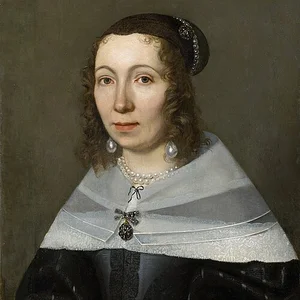

A German naturalist and artist of the 17th century, Maria Sibylla Merian was a pioneer in the study of insects and their metamorphosis. She led an expedition to Suriname (1699–1701) to observe and illustrate tropical flora and fauna, at a time when women rarely had access to the sciences.
Maria Sibylla Merian(1647 — 1717)
Anna Maria Sibylla Merian
Allemagne, Provinces-Unies
7 min read
Frequently asked questions
Key Facts
- Born in Frankfurt am Main in 1647, she published her first illustrated botanical plates as early as 1675.
- In 1679, she published 'Der Raupen wunderbare Verwandlung', the first illustrated study on the metamorphosis of caterpillars.
- In 1699, at the age of 52, she traveled to Suriname (South America) to study tropical insects — an extraordinary journey for a woman of her time.
- Her masterwork, 'Metamorphosis Insectorum Surinamensium' (1705), revolutionized entomology and natural history illustration.
- She died in Amsterdam in 1717; her plates would go on to influence Linnaeus and the naturalists of the 18th century.
Works & Achievements
Merian's first major work, dedicated to the caterpillars and butterflies of Central Europe, with illustrated plates showing each stage of metamorphosis. It revolutionized descriptive entomology.
A collection of botanical plates featuring meticulously drawn flowers, originally intended for embroiderers and artists. It showcases her dual talent as both scientist and artist.
A scientific and artistic masterpiece published in Amsterdam, presenting 60 color plates of insects, plants, and animals from Suriname. It remained a reference work in tropical entomology for over a century.
A posthumous publication bringing together additional plates on European insects, edited by her daughter Dorothea Maria after Merian's death.
A collection of original watercolor drawings depicting insects and plants from Suriname, remarkable for their exceptional precision and beauty, acquired by the British Crown in the 18th century.
Anecdotes
From the age of thirteen, Maria Sibylla Merian secretly kept caterpillars in her room to observe their transformation into butterflies. At a time when insects were often regarded as creatures of the devil, this kind of curiosity was considered improper for a young girl. She recorded her observations in illustrated notebooks with a remarkable precision for her age.
In 1699, at the age of 52, Merian embarked on an expedition to Dutch Guiana (Suriname) with her daughter Dorothea Maria — making her one of the first European women to travel for purely scientific purposes. She funded the journey herself by selling part of her collection of preserved specimens. For two years, she observed insects, plants, and reptiles in the tropical rainforest, braving disease and a hostile climate.
Merian was among the first scientists to disprove the theory of 'spontaneous generation' — the belief that insects arose from mud or rotting matter. By meticulously documenting every stage of the life cycle of butterflies and caterpillars, she provided irrefutable visual evidence of metamorphosis, long before the term was fully understood in biology.
On her return from Suriname, Merian brought back hundreds of drawings and preserved specimens. Her landmark work Metamorphosis Insectorum Surinamensium (1705) was immediately recognized across the European scholarly world. Peter the Great of Russia personally acquired several of her original works, and part of his collection is still held in Saint Petersburg today.
Primary Sources
I have observed insects since my youth […] I have represented all of this from nature with their natural colors, so that lovers of such things may come to know them.
I traveled to Surinam […] to observe insects in their natural state, their food sources, their successive metamorphoses, as well as the form of their chrysalises and cocoons.
These plates were drawn and engraved by my own hands, with the greatest care, in order to faithfully represent the nature of the flowers and plants that nourish caterpillars.
I found in Surinam creatures that no European had yet described or depicted; the forest is of a diversity that surpasses all imagination.
Key Places
Merian's birthplace and a major intellectual and commercial hub where her stepfather Jacob Marrel taught her flower painting and engraving. It was here that she began her first entomological observations.
The scientific and commercial capital of 17th-century Europe, where Merian settled in 1691. She frequented its curiosity cabinets and learned circles, and had her major work published there.
Capital of the colony where Merian stayed from 1699 to 1701. There she observed and illustrated a tropical biodiversity unknown to Europeans, sometimes working with the help of enslaved people and Indigenous Americans.
The village where Merian joined a Pietist community (the Labadists) in 1685. This stay allowed her to break free from her marriage and devote herself more fully to her natural history research.
The city where Merian lived with her husband from 1670 to 1682, and where she published her first entomological works, benefiting from the local network of botanists and naturalists.
Typical Objects

An essential tool for observing insects in the early modern period, Merian used it to examine the fine details of wings, antennae, and legs of the butterflies and caterpillars she studied.

She kept caterpillars, cocoons, and insects in compartmented boxes or jars to observe them at each stage of their development before illustrating them.

Merian recorded her observations daily in illustrated notebooks, noting the host plant, weather conditions, and the duration of each stage of metamorphosis.

Her illustrations were first drawn with a goose quill and then enhanced with natural pigments, in keeping with the tradition of botanical and entomological painting in the 17th century.

Coming from a family of engravers, Merian was skilled in copperplate intaglio, a technique that allowed her to reproduce her illustrations with great precision in her published works.

This handcrafted tool allowed her to capture living insects in the gardens and forests of Suriname, observing them before painting them, then releasing or preserving them.
School Curriculum
Vocabulary & Tags
Key Vocabulary
Tags
Daily Life
Morning
Merian rose at dawn to take advantage of natural light, essential for her painting work. She would begin by inspecting her rearing boxes of caterpillars and chrysalises, noting in her journals any changes that had occurred overnight. She ate a frugal meal — bread, cheese, and light beer — before settling at her worktable.
Afternoon
The afternoon was devoted to collecting in gardens or, in Suriname, in the tropical forest: Merian observed insects on their host plants and carefully gathered specimens. Back in the studio, she prepared her natural pigments and created her illustrations first in pen, then in watercolor, sometimes assisted by her daughter Dorothea Maria.
Evening
In the evening, she wrote her scientific notes and correspondence with European naturalists. She also prepared specimens to be preserved in alcohol or mounted on paper. In Amsterdam, she would sometimes receive curiosity dealers or botanists who came to examine her collections.
Food
Like most Dutch bourgeois of the 17th century, Merian ate rye bread, dried fish, vegetables, and dairy products. During her travels in Suriname, her diet was turned upside down: she had to adapt to local cuisine based on cassava, plantain, and tropical game, which caused her health problems.
Clothing
In Amsterdam, Merian wore the Protestant bourgeois dress: a dark wool gown with a starched white collar, and a linen work apron to protect her clothes while handling specimens and pigments. On expedition in Suriname, she had to adapt her clothing to the tropical climate, lightening her petticoats but keeping her bonnet and shawl for modesty and protection.
Housing
In Amsterdam, Merian occupied a narrow-fronted bourgeois house on a canal, with a well-lit studio on the first floor. She kept a small collection of natural curiosities there, along with a scientific library. In Suriname, she stayed in colonial dwellings in Paramaribo, far more modest, suffering from the heat and humidity.
Historical Timeline
Period Vocabulary
Visual Style
Style naturaliste du Siècle d'or néerlandais : illustrations scientifiques à l'aquarelle sur vélin, mêlant précision entomologique et beauté picturale dans une palette chaude aux verts tropicaux et aux orangés dorés.
Sound Ambience
Atmosphère sonore entre l'atelier de naturaliste d'Amsterdam et la forêt tropicale du Surinam : plumes qui grattent, bocaux de verre, bourdonnement d'insectes et canaux de la ville.
Liens externes & ressources
Références
Œuvres
Der Raupen wunderbare Verwandlung und sonderbare Blumennahrung (3 volumes)
1679–1683
Neues Blumenbuch
1680
Metamorphosis Insectorum Surinamensium
1705
Erucarum Ortus Alimentum et Paradoxa Metamorphosis
1718
Album de dessins originaux conservé à la Bibliothèque royale de Windsor
vers 1700–1715