
Mary of Magdala, known as Mary Magdalene, is a disciple of Jesus of Nazareth mentioned in the Gospels. She is presented as the first witness to Christ's resurrection, earning her the title of “apostle to the apostles” in Christian tradition.
Mary Magdalene
Mary of Magdala
6 min read
Frequently asked questions
Famous Quotes
« I have seen the Lord»
Key Facts
- A native of Magdala, a village in Galilee, she is among the disciples who follow Jesus (1st century AD)
- According to the Gospels, Jesus casts seven demons out of her (Luke 8:2)
- Present at the crucifixion of Jesus in Jerusalem (around AD 30-33)
- First witness to the empty tomb and the resurrection according to the Gospel of John (John 20)
- Venerated as a saint and called the “apostle to the apostles” by Christian tradition
Works & Achievements
First to announce the resurrection to the disciples, which earned her the title of “apostle to the apostles” in Christian tradition.
Faithful to the very end during the crucifixion, when most of the disciples had fled, as emphasized by all four Gospels.
According to Luke, she was among the women who supported Jesus and the Twelve “out of their own means” during the preaching in Galilee.
A Gnostic text placing Mary at its center, in which she passes on a secret teaching of the Savior; a testament to her prestige in certain communities.
The *Golden Legend* credits her with preaching Christianity in Marseille and converting the region.
Became the patron saint of penitents, perfumers, and gardeners; her feast day is set on 22 July.
Anecdotes
In the Gospel of John, Mary Magdalene goes to Jesus's tomb at dawn on the first day of the week and finds it empty. When the risen Christ appears to her, she at first mistakes him for the gardener, until he speaks her name: “Mary.”
The Gospels state that Jesus had cast “seven demons” out of her, an expression of the time used to describe a profound healing. It was this detail that long fed her reputation as a repentant sinner.
In the 6th century, Pope Gregory the Great, in a homily, conflated Mary Magdalene with the anonymous sinner in Luke and with Mary of Bethany. This famous merging was not officially corrected by the Catholic Church until 1969.
Because she was the first to announce the resurrection to the disciples, Christian tradition gave her the title of “apostle to the apostles” (apostola apostolorum), taken up in the Middle Ages by Thomas Aquinas.
A medieval Provençal tradition holds that Mary Magdalene landed at Saintes-Maries-de-la-Mer and then withdrew for thirty years into a cave in the Sainte-Baume; this account made the basilica of Vézelay, and later Saint-Maximin, great places of pilgrimage.
Primary Sources
Jesus said to her, “Mary!” She turned and said to him in Hebrew, “Rabbouni!” which means Teacher. Jesus said to her, “Do not hold on to me... but go to my brothers.”
...as well as some women who had been cured of evil spirits and diseases: Mary, called Magdalene, from whom seven demons had gone out.
Risen on the morning of the first day of the week, Jesus appeared first to Mary Magdalene, from whom he had cast out seven demons.
Peter said to Mary, “Sister, we know that the Savior loved you more than the other women. Tell us the words of the Savior that you remember.”
Mary Magdalene, after the Lord's Ascension, sailed to the region of Marseille, where she preached Christ.
Key Places
A fishing town on the western shore of the Sea of Galilee, from which Mary takes her name. Renowned for its salting of fish.
The site of Jesus's crucifixion, where the Gospels place Mary Magdalene among the women present at the foot of the cross.
The tomb where Mary discovers the stone rolled away and witnesses the appearance of the risen Christ, the founding scene of the Easter narrative.
According to Provençal legend, the landing place of Mary Magdalene and her companions driven out of Judea.
The cave where tradition places the saint's final thirty years, withdrawn in prayer and penance.
A major site of medieval pilgrimage dedicated to Mary Magdalene, and the starting point of one of the routes to Santiago de Compostela.
Typical Objects

Flask of scented ointment, the constant iconographic attribute of Mary Magdalene, linked to the anointing of Jesus. It is the object by which she is recognized in Christian art.

Strips of linen that Mary discovers in the empty tomb according to the Gospel of John. They become the material sign of the resurrection.

According to an Eastern tradition, Mary Magdalene is said to have offered an egg to Emperor Tiberius while announcing the resurrection, and the egg is said to have turned red. It is at the origin of Easter eggs.

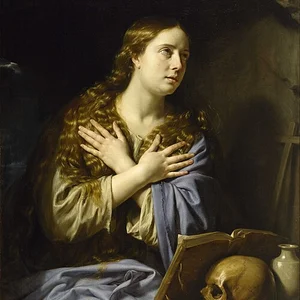
In the medieval and Baroque iconography of the Magdalene withdrawn at Sainte-Baume, the skull and the crucifix evoke meditation and penance.

Her long hair, with which tradition shows her wiping the feet of Jesus, becomes a symbolic attribute of love and repentance.
School Curriculum
Vocabulary & Tags
Key Vocabulary
Tags
Daily Life
Morning
A Galilean woman of the first century, her day begins early with prayer and household tasks. A native of Magdala, a fishing town, she lives to the rhythm of the lake, the fish market, and the comings and goings along the shores of Tiberias.
Afternoon
Having become a disciple, she follows Jesus and the group along the dusty roads of Galilee, from village to village. Together with other women, she provides for the group's material needs: food, supplies, and hospitality.
Evening
The evening is spent in shared meals and listening to the teachings. In the later accounts of the Sainte-Baume, tradition portrays her withdrawn into contemplation and nighttime prayer.
Food
The Jewish diet of Galilee: barley or wheat bread, dried fish from the lake, olives, figs, lentils, and wine diluted with water. Observance of the Jewish dietary laws (kashrut) shapes the meals.
Clothing
A linen or woolen tunic reaching to the ankles, a belt, and a veil covering the hair as was customary among the women of Judea. Later iconography often adorns her with a red cloak and long, loosened hair.
Housing
A modest house of stone and cob with a flat roof, typical of the villages of Galilee, arranged around a courtyard. In the Provençal legend, her dwelling becomes a cave at the Sainte-Baume.
Historical Timeline
Period Vocabulary
Liens externes & ressources
Références
Œuvres
Témoignage de la résurrection
vers 30-33 ap. J.-C.
Présence au pied de la croix
vers 30-33 ap. J.-C.
Soutien matériel du groupe de Jésus
vers 28-30 ap. J.-C.
Évangile de Marie (attribué)
IIe siècle ap. J.-C.
Évangélisation légendaire de la Provence
Ier siècle (tradition médiévale)
Patronage et culte
depuis le Moyen Âge