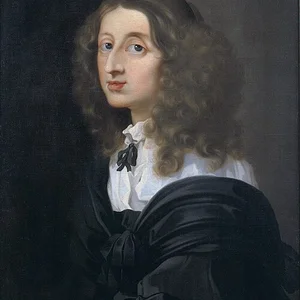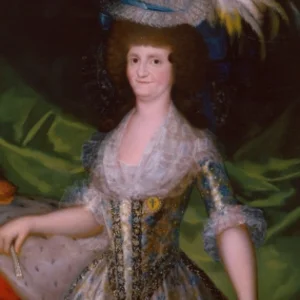

Princess of Parma who became Queen of Spain through her marriage to Charles IV. A woman of strong character, she wielded considerable political influence and promoted the rise of her favorite, Manuel Godoy, within the government.
Maria Luisa of Parma
Maria Luisa of Bourbon-Parma
5 min read
Frequently asked questions
Key Facts
- Born in 1751 in Parma, daughter of the Infante Philip of Bourbon-Parma
- Married the future Charles IV of Spain in 1765
- Became Queen of Spain in 1788 upon the accession of Charles IV
- Promoted the rise of Manuel Godoy as the strongman of the Spanish government
- Depicted at the center of Goya's portrait 'The Family of Charles IV' (1800), abdicated and went into exile after 1808, died in Rome in 1819
Works & Achievements
A union that sealed the alliance between the Bourbons of Parma and Spain and made her the future queen.
Decisive support for the rise of her favourite, who dominated Spanish politics for more than fifteen years.
Through her backing of Godoy, she shaped Spain's alliances, notably the rapprochement with revolutionary and then Napoleonic France.
She was a favoured model of the court painter, whose works rank among the masterpieces of Spanish art.
As queen, she took part in supporting artists and in the cultural prestige of the Spanish monarchy.
Anecdotes
Married at thirteen to her cousin, the future Charles IV, Marie-Louise went through eighteen pregnancies, only a few of whose children reached adulthood. The court watched this succession of childbirths with concern, in an age when death in childbed was common.
Her favorite Manuel Godoy, a young officer of the guard, rose in just a few years to the post of Prime Minister and received the title of “Prince of the Peace” after the Treaty of Basel in 1795. Many at court whispered that the queen was behind this dazzling rise.
The painter Francisco de Goya produced several portraits of the royal family, including the famous painting *The Family of Charles IV* (1800). Far from flattering his subjects, Goya painted them without indulgence, and Marie-Louise's face appears there worn and stern.
In 1808, during the events at Bayonne, Napoleon Bonaparte summoned the Spanish royal family and obtained the abdication of Charles IV in favor of his own brother Joseph. Marie-Louise and her husband ended their days in exile, first in France and then in Italy.
Marie-Louise died in Rome in January 1819, barely a few weeks before her husband Charles IV. Both were finally buried in the royal necropolis of El Escorial, near Madrid.
Primary Sources
The queen exchanged an abundant correspondence with her minister, in which she commented on the affairs of the kingdom and expressed her complete trust in her “friend.”
In them, Godoy defends his political actions and the role of the sovereigns, providing a first-hand account of the court of Charles IV and Marie Louise.
This group portrait, painted in 1800, places Marie Louise at the center of the composition, attesting to her rank and influence within the royal family.
Key Places
City in northern Italy where Marie-Louise was born in 1751, capital of the duchy governed by her father.
Main residence of the Spanish court where Marie-Louise wielded her influence as queen. Centre of royal power under Charles IV.
Royal residence south of Madrid, scene in 1808 of the riot that forced Charles IV to abdicate.
City in south-western France where, in 1808, Napoleon secured the abdication of the Spanish sovereigns.
City where Marie-Louise lived in exile and died in January 1819.
Royal necropolis near Madrid where Marie-Louise and Charles IV finally rest.
Typical Objects

Head ornament set with diamonds, worn by the queen during official ceremonies. A dazzling symbol of her rank and dignity as sovereign of Spain.

A refined accessory of mother-of-pearl and painted silk, essential to the ladies of the Spanish nobility. It served both to cool oneself and to communicate discreetly through a coded language.

A ceremonial outfit, richly embroidered and adorned with lace, in keeping with the fashion of the late 18th century. Goya immortalized it in his portraits of the queen.

An engraved matrix used to authenticate the official acts of royal power. Its imprint in wax validated decrees and state correspondence.

A painting by a court artist such as Goya, intended to spread the queen's image throughout palaces and institutions. A tool of prestige and dynastic propaganda.

A ceremonial horse-drawn coach, gilded and adorned with the royal coat of arms, used for official journeys between residences. A visible assertion of royal majesty.
School Curriculum
Vocabulary & Tags
Key Vocabulary
Daily Life
Morning
The queen began her day with an elaborate toilette assisted by her ladies-in-waiting, followed by Mass in the palace chapel. The early hours were governed by the strict etiquette of the Bourbon court.
Afternoon
Afternoons combined audiences, the reception of courtiers, and private meetings, notably with her minister Godoy. She also looked after the large royal brood and the affairs of the household.
Evening
Evenings were devoted to court entertainments: concerts, card games, conversations, and sometimes theatrical performances. These gatherings were moments of political intrigue as much as of pleasure.
Food
The royal table offered refined dishes inspired by Spanish, French, and Italian cuisine, accompanied by fine wines. Chocolate, highly prized at the Spanish court, was consumed daily.
Clothing
Marie Louise wore embroidered ceremonial gowns, precious lace, and sumptuous jewels, in keeping with the fashion of the late 18th century. Her wardrobe asserted her rank as sovereign.
Housing
She lived in the royal palaces of Madrid, Aranjuez, and the Escorial, vast residences adorned with paintings, tapestries, and gardens. Each dwelling housed a large and hierarchical court.
Historical Timeline
Period Vocabulary
Liens externes & ressources
Références
Œuvres
Mariage dynastique avec Charles IV
1765
Promotion de Manuel Godoy au gouvernement
1792
Influence sur la politique étrangère espagnole
1795-1808
Portraits par Francisco de Goya
vers 1789-1800
Mécénat de cour
fin XVIIIe siècle