
Venetian painter of the late Renaissance (1554–1590), daughter and pupil of Tintoretto. Known as "la Tintoretta," she was celebrated for her portraits of remarkable psychological depth. Highly sought after at court, she turned down invitations from Philip II of Spain and Emperor Maximilian II in order to remain in Venice.
Marietta Robusti(1554 — 1590)
Marietta Robusti
république de Venise
7 min read
Frequently asked questions
Key Facts
- Born in 1554 in Venice, daughter of Jacopo Robusti, known as Tintoretto
- Nicknamed "la Tintoretta" in reference to her father
- Trained in her father's workshop, she likely contributed to several collaborative works
- Courted by Philip II of Spain and Emperor Maximilian II, she refused to leave Venice
- Died in 1590 at just 36 years old, following the birth of her first child
Works & Achievements
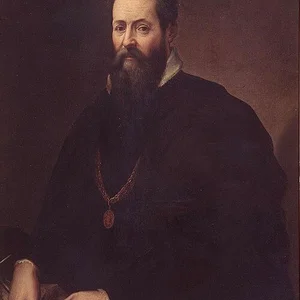
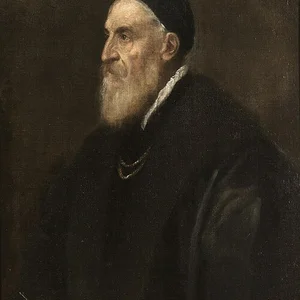
Sometimes attributed to Marietta, this painting reflects the psychological depth characteristic of her portraits: the old man's gaze carries a striking melancholy, and the rendering of textures is exceptional.
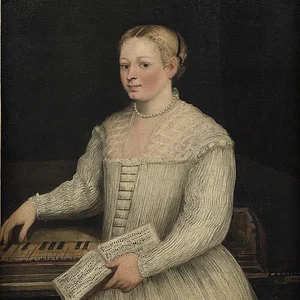
Several portraits of noble Venetian women are attributed to her with varying degrees of certainty. They stand out for their particular attention to jewelry, fabrics, and the inner expression of the sitter.
A self-portrait held at the Uffizi in Florence is sometimes attributed to her. If authenticated, it would be a rare testament to a woman painter asserting herself through her gaze as both subject and artist.
Marietta was particularly sought after for portraits of the Venetian aristocracy. This type of commission, ordered by prominent families, earned her a reputation as a court portraitist.
Anecdotes
Marietta Robusti grew up in her father's workshop — the famous Tintoretto — disguised as a boy so she could accompany him everywhere without raising suspicion. This clever ruse allowed her to train as a painter from a very young age, in an artistic world that was then almost exclusively male.
Her fame reached the royal courts of Europe: Philip II of Spain and Emperor Maximilian II each offered her a place at their court, with honors and riches. Marietta refused both invitations, preferring to remain in Venice by her father's side — he could not bear the thought of seeing her leave.
Her father Jacopo Tintoretto, well aware of his daughter's exceptional talent, long refused to arrange her marriage for fear of losing her. It was not until around 1580 that he agreed to find her a husband — on the express condition that the chosen man, Mario Augusta, a goldsmith, would come to live with them in Venice.
At her untimely death in 1590, Marietta was only 36 years old. Her father was devastated by the loss. The biographer Carlo Ridolfi recounts that Tintoretto never fully recovered from the disappearance of the woman he considered his most brilliant pupil and his beloved daughter.
Marietta was also a celebrated musician: she sang and played the lute with great skill, which added to her legend at the Venetian court. Her contemporaries described her as a woman of rare culture and grace, as accomplished with a paintbrush as with the strings of an instrument.
Primary Sources
Marietta, daughter of Tintoretto, was gifted with singular talent in painting, and especially in portraiture, in which she surpassed many skilled artists. She was sought by the Emperor and the King of Spain, but refused to leave her father.
La Tintoretta, so called for being the daughter of the great Tintoretto, left works of great skill, especially in capturing likenesses with true resemblance and vivid spirit.
His Majesty the King of Spain expressed the wish to have at his court the daughter of Tintoretto, highly renowned for her portraits, but the father did not consent to let her go.
In the most illustrious Venetian workshops, painters' daughters learn the secrets of the craft from childhood, and some achieve a mastery that few men can equal.
Key Places
It was in this district of Cannaregio that Marietta grew up and trained as a painter. Her father's workshop served at once as school, home, and artistic production center for the entire family.
An iconic site of Tintoretto's work, where Marietta likely collaborated on the large painted cycles. These halls still house the greatest concentration of Tintorettian works in existence.
Following the fire of 1577, Tintoretto's workshop received major commissions to redecorate the official chambers. Marietta likely took part in these large-scale collective works.
The parish church of the Sant'Angelo district, where Marietta Robusti was buried upon her death in 1590. The church also preserves works by Tintoretto commissioned for this neighborhood.
The commercial heart of Venice, home to goldsmiths, merchants, and craftsmen. Mario Augusta, Marietta's husband, practiced his trade as a goldsmith here, placing the family among the artisan elite of the Serenissima.
Typical Objects

Marietta inherited the practices of Tintoretto's workshop, which used exceptionally rich pigments: lapis lazuli, vermilion, and Venetian ochre. The palette was the central tool of her daily life as an artist.

Marietta was as celebrated for her musical talents as for her painting. The lute, a noble and fashionable instrument in Venetian courts, accompanied the elite gatherings to which she was invited.

Murano mirrors, masterpieces of Venetian glassmaking, were indispensable to portrait painters for observing the play of light and controlling the effects of reflection on painted faces.

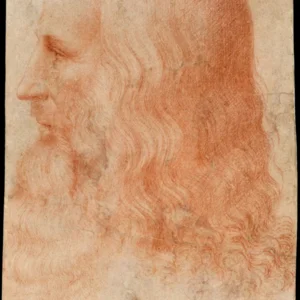
As in any Renaissance workshop, pencil or pen studies preceded painted works. Marietta used hers to record sketches of faces, drapery, and compositions before moving to canvas.

Venetian lace, produced notably on the island of Burano, was a symbol of refinement. Portraits attributed to Marietta show a particular attention to textiles, which she rendered with remarkable precision.

Tintoretto's workshop was renowned for its large nocturnal compositions with dramatic lighting. Marietta, trained in this tradition, used artificial light sources to study the effects of shadow and chiaroscuro.
School Curriculum
Vocabulary & Tags
Key Vocabulary
Daily Life
Morning
Marietta rose early to make the most of the morning's natural light — the most prized resource for a portrait painter. She prepared her pigments with Mario or an assistant, grinding colors in linseed oil, before receiving her sitters — Venetian noblewomen, senators, or merchants — in the brightest part of the family workshop.
Afternoon
Afternoons were devoted to long sitting sessions, sometimes accompanied by music: Marietta would play the lute between layers of paint to relax her subjects and draw out more natural expressions. She also collaborated on the large collective commissions of her father's workshop.
Evening
In the evening, by candlelight, Marietta reworked fine details — lace, jewelry, the glint in a subject's eyes — that made her portraits so sought after. Meals brought the Robusti family together in a lively household frequented by the artists and scholars of the neighborhood.
Food
Venetian cuisine of the period blended lagoon fish (sardines, squid cooked in their own ink), vegetables from the terra ferma, polenta — then still a rare novelty — and spices from the East imported through the Serenissima's great trading networks. Wine from the Colli Euganei accompanied the family's meals.
Clothing
Marietta wore wide-sleeved dresses practical for painting, often in dyed wool cloth, with a work apron to protect her clothes from pigments. For receiving guests or attending social occasions, she dressed in the fashion of Venice's elite: velvet, Burano lace collars, and ornate headdresses, as seen in her own portraits.
Housing
The family lived in a spacious house in the Cannaregio district, whose upper floors overlooked a canal. Tintoretto's workshop occupied the ground floor and mezzanine, crowded with canvases of all sizes, ladders, articulated mannequins, and plaster casts. After her marriage, Marietta continued to work there every day.
Historical Timeline
Period Vocabulary
Visual Style
Palette vénitienne tardive aux ombres profondes et lumières ambrées, drapés somptueux, finesse psychologique des visages dans la tradition manièriste du Tintoret.
Sound Ambience
L'atelier vénitien de la Tintoretta : eau des canaux, cloches d'église, sons de luth et murmure des pigments mélangés à l'huile dans la lumière dorée du Cannaregio.
Liens externes & ressources
Références
Œuvres
Portrait d'une dame vénitienne
vers 1580
Autoportrait présumé
vers 1580
Portrait d'un sénateur vénitien
vers 1583