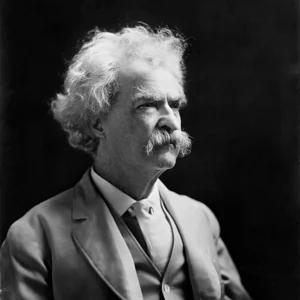

American writer, journalist, and humorist, considered one of the fathers of modern American literature. His novels, rooted in the Mississippi River valley, blend social satire, criticism of racism, and vernacular speech.
Mark Twain(1835 — 1910)
Mark Twain
États-Unis
6 min read
Frequently asked questions
Key Facts
- Born on November 30, 1835, in Florida (Missouri), he grew up in Hannibal on the banks of the Mississippi
- A steamboat pilot on the Mississippi before becoming a journalist — his pen name “Mark Twain” comes from river jargon (a depth of two fathoms)
- Published *The Adventures of Tom Sawyer* in 1876
- Published *Adventures of Huckleberry Finn* in 1884–1885, a major work denouncing racism
- Died on April 21, 1910, in Redding (Connecticut)
Works & Achievements
Humorous short story that made Twain famous across the country and established his reputation as a storyteller.
Satirical account of a journey through Europe and the Holy Land, one of his greatest bestsellers during his lifetime.
A novel of childhood and adventure along the Mississippi, now a classic of children's literature.
A tale in which a prince and a beggar swap lives, a critique of social inequality.
Autobiographical account of his work as a riverboat pilot and of the river he knew by heart.
A masterpiece recounting the flight of a boy and the enslaved Jim; a biting satire of racism, written in vernacular speech.
A science-fiction and satirical novel in which a modern American is thrown back into medieval England.
Anecdotes
Samuel Clemens chose his pen name "Mark Twain" in memory of the Mississippi: it was the call of the leadsmen on the steamboats. When the sounding lead touched two fathoms of water (about 3.6 meters), a depth just deep enough to navigate safely, the leadsman would call out "mark twain!".
Twain was born in 1835
two weeks after the passing of Halley
s Comet
which returns roughly every 75 years. In 1909 he declared:
I came in with Halley's Comet; I will go out with it." He died on April 21, 1910, the day after the comet passed closest to the Sun.
Before becoming a writer, Twain fulfilled his childhood dream by becoming a steamboat pilot on the Mississippi in 1859. He had to memorize by heart every bend, sandbar, and reef of the river over hundreds of kilometers, by day and by night.
Twain invested a fortune (about 300,000 dollars at the time) in a typesetting machine, the Paige, which turned out to be a fiasco. Ruined, he set off on a world tour giving lectures to repay all his creditors, which he did honorably.
His novel "Adventures of Huckleberry Finn
(1884) is written in the spoken language of the people of the Mississippi
with the accents and mistakes of its characters. It was a literary revolution: Ernest Hemingway later claimed that all modern American literature descended from it.
Primary Sources
I came in with Halley's Comet in 1835. It is coming again next year, and I expect to go out with it.
When I was a boy, there was but one permanent ambition among my comrades in our village on the west bank of the Mississippi River: to be a steamboatman.
Persons attempting to find a motive in this narrative will be prosecuted; persons attempting to find a moral in it will be banished; persons attempting to find a plot in it will be shot.
Most of the adventures recorded in this book really occurred; one or two were experiences of my own, the rest those of boys who were schoolmates of mine.
Key Places
Small village where Samuel Clemens is born in 1835. His family moves to Hannibal shortly afterward.
Town on the banks of the Mississippi where Twain spends his childhood. It inspires the setting of Tom Sawyer and Huckleberry Finn.
Great river where Twain works as a steamboat pilot and which becomes the heart of his work.
Western mining town where Twain works as a journalist and adopts the pen name Mark Twain in 1863.
Grand residence where Twain lives with his family from 1874 to 1891 and writes his greatest novels. Today it is a museum.
Twain's last home, where he dies on April 21, 1910.
Typical Objects

Large paddle-wheel vessel powered by a steam engine, which carried passengers and goods along the river. Twain worked aboard one as a pilot, a profession he considered the freest in the world.

A lead weight attached to a marked rope that was thrown into the water to measure the river's depth. The call “mark twain” signaled two fathoms, meaning water just deep enough to pass through safely.

In his later years, Twain took to wearing a white serge suit in every season, which became his trademark and the symbol of his public persona.

A heavy smoker, Twain went through dozens of cigars a day and joked endlessly about tobacco. “Giving up smoking is easy, I've done it thousands of times,” he used to say.

Twain was one of the first authors to use a typewriter and to submit a typed manuscript to a publisher. The machine was transforming the work of writing at the time.

A machine designed to automate typesetting in printing. Too complex and fragile, it ruined Twain, who had poured his fortune into it.

The writing instruments of the author and journalist before the typewriter. Twain wrote his first stories and articles with a pen.
School Curriculum
Vocabulary & Tags
Key Vocabulary
Tags
Daily Life
Morning
Twain woke up late and ate a hearty breakfast. He then devoted the morning to writing, often working in his study or, in summer, in a small octagonal hut set apart from the house so he would not be disturbed.
Afternoon
He wrote in one continuous stretch until mid-afternoon, often skipping lunch so as not to break his momentum. He could write thousands of words a day when inspiration struck.
Evening
In the evening, with his family, Twain read aloud the pages he had written during the day to his wife Olivia and his daughters, who acted as his first critics. He also entertained many friends and dazzled them with his wit.
Food
Twain enjoyed traditional American cooking: steaks, corn, oysters, pies, and coffee in abundance. Returning from a long stay in Europe, he wrote a long, nostalgic list of the American dishes he had missed.
Clothing
Dressed as a Victorian gentleman for most of his life, in his later years he adopted an immaculate white suit worn in every season, which became his trademark, crowned by a bushy white head of hair and mustache.
Housing
At the height of his fame, Twain lived in a large, eccentric brick house in Hartford, Connecticut, boasting nineteen rooms and inspired by steamboats. His fortunes fluctuated wildly with his successes and his bankruptcies.
Historical Timeline
Period Vocabulary
Liens externes & ressources
Références
Œuvres
La Célèbre Grenouille sauteuse du comté de Calaveras
1865
Le Voyage des innocents (The Innocents Abroad)
1869
Les Aventures de Tom Sawyer
1876
Le Prince et le Pauvre
1881
La Vie sur le Mississippi
1883
Les Aventures de Huckleberry Finn
1884
Un Yankee du Connecticut à la cour du roi Arthur
1889