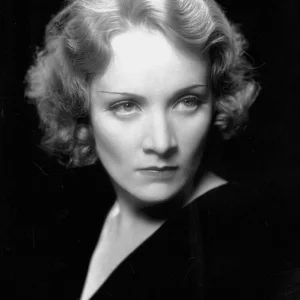

A German-American actress and singer, Marlene Dietrich established herself as an icon of Hollywood cinema in the 1930s. Refusing to collaborate with the Nazi regime, she committed herself to the Allied cause during the Second World War.
Marlene Dietrich(1901 — 1992)
Marlene Dietrich
États-Unis, Troisième Reich, république de Weimar, Empire allemand, Reich allemand
8 min read
Frequently asked questions
Famous Quotes
« I am not a legend, I am a woman.»
« America took me in when Germany abandoned me.»
Key Facts
- 1901: born in Berlin (German Empire)
- 1930: worldwide breakthrough with The Blue Angel, directed by Josef von Sternberg
- 1939: naturalized as an American citizen, refusing to return to Nazi Germany
- 1944–1945: tours Allied camps to entertain American troops on the European front
- 1992: dies in Paris; buried in Berlin following a controversial funeral
Works & Achievements
The first major German sound film, directed by Josef von Sternberg, in which Dietrich plays cabaret singer Lola Lola. The role revealed her talent and unique stage presence to the world, opening the doors of Hollywood to her.
A Hollywood film by Von Sternberg in which Dietrich plays Shanghai Lily, a mysterious adventuress. The film represents the pinnacle of the glamorous aesthetic and interplay of light and shadow that defined their collaboration.
The final film of the Von Sternberg–Dietrich collaboration, considered by the director to be his visual masterpiece. It marks the end of a uniquely creative period in cinema history.
Dietrich traveled through North Africa, Italy, France, and Germany to perform for more than 500,000 Allied soldiers, often just a few miles from the front lines. This commitment earned her the U.S. Medal of Freedom.
An English-language version of the famous German song, recorded for Allied soldiers, which became one of the defining musical symbols of World War II. Dietrich reclaimed this song — born on the opposing side — and turned it into an anthem for peace.
A documentary film directed by Maximilian Schell in which Dietrich, refusing to be filmed, speaks only in voice-over. An exceptional record of her life and memories, made while she was already living in seclusion.
Anecdotes
Marlene Dietrich was one of the first actresses to wear trousers in public in the 1930s, scandalizing Parisian high society. The city of Paris even temporarily banned her from certain venues for 'cross-dressing.' She persisted regardless, turning this wardrobe choice into an act of female liberation.
When Adolf Hitler offered her the chance to return to Germany and become the star of Third Reich cinema, Dietrich flatly refused. She obtained American citizenship in 1939 and devoted a large portion of her personal fortune to supporting Jewish refugees fleeing Nazism.
During World War II, Marlene Dietrich traveled over 300,000 miles to perform for Allied troops, often just a few miles from the front lines. She performed in North Africa, Italy, and even occupied Germany, despite very real risks to her life. General Patton personally awarded her the Medal of Freedom in 1947.
On the set of The Blue Angel (1930), director Josef von Sternberg fell desperately in love with her. Their collaboration produced seven films and a unique visual aesthetic — shadow play, sophisticated studio lighting — that redefined glamour in cinema. Dietrich personally controlled the lighting setups used to film her, insisting that light always come from above.
In her later years, Dietrich lived as a recluse in her Paris apartment on the Avenue Montaigne for nearly twelve years, refusing to be photographed or filmed. She still gave telephone interviews, but no longer wanted the world to see her aged face. She died in 1992 at the age of 90 and was buried in Berlin — the city she had fled fifty years earlier.
Primary Sources
I never wanted to be a legend. I simply wanted to live my life on my own terms, without submitting to those who wanted to dictate to me who I should be.
I came to sing for your soldiers because it was the only thing I could do against Hitler. My voice was my weapon.
I swear allegiance to the United States of America and renounce all fidelity to any other foreign state or sovereign.
Glamour is what I sell, it's my stock in trade. But I have never confused it with life itself.
Key Places
Marlene Dietrich's birth neighborhood, now marked with a golden star bearing her name on the sidewalk of Leberstrasse. It was in the vibrant Weimar-era Berlin that she cut her teeth as a cabaret singer.
It was in these legendary studios that The Blue Angel was filmed in 1929-1930, the movie that launched Dietrich's international career. The UFA studios were at that time the European equivalent of Hollywood.
Dietrich settled in Hollywood in 1930 under contract with Paramount, making seven iconic films with Josef von Sternberg. She lived there throughout the war years and built her American legend.
The famous Parisian concert hall where Marlene Dietrich triumphed on multiple occasions during the 1950s and 1960s. Bruno Coquatrix gave her a rapturous reception that cemented her status as a global music-hall star.
It was in her apartment on the Avenue Montaigne that Dietrich spent the last twelve years of her life, a recluse who refused to appear in public. She died there on May 6, 1992.
The burial place of Marlene Dietrich, in accordance with her wish to be laid to rest near her mother's grave in Berlin. Her posthumous return symbolizes a reconciliation with the city she had left to flee Nazism.
Typical Objects

Dietrich popularized the wearing of men's tuxedos by women from the 1930s onward, blurring gender codes with provocative elegance. This garment became her most iconic style signature and a symbol of her independence.

On stage, Dietrich handled the microphone with calculated sensuality, turning it into a full theatrical prop. Her concerts in the 1950s and 1960s were built around this minimalist yet magnetic stage presence.

Marlene Dietrich was obsessed with lighting and understood photographic techniques as well as any cinematographer. She demanded a single overhead spot to sculpt her cheekbones and eliminate unwanted shadows.

In The Blue Angel and her Hollywood films, Dietrich's legs clad in fishnet stockings became an erotic symbol recognized around the world. She was one of the first stars to use her body as a tool of cultural subversion.

During World War II, Dietrich wore the khaki uniform of USO tour performers to entertain troops near the front lines. This outfit symbolizes her concrete commitment to the Allied soldiers' cause.

Her concert gowns in Paris and Las Vegas, often designed by Jean Louis, were so form-fitting they appeared painted on. They helped forge the myth of a sculptural woman who transcended time.
School Curriculum
Vocabulary & Tags
Key Vocabulary
Tags
Daily Life
Morning
During her Hollywood years, Dietrich rose early to prepare her own costumes and review lighting setups with the cinematographers. She devoted two to three hours to her beauty routine, which she regarded as a craft as much as an art. A perfectionist, she oversaw every detail before stepping onto the set.
Afternoon
Filming afternoons could stretch ten to twelve hours in Paramount's air-conditioned studios. She cooked for her crews herself, bringing traditional German dishes to the set — earning her a reputation for camaraderie rare among major stars. During her war tours, afternoons were spent traveling by jeep between military bases.
Evening
Dietrich's evenings in Hollywood were often lively: she hosted intellectuals and artists exiled from Europe — Erich Maria Remarque, Ernest Hemingway, and Jean Gabin were among her lovers or close friends. In Paris during her final years, evenings meant phone conversations, reading, and music, alone in her apartment.
Food
Dietrich was known for her culinary talents and willingly prepared traditional German recipes: sauerkraut, sauerbraten, Königsberger Klopse. She enjoyed champagne and whisky, but ate with relative moderation to maintain her figure. During the war, she shared soldiers' military rations without complaint.
Clothing
Off stage, Dietrich favored wide-leg trousers and men's blazers at a time when this deeply shocked polite society. On stage or at formal events, she alternated between sequined sheath gowns designed by Jean Louis and precisely tailored men's suits. She chose her clothes the way she chose her lighting: to sculpt her image.
Housing
In Hollywood during the 1930s and 1940s, Dietrich rented large villas in the upscale residential neighborhoods of Bel Air and Beverly Hills, where she entertained frequently. After the war, she divided her time between New York, Paris, and world tours, living in luxury hotels. From the 1980s onward, she lived alone in her apartment in the 8th arrondissement of Paris, surrounded by photographs and mementos.
Historical Timeline
Period Vocabulary
Visual Style
L'esthétique Dietrich fusionne le noir et blanc expressionniste du studio hollywoodien des années 1930 et le glamour élégant et androgyne des grandes scènes européennes des années 1960.
Sound Ambience
L'univers sonore de Dietrich mêle le cabaret berlinois de Weimar, les scènes de guerre des tournées USO et les grandes salles de concert parisiennes des années 1950-1960.