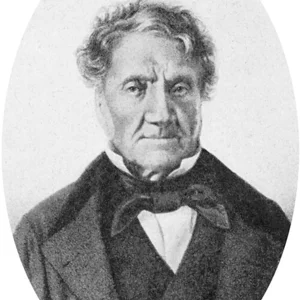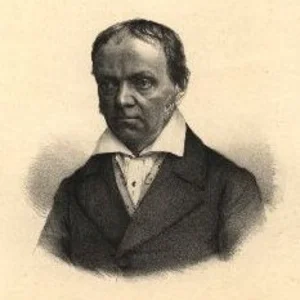

German mathematician (1792–1872), brother of Georg Simon Ohm. He contributed to the formal rigor of mathematical analysis and to mathematics education in 19th-century Germany.
Martin Ohm(1792 — 1872)
Martin Ohm
royaume de Bavière
7 min read
Frequently asked questions
Key Facts
- Born on May 6, 1792, in Erlangen, Bavaria
- Younger brother of physicist Georg Simon Ohm, discoverer of Ohm's law
- Professor of mathematics in Berlin for several decades
- Author of a multi-volume work on the rigorous teaching of elementary mathematics
- Died on April 1, 1872, in Berlin
Works & Achievements
Martin Ohm's magnum opus, published in several volumes over thirty years. This ambitious treatise aimed to rebuild the whole of mathematics on rigorous logical foundations, anticipating the demands for formalism that would prevail in the twentieth century.
A textbook on elementary mathematics in which Ohm introduced in print for the first time the term *goldener Schnitt* (golden ratio or golden section), a phrase that would establish itself across all mathematical languages.
A pedagogical textbook on arithmetic and algebra aimed at students in German Gymnasien and universities, notable for its definitional clarity and rigorous logical progression.
A work devoted to the spirit and foundations of differential and integral calculus, in which Ohm sought to provide solid conceptual underpinnings for mathematical analysis — a field still being consolidated in his day.
Anecdotes
Martin Ohm is the younger brother of Georg Simon Ohm, the physicist who discovered the famous electrical law that bears their family name. The two brothers grew up in Erlangen in a modest family and shared a common passion for the exact sciences, though their paths diverged: one toward experimental physics, the other toward pure mathematics and teaching.
Martin Ohm is credited with the first printed use of the expression 'goldener Schnitt' — rendered in English as the 'golden section' or 'golden ratio' — in the second edition of his textbook 'Die reine Elementar-Mathematik' in 1835. The term refers to the mathematical ratio φ ≈ 1.618, which has fascinated artists and architects since Antiquity. Martin Ohm did not invent the concept, but he gave it the name that would take hold in every language.
Despite a substantial body of mathematical work, Martin Ohm waited years before obtaining a full professorship at the University of Berlin. This slow academic recognition was partly rooted in the resistance his ambitious programme provoked: building an entirely rigorous and coherent mathematical system in which every definition and every proof would be stated without the slightest ambiguity. This demand, dismissed as excessive by some of his contemporaries, is today regarded as visionary.
Martin Ohm devoted much of his life to writing a monumental treatise titled 'Versuch eines vollkommen consequenten Systems der Mathematik' ('Essay on an Entirely Coherent System of Mathematics'), published in several volumes from 1822 onward. His goal was to rebuild the teaching of mathematics on logically unimpeachable foundations, at a time when rigorous proofs were not yet the norm in German universities.
Primary Sources
The purpose of this work is to establish a perfectly consistent system of mathematics, in which every concept is defined with the utmost rigor, and every theorem is proved with the utmost completeness.
This division of a finite line into two parts, such that the whole line is to the larger part as the larger part is to the smaller, well deserves the name: the golden section.
Arithmetic is the science of numbers. It teaches how to find other numbers from given numbers according to specific rules.
Key Places
Birthplace of Martin Ohm and his brother Georg Simon. Erlangen was home to a university founded in 1743 where the Ohm brothers received their early scientific education in a stimulating intellectual environment.
Martin Ohm's primary place of work for most of his career. He taught mathematics there for decades, first as an associate professor and then as a full professor, training generations of Prussian students.
Capital of Prussia, where Martin Ohm lived, worked, and died in 1872. In the nineteenth century, Berlin was the intellectual hub of Germany, home to the great universities and scientific academies that drew the finest mathematicians in Europe.
The secondary school where Martin Ohm received his classical education before entering university, typical of the Prussian and Bavarian gymnasiums that provided future academics with a solid grounding in mathematics and Latin.
Liens externes & ressources
Références
Œuvres
Versuch eines vollkommen consequenten Systems der Mathematik
1822–1852
Die reine Elementar-Mathematik
1835 (2e éd.)
Lehrbuch der Arithmetik und Algebra
1827
Geist der Differential- und Integralrechnung
1846