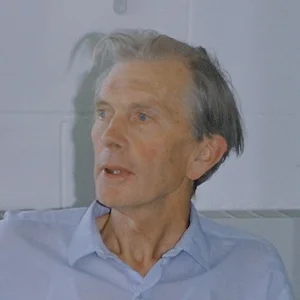

British astronomer and pioneer of radio astronomy. He developed the aperture synthesis technique that made it possible to map the sky with great precision, and was awarded the Nobel Prize in Physics in 1974.
Martin Ryle(1918 — 1984)
Martin Ryle
Royaume-Uni
5 min read
Frequently asked questions
Key Facts
- Born in 1918 in Brighton and died in 1984 in Cambridge
- Develops radar systems for British defence during the Second World War (1939-1945)
- Develops the aperture synthesis technique for radio astronomy in the 1950s and 1960s
- Compiles the Cambridge catalogues of radio sources (3C in 1959), supporting the Big Bang theory against the steady-state theory
- Receives the Nobel Prize in Physics in 1974 with Antony Hewish, the first Nobel awarded for astronomy
Works & Achievements
A revolutionary method combining the signals from several antennas to achieve the resolution of a giant instrument. It would earn Ryle the Nobel Prize.
A series of surveys of the sky's radio sources. The 3C catalogue remains a reference for identifying galaxies and quasars.
The first demonstration, with D. Vonberg, that the Sun's radio emissions are linked to sunspots and magnetic fields.
Statistics of distant sources showed that the Universe evolves over time, providing decisive observational evidence in favour of the Big Bang.
A one-mile-long synthesis radio telescope, the first to produce detailed radio maps using the Earth's rotation.
A large five-kilometre interferometric array that pushed the resolution of radio astronomy even further.
Anecdotes
During the Second World War, Martin Ryle worked on the development of radar and electronic countermeasures to jam German radar. It was this wartime expertise in radio waves that prepared him, as early as 1945, to scan the sky with antennas rather than optical telescopes.
Ryle had the brilliant idea of using several spaced-out antennas and combining their signals: this is *aperture synthesis*. As the Earth turned beneath the sky, his small antennas behaved like a giant radio telescope several kilometres across, allowing him to map radio sources with unprecedented sharpness.
Ryle fiercely opposed the astronomer **Fred Hoyle** and his *steady-state* theory of the Universe. His counts of distant radio sources showed that the Universe had changed over time, a major observational argument in favour of the Big Bang.
In **1974**, Martin Ryle and his colleague **Antony Hewish** received the Nobel Prize in Physics: it was the very first time the Nobel had rewarded work in astronomy. Ryle was honoured for his revolutionary observation techniques, notably aperture synthesis.
Towards the end of his life, Ryle, deeply troubled by the arms race, turned part of his engineering genius away from defence and towards protecting the environment and criticising military nuclear power, advocating for renewable energy sources such as wind power.
Primary Sources
The angular resolution that can be achieved is limited not by the size of a single antenna, but by the maximum separation between the antennas that can be linked together.
It is shown that a telescope of large effective area can be synthesised by successively measuring, with smaller movable elements, the amplitude and phase of the signal for all the required separations.
The observations indicate that the intense radio emission from the Sun originates in regions associated with sunspots and their magnetic fields.
Key Places
Coastal town in southern England where Martin Ryle was born in 1918.
Ryle studied physics here before the war, earning his degree in 1939.
A landmark of British physics where Ryle developed radio astronomy and aperture synthesis after 1945.
Radio astronomy observatory near Cambridge where Ryle installed his large arrays of interferometric antennas.
University town where Ryle spent most of his career and where he died in 1984.
Typical Objects

Cup-shaped reflector that concentrates radio waves coming from the sky onto a receiver. The basic building block of Ryle's radio telescopes.

Array of several antennas whose signals are combined to simulate a giant instrument. The heart of the aperture synthesis technique.

Electronic device inherited from the war, capable of detecting and amplifying faint radio signals. Ryle adapted it for astronomical observation.

Printed list recording the position and intensity of the sky's radio sources. The Cambridge 3C catalogue became a reference for astronomers around the world.

Computer used to combine the enormous amounts of measurements and reconstruct images of the radio sky. Essential to aperture synthesis.

Special cables linking the antennas together to carry signals without distorting them. They made it possible to synchronize the antenna array.
School Curriculum
Vocabulary & Tags
Key Vocabulary
Tags
Daily Life
Morning
Ryle arrived early at the Cavendish Laboratory or the observatory, often by bicycle. He devoted his mornings to meetings with his team and to designing new instruments, sketching antenna diagrams on any scrap of paper he could find.
Afternoon
Afternoons were spent in the observatory's fields, adjusting antennas, checking cables and calibrating receivers. Ryle, an engineer at heart, liked to get his own hands on the equipment.
Evening
In the evening, he analysed the recordings and the long strips of data, discussing the results with his colleagues. Radio observations, unlike optical astronomy, could be carried out by day as well as by night.
Food
Ryle led the sober life of a mid-twentieth-century British academic: simple meals taken at college or at home, with frequent cups of tea setting the rhythm of his working days.
Clothing
He wore the suit and tie of the Cambridge academic, but did not hesitate to pull on a work jacket and boots to go and tinker with the antennas out in the muddy fields.
Housing
He lived in Cambridge, in a house near the university, dividing his time between his home, the Cavendish Laboratory and the grounds of the radio astronomy observatory.
Historical Timeline
Period Vocabulary
Liens externes & ressources
Références
Œuvres
Technique de la synthèse d'ouverture
années 1950-1960
Catalogues de Cambridge (1C, 2C, 3C, 4C)
1950-1965
Mesure du rayonnement radio du Soleil
1946
Comptages de sources radio et critique de l'état stationnaire
1955-1961
Le One-Mile Telescope
1964
Le Five-Kilometre Telescope (Ryle Telescope)
1972