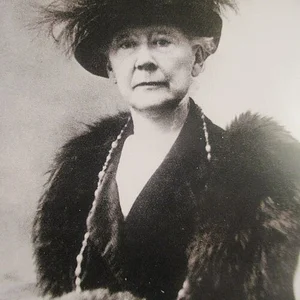

Mary Cassatt (1844-1926) was an American painter and printmaker who settled in France, one of the few women to join the Impressionist movement. She is famous for her intimate paintings of women's lives, especially her scenes of mothers and children.
Mary Cassatt(1844 — 1926)
Mary Cassatt
États-Unis
6 min read
Frequently asked questions
Key Facts
- Born in 1844 in Allegheny City (Pennsylvania), she settled permanently in Paris from 1874 onward
- Invited by Edgar Degas, she exhibited with the Impressionists from 1879
- A specialist in intimate scenes of mothers and children, such as “The Child's Bath” (1893)
- In 1890-1891 she created a series of color prints inspired by Japanese woodblock prints (ukiyo-e)
- Died in 1926 at the Château de Beaufresne, in Mesnil-Théribus (France)
Works & Achievements
A scene of a young woman at the theater, one of her first major Impressionist works to win critical praise.
A boldly framed painting, suggested by Degas, that breaks with the prim pose of traditional children's portraits.
A masterpiece influenced by Japanese prints, with its patterns, its overhead viewpoint, and its intimate tenderness.
A color print from her series inspired by ukiyo-e, a dazzling example of her genius for drypoint and aquatint.
A large mural created for the Woman's Building at the Chicago World's Fair, now lost.
A recurring theme in her work, depicting motherhood with dignity and without excessive sentimentality.
A canvas that extends the allegorical theme of the modern woman and the passing on of knowledge.
Anecdotes
When Edgar Degas discovered one of Mary Cassatt's works on display at the Salon, he exclaimed that he recognized in her someone who saw things the way he did. In 1877, he personally invited her to exhibit with the Impressionists, freeing her from the official Salon jury that she despised. Their demanding friendship would last more than forty years, punctuated by memorable quarrels.
Mary Cassatt played a decisive role in the birth of the great American art collections. She advised her wealthy friend Louisine Havemeyer to buy works by Manet, Degas, and Courbet, convinced that these canvases should one day find their way into the museums of the United States. Many of these works are now in the Metropolitan Museum in New York.
During a trip to Paris in 1890, Cassatt visited a major exhibition of Japanese prints right in the heart of the École des Beaux-Arts. Dazzled by Utamaro's woodblock prints, she set out to create a series of ten color prints of extraordinary refinement, considered today to be masterpieces of Western printmaking.
Suffering from cataracts and nearly blind at the end of her life, Mary Cassatt had to stop painting. She nevertheless remained an influential figure, passionately championing women's right to vote: in 1915, she agreed to exhibit her works for the benefit of the suffragist movement, falling out with Louisine Havemeyer before reconciling over this shared cause.
Although she spent almost her entire life in France, Cassatt never married and devoted her whole existence to her art, which was a bold choice for a woman of her time and her bourgeois background. Her father is said to have first told her that he would rather see her dead than become an artist.
Primary Sources
I cannot accept money for my paintings. I have reached the limit of what I can do, and I know it.
I will not admit that a woman can draw that well.
The first biography devoted to the artist, written from direct interviews with Mary Cassatt during her lifetime.
I first saw pastels by Degas in a dealer's window, and I would press my nose against the glass to absorb all I could of his art. It changed my life.
Key Places
Birthplace of Mary Cassatt, now part of Pittsburgh; she was born there into a well-to-do family.
Cassatt's first art school, where she studied from 1860 to 1865 before leaving for Europe.
The city where Cassatt lived and worked for most of her career, at the heart of the Impressionist movement.
She copied the great masters here early in her career, as young artists in training did at the time.
The country home she acquired in 1894 and where she died in 1926.
Typical Objects

Tools of drypoint and aquatint engraving, which Cassatt mastered to produce her color prints inspired by Japanese artists.
Sticks of dry pigment that Cassatt used, like Degas, for her vibrantly colored portraits of mothers and children.

A wooden stand on which she placed her canvases; her Paris studio was her daily workplace.

Woodblock prints by artists such as Utamaro, whose flat areas of color and bold framing revolutionized Cassatt's art.

Metal tubes of color, invented in the mid-19th century, allowed painters to work with fresh, ready-to-use colors.

A common women's fashion accessory in her paintings, a witness to the elegant life of the bourgeois women she portrayed.
School Curriculum
Vocabulary & Tags
Key Vocabulary
Daily Life
Morning
Mary Cassatt rose early to make the most of the morning light, which was ideal for painting. She would head to her Paris studio, where canvases, pastels, and models awaited her — often mothers and children from the neighbourhood.
Afternoon
Her afternoons were divided between long posing sessions and printmaking, which she practised with the rigour of a craftsman. She sometimes received visits from **Degas** or other artists to discuss their work.
Evening
In the evening, she attended exhibitions, art sales, and the salons where collectors and painters mingled. She also wrote many letters, advising her American friends on which works to acquire.
Food
Born into the well-off middle class, Cassatt took her meals in the French style — refined and on a regular schedule. Tea, inherited from her American and English habits, held an important place at her gatherings.
Clothing
She dressed with the understated elegance of a high-society lady of the *Belle Époque*: long dresses with a fitted waist, ornate hats, and gloves. These outfits often appear in her own paintings.
Housing
In Paris, she occupied a middle-class apartment paired with a studio. From **1894** onward, she spent her summers at the Château de Beaufresne, in the Oise, a vast country residence surrounded by parkland.
Historical Timeline
Period Vocabulary
Liens externes & ressources
Références
Œuvres
Le Bain de l'enfant (The Child's Bath)
1893
La Lettre
1890-1891
Mère et enfant (Mother and Child)
vers 1900
Jeunes filles cueillant des fruits
1891-1892