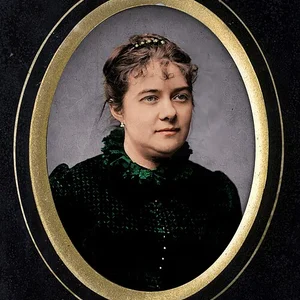

First wife of Paul Verlaine, whom she married in 1870 at the age of sixteen. The dedicatee of the collection La Bonne Chanson, she saw her marriage shattered by the poet's alcoholism and his affair with Arthur Rimbaud.
Mathilde Mauté(1853 — 1914)
Mathilde Mauté
France
5 min read
Frequently asked questions
Key Facts
- Born in 1853 in Paris into a cultured middle-class family
- Marries Paul Verlaine in August 1870, at the age of sixteen
- Inspires the collection La Bonne Chanson, published by Verlaine in 1870
- The couple separates in 1872 after Rimbaud's irruption into Verlaine's life; divorce granted in 1885
- Belatedly publishes her Mémoires de ma vie, a testimony about Verlaine (published posthumously in 1935)
Works & Achievements
Mathilde inspired and received the dedication of this collection by Verlaine, becoming the muse of one of the great love books of French poetry.
An autobiographical account in which Mathilde gives her version of the marriage, of Rimbaud and of the breakup — a precious source seen from the wife's side.
A process pursued by Mathilde, illustrating one of the first major applications of the law that reinstated divorce in 1884.
Anecdotes
In 1870, Mathilde was only sixteen when she married Paul Verlaine, ten years her senior. The poet, hoping to find a settled life at her side, dedicated to her his collection *La Bonne Chanson*, written during their engagement.
In the autumn of 1871, Verlaine invited to the Mauté home a young unknown who had come from Charleville: Arthur Rimbaud. The intrusion of this sixteen-year-old adolescent into the marital household upended the couple and hastened Verlaine's flight.
In July 1872, Mathilde travelled all the way to Brussels to try to bring back her husband, who had left Paris with Rimbaud. For a moment she believed she had won him back, but Verlaine ultimately set off again with the young poet, heading to Belgium and then England.
After years of separation, Mathilde obtained a divorce in 1885, one of the first major separations made possible by the Naquet law, which had reinstated divorce in France the previous year.
Much later, towards the end of her life, Mathilde wrote her *Mémoires de ma vie*, in which she gave her own often-forgotten version of this famous marriage, seen from the side of the abandoned wife.
Primary Sources
An autobiographical account in which Mathilde tells of her meeting with Verlaine, their marriage, and the intrusion of Rimbaud into their household, offering the wife's point of view.
A collection composed during their engagement and dedicated to Mathilde, celebrating love and the hope of a peaceful life: “And let the dawn come once more with its calm joys.”
The poet's letters evoke his marriage and the crisis triggered by Rimbaud's arrival, a direct testimony to the breakup of the household.
Key Places
Mathilde's native city and the setting of her life as a young wife in a cultured bourgeois milieu, passionate about music and letters.
Family home where the couple settled and where Rimbaud was welcomed in 1871, triggering the household crisis.
City where Mathilde travelled in 1872 to try to bring back Verlaine, who had left with Rimbaud, and where the drama of the two poets would unfold the following year.
Typical Objects

A slim volume of poems that Verlaine dedicated to his fiancée and later wife. For Mathilde, it became the symbol of a promised happiness that was soon disappointed.

The ring exchanged at the 1870 wedding. It sealed a union that would last barely a few years before the separation.

An instrument typical of Parisian bourgeois homes, around which the Mauté family — a cultured and musical household — would gather.

Handwritten exchanges between Mathilde, Verlaine, and their relatives. They served as attempts to reconcile the couple during the poet's escapades.

A women's outfit fashionable among the Parisian bourgeoisie of the 1870s, marked by a silhouette cinched at the waist and draped at the back.
School Curriculum
Vocabulary & Tags
Key Vocabulary
Daily Life
Morning
A young woman from a Parisian middle-class family, Mathilde starts the day with a careful wash and a light breakfast. The morning is spent reading, writing letters, and tending to the household, with the help of servants.
Afternoon
The afternoon is devoted to visits, walks, and music, an art widely practiced in her family. She receives or calls on relatives according to the social codes of the cultured middle class.
Evening
Evening brings the family together around dinner, sometimes enlivened by poetry or parlor music. But the evenings of the Verlaine household are also disturbed by the poet's alcoholism and outbursts of temper.
Food
Her diet is that of the well-to-do Parisian middle class: bread, meats, vegetables, wine at the table, meals served in several courses. Coffee and pastries accompany social gatherings.
Clothing
Mathilde wears the women's fashions of the 1870s: dresses fitted at the waist, a bustle at the back, a corset, gloves, and elegant hats, all signs of her social rank.
Housing
She lives in comfortable Parisian apartments and houses, notably the family home in the Montmartre district, furnished according to the bourgeois taste of the era.
Historical Timeline
Period Vocabulary
Liens externes & ressources
Références
Œuvres
Dédicataire de La Bonne Chanson
1870
Mémoires de ma vie
rédigés vers 1907-1914, publiés en 1935
Procédure de séparation puis de divorce
1874-1885