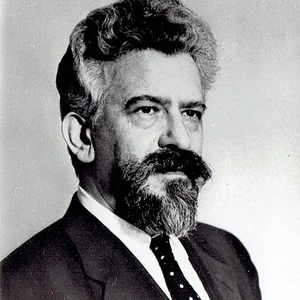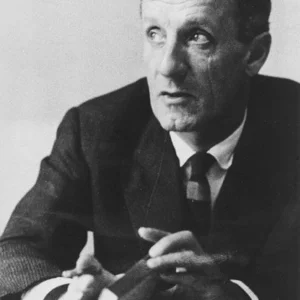

French philosopher and a major figure in phenomenology. He placed the body and perception at the heart of knowledge, breaking with the dualism between subject and object. A professor at the Collège de France, he was also a close friend and later a critic of Sartre.
Maurice Merleau-Ponty(1908 — 1961)
Maurice Merleau-Ponty
France
6 min read
Frequently asked questions
Famous Quotes
« The world is not what I think, but what I live through.»
Key Facts
- Born in 1908 in Rochefort-sur-Mer and died in 1961 in Paris
- Published *The Structure of Behavior* in 1942
- Published his major work *Phenomenology of Perception* in 1945
- Co-founded the journal *Les Temps modernes* with Sartre in 1945
- Elected professor at the Collège de France in 1952, the youngest ever to hold the chair of philosophy
Works & Achievements
His first major work, which critiques behaviorism and rethinks the relationship between consciousness and nature.
His masterpiece, which makes the lived body the center of perception and of our knowledge of the world.
A political essay on revolutionary violence and communism, shaped by the debates of the post-war years.
A collection of essays on art, cinema, literature and politics, broadening the scope of his phenomenology.
His inaugural lecture at the Collège de France, a manifesto on the role of the philosopher within society.
A critique of Marxism and of Sartre's communism, which sealed their intellectual break.
A collection of essays on language, expression, art and politics.
A posthumous and unfinished work in which he develops his notion of the “flesh” of the world, the summit of his late thought.
Anecdotes
Maurice Merleau-Ponty lost his father at a very young age, yet kept such a happy memory of his childhood that he would later say he never truly got over it: this childhood happiness fed his reflection on perception and our relationship to the world.
A classmate of Jean-Paul Sartre and Simone de Beauvoir at the École normale supérieure, he co-founded the journal Les Temps modernes with them in 1945, but their paths diverged in 1953 when he broke with Sartre over the question of communism and the USSR.
In 1952, at just 44 years old, he became the youngest professor ever elected to the Collège de France, holding the chair of philosophy once occupied by Henri Bergson.
To explain his philosophy, Merleau-Ponty liked to start from very concrete examples: the hand that touches and is touched, the painter Cézanne before Mont Sainte-Victoire, or the sensation of a phantom limb in amputees.
He died suddenly of a heart attack in May 1961, at the age of 53, leaving his great book Le Visible et l'Invisible unfinished; a volume of Descartes was said to have been found open on his desk.
Primary Sources
The world is not what I think, but what I live through; I am open to the world, I have no doubt that I am in communication with it, but I do not possess it; it is inexhaustible.
It is by lending his body to the world that the painter changes the world into paintings. To understand these transubstantiations we must go back to the working, actual body.
The philosopher is recognizable in that he inseparably possesses a taste for evidence and a feeling for ambiguity.
The flesh is not matter, is not mind, is not substance. To designate it, we should need the old term “element”.
Key Places
Town in the Charente-Maritime department where Maurice Merleau-Ponty was born in 1908. He spent part of his childhood there.
On the Rue d'Ulm, where he studied philosophy from 1926 alongside Sartre and Beauvoir. A training ground for the French intellectual elite.
Prestigious institution where he taught philosophy from 1952 until his death. He was the youngest person ever to hold the chair there.
Where he taught philosophy in the 1940s before moving to Paris. An important step in his academic career.
Where he held a chair in child psychology and pedagogy from 1949 to 1952. There he developed his thinking on perception and childhood.
Capital where he lived, wrote, and died suddenly in 1961. The center of postwar intellectual life.
Typical Objects

The manuscript of his thesis, which became his major work, where he makes the body the subject of perception. A foundational text of French phenomenology.

The chair of philosophy he held from 1952, once occupied by Bergson. A symbol of the highest French academic recognition.

The intellectual journal he directed alongside Sartre from 1945. It spread existentialism and the major political debates of the postwar years.

Cézanne's paintings, notably the Sainte-Victoire mountain, which he analyzed to show how the painter's body makes the world visible. A favored object of his reflection on perception.

The works of Edmund Husserl, founder of phenomenology, which he studied at the Husserl Archives in Leuven. His reading of them nourished his entire body of work.

The preparatory notes for his lectures at the Collège de France, often dense and crossed out. They bear witness to a mind in the act of searching itself.
School Curriculum
Vocabulary & Tags
Key Vocabulary
Daily Life
Morning
A conscientious teacher, Merleau-Ponty devotes his mornings to the meticulous preparation of his lectures and to reading the philosophers, from Descartes to Husserl. He crosses out and reworks his notes endlessly, searching for just the right phrasing.
Afternoon
The afternoon is often set aside for teaching, in the lecture halls of the Sorbonne and later at the Collège de France, where his lectures draw a wide audience. He also engages in dialogue with the painters, psychologists, and linguists who feed his thinking.
Evening
In the evening, he frequents the cafés and Parisian intellectual circles of Saint-Germain-des-Prés, meeting up for a while with Sartre and Beauvoir. There he discusses politics, literature, and philosophy, before returning to his study to write.
Food
Like the Parisian intellectuals of his time, he takes his meals in the brasseries and cafés of the Latin Quarter and Saint-Germain. Classic postwar French cuisine sets the rhythm of these moments of exchange.
Clothing
He wears the sober attire of the 1940s-1950s university professor: jacket, shirt, and tie. This understated dress matches his reputation as a measured and reserved man.
Housing
He lives in Paris, in Left Bank apartments close to the centers of intellectual life. His study, covered with books and manuscripts, is the heart of his work.
Historical Timeline
Period Vocabulary
Liens externes & ressources
Références
Œuvres
La Structure du comportement
1942
Phénoménologie de la perception
1945
Humanisme et terreur
1947
Éloge de la philosophie
1953
Les Aventures de la dialectique
1955