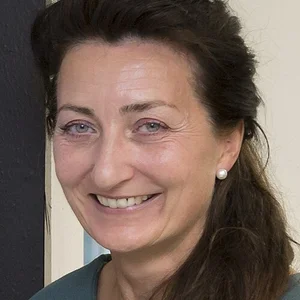

May-Britt Moser is a Norwegian neuroscientist and psychologist born in 1963. Together with her colleague Edvard Moser, she discovered “grid cells,” neurons that form the brain's positioning system. This work earned her the Nobel Prize in Physiology or Medicine in 2014.
May-Britt Moser(1963 — ?)
May-Britt Moser
Norvège
6 min read
Frequently asked questions
Key Facts
- Born on January 4, 1963, in Fosnavåg, Norway
- Co-founds the Kavli Institute for Systems Neuroscience in Trondheim with Edvard Moser (2007)
- Discovers the “grid cells” of the hippocampus, the basis of spatial navigation (2005)
- Receives the Nobel Prize in Physiology or Medicine in 2014, shared with Edvard Moser and John O'Keefe
- One of the few women to win a scientific Nobel Prize in the 21st century
Works & Achievements
Identification of neurons in the entorhinal cortex that form a grid-like map of space, regarded as a major breakthrough in neuroscience.
Establishment in Trondheim of a world-renowned research institute devoted to memory and spatial orientation.
Identification of complementary neurons that clarify how the brain perceives directions and the boundaries of space.
Award for the discovery of the brain's positioning system, shared with Edvard Moser and John O'Keefe.
A lecture in which she explains how the brain builds an internal map of space, which has become an educational reference.
Anecdotes
At the Nobel Prize ceremony in Stockholm in 2014, May-Britt Moser wore a black dress specially created by the artist Matthew Hubble: it was embroidered with patterns depicting the nerve cells she had studied her entire life. The science she loved was literally worn on her body.
May-Britt and Edvard Moser are one of the few married couples to have received a scientific Nobel Prize together — only the fifth in history. They had met as students at the University of Oslo and pursued their research hand in hand for decades in Trondheim.
To discover the famous “grid cells,” the team observed rats moving freely in a box while recording the activity of individual neurons. They were astonished to find that certain neurons fired in a regular honeycomb-shaped pattern, like an invisible grid laid over the floor.
The Mosers compared their discovery to a true “internal GPS”: the brain has its own coordinate system that allows us to know where we are and to find our way, without any satellite or paper map.
Passionate about teaching, May-Britt Moser co-founded a large research institute in Trondheim where scientists from all over the world come to unlock the secrets of memory and orientation, turning a small Norwegian town into a global hub for neuroscience.
Primary Sources
The authors describe neurons in the entorhinal cortex whose activity fields form a regular grid of equilateral triangles covering the entire environment explored by the animal.
In it, she explains how grid cells provide the brain with a metric system of space, the foundation of our ability to find our way and to remember places.
The 2014 Nobel Prize in Physiology or Medicine honours the discovery of cells that form a positioning system in the brain, an “internal GPS”.
Key Places
Small fishing port on Norway's west coast where May-Britt Moser was born in 1963 and grew up in a modest family.
University where May-Britt Moser studied psychology and met Edvard Moser, her future research partner.
Research center in Trondheim that she co-directs and where grid cells were discovered. It is the heart of her scientific work.
Site of the Nobel Prize ceremony and banquet, where May-Britt Moser was honored in December 2014.
Typical Objects

An extremely thin metal wire implanted in an animal's brain to capture the electrical activity of a single neuron. It is the key tool that made it possible to “see” grid cells light up.

A box or enclosure in which a rat moves about freely while its neurons are being recorded. The animal's movements are tracked on camera to link position with brain activity.

A colour-coded representation showing where, in space, a neuron fires: the points form a regular honeycomb grid. It is the visual signature of the Mosers' discovery.

Computers and software that record and analyse the signals of hundreds of neurons in real time. Without this computing power, spotting the regular patterns would have been impossible.

An optical instrument used to examine thin slices of brain tissue and to pinpoint the neurons being studied. It serves to verify where the electrodes recorded.

A gold medal awarded in Stockholm to Nobel laureates. May-Britt Moser's medal honours the discovery of the brain's positioning system.
School Curriculum
Vocabulary & Tags
Key Vocabulary
Daily Life
Morning
A neuroscientist's morning often begins by reading the latest scientific papers and preparing the day's experiments. May-Britt Moser heads to her laboratory in Trondheim to check the neural recordings and confer with her team.
Afternoon
The afternoon is devoted to experiments: observing the animals in the arena, analyzing data on the computer, and meeting with students and researchers. This is when results are discussed and new hypotheses are formulated.
Evening
In the evening, she writes papers, prepares lectures, or connects with colleagues abroad by video call. Modern science knows no borders, and the work often continues late into the night.
Food
Like most Norwegians, her diet includes fish, wholemeal bread, dairy products, and plenty of coffee, an essential beverage in the laboratory. Meals are simple and often eaten on site between experiments.
Clothing
In the laboratory, she wears a white coat and sometimes gloves to handle the instruments. Outside, May-Britt Moser dresses in a plain, practical style suited to the cold climate of Trondheim.
Housing
She lives in the university city of Trondheim, in central Norway, nestled between fjords and hills. Her daily life is split between a comfortable home and a modern, light-filled research institute.
Historical Timeline
Period Vocabulary
Liens externes & ressources
Références
Œuvres
Découverte des cellules de grille (article dans Nature)
2005
Fondation de l'Institut Kavli de neurosciences des systèmes
2007
Travaux sur les cellules de direction et de bordure
2008
Prix Nobel de physiologie ou médecine
2014
Discours Nobel « Grid Cells and the Entorhinal Map of Space »
2014