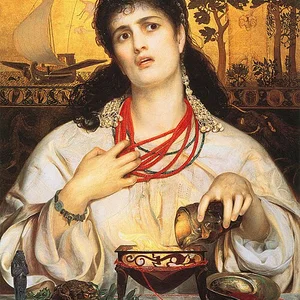

A tragic figure of Greek mythology, Medea is a sorceress from Colchis, daughter of King Aeëtes and granddaughter of Helios. Driven by love for Jason, she helps him seize the Golden Fleece, but when he betrays her, she exacts a terrible revenge by killing her own children.
Medea
Medea
8 min read
Frequently asked questions
Famous Quotes
« "I know what evil I am about to do, but my passion is stronger than my reason." (attributed to Medea in Euripides' tragedy, 5th century BCE)»
Key Facts
- Medea helps Jason put the dragon guarding the Golden Fleece to sleep using her magical powers
- She kills her own brother Absyrtus to slow down her father Aeëtes' pursuit
- Abandoned by Jason, who marries the princess Creusa in Corinth, she takes revenge by killing his new bride and her own children
- Euripides' tragedy Medea was first performed in 431 BCE in Athens
- After her revenge, she flees on a chariot drawn by winged dragons, a symbol of her divine and magical origins
Works & Achievements
Medea helps Jason overcome the trials set by her father (plowing with fire-breathing bulls, sowing dragon's teeth) and lulls the guardian dragon to sleep. Without her, the Argonauts' quest would have failed.
At Iolcus, Medea successfully rejuvenates Aeson, Jason's elderly father, by boiling him in a cauldron with magical herbs. This marvel demonstrates the full extent of her powers as a sorceress.
Medea persuades Pelias's daughters to attempt to rejuvenate their father by cutting him up and boiling him — but without adding the life-giving herbs. It is her revenge for the wrongs the usurper inflicted upon Jason.
Through a robe and a diadem soaked in magical poison, Medea causes the deaths of her rival and her rival's father, destroying Jason's new marriage before fleeing Corinth.
The most devastating act of the myth, Medea kills the children she had with Jason to inflict the worst possible punishment upon him. This tragic act goes beyond ordinary revenge and makes her a complex figure of human suffering.
Anecdotes
Medea was a formidable sorceress and granddaughter of the sun god Helios. When Jason arrived in Colchis to claim the Golden Fleece, she prepared a magic ointment that made him invulnerable to fire and to the blows of the bronze-hoofed bulls he had to face. Without her, Jason could never have accomplished his feats.
To allow Jason to escape with the Golden Fleece, Medea committed a terrible act: she killed her own brother Absyrtus and scattered his body parts across the sea to slow her father Aeëtes' pursuit. This act shows just how far she was willing to go out of love for Jason.
Upon arriving in Iolcos, Medea convinced the daughters of King Pelias to rejuvenate their father through a trick: she boiled an old ram in a cauldron with magic herbs, and it emerged as a young lamb. The daughters, deceived, cut up their father and cooked him — but Medea added no rejuvenating herbs. It was her revenge for the wrongs done to Jason.
Betrayed by Jason, who abandoned her to marry Princess Creusa, Medea sent her rival a poisoned robe and diadem. The moment Creusa put them on, she was consumed by a magical fire that also killed her father Creon. This poisoned wedding gift is one of the darkest acts in all of Greek mythology.
Medea's ultimate revenge was to kill her own children by Jason, in order to inflict the deepest possible pain upon him. After this act, she fled on a winged chariot drawn by dragons, sent by her grandfather Helios, escaping all human justice. This ending made Medea a tragic figure who has haunted Western literature for centuries.
Primary Sources
"I know what evil I am about to do, but my passion is stronger than my reason, passion that causes the worst of evils among mortals."
"Medea, whom Eros had struck with a burning arrow, could not close her eyes all night, so fiercely did her heart burn for Jason, son of Aeson."
"Medea superest. Here you will see what a woman can do, what love can do, and what the anguish of a betrayed wife can do."
"By these gods whom I betrayed for you, by the children we share, by my sacrifices and your crimes against me, I beg you: come back."
A tale transmitted orally about the lineage of Medea, daughter of Aeëtes king of Colchis and granddaughter of Helios the sun god, a sorceress who inherited the secrets of the goddess Hecate.
Key Places
A kingdom on the shores of the Black Sea, ruled by Medea's father Aeëtes. This is where the Golden Fleece is kept, and where Medea grew up, learning the art of magic from the goddess Hecate.
The Greek city where Medea settles with Jason after their exile from Iolcos. It is here that the central tragedy unfolds: Jason's betrayal and Medea's terrible revenge.
The city in Greece where Jason was born and to which he returns bearing the Golden Fleece. It is here that Medea carries out her revenge against Pelias by manipulating his daughters.
Medea's refuge after fleeing Corinth: King Aegeus had promised her sanctuary in exchange for remedies to cure his childlessness. She stays there for a time before ultimately being driven out.
A mythical place associated with Colchis and the palace of Aeëtes in the Argonautica. It is the symbolic starting point of Medea's story, the birthplace of her magical power.
Typical Objects

One of Medea's most iconic objects, the cauldron is her instrument of sorcery. She uses it to prepare her potions, ointments, and poisons — most notably in the staged false rejuvenation of Pelias.

The skin of the golden ram, guarded by a dragon in Colchis and the reason for Jason's quest. Medea lulls the dragon to sleep and allows Jason to seize it, making the Fleece the symbol of their love pact and of the sacrifice she made for him.

The wedding gifts Medea sends to her rival Creusa, soaked in a magical poison that burns flesh like fire. They embody the vengeful dimension of Medea's magic.

Medea is an unrivaled herbalist and pharmacist, initiated into her craft by the goddess Hecate. She gathers her plants at night by moonlight, using them equally to heal or to kill.

A gift from her grandfather Helios, this winged chariot allows Medea to flee after her crimes — a symbol of her divine nature and her escape from all human justice.

Medea is a priestess of Hecate, goddess of crossroads and magic. The torch is the ritual attribute of this nocturnal goddess, and Medea invokes her during her magical ceremonies.
School Curriculum
Vocabulary & Tags
Key Vocabulary
Tags
Daily Life
Morning
Medea rises before dawn to gather medicinal and magical plants at the hour when their power is greatest. She recites prayers to Hecate at sunrise, honoring her divine nature as granddaughter of Helios. Her mornings are shaped by the preparation of potions and ointments in her workshop.
Afternoon
In the afternoon, Medea oversees household affairs, instructs her handmaidens, and tends to her children. As a princess and later wife of a hero, she receives visitors and serves as an advisor. She studies sacred texts and deepens her knowledge of plant properties and magical rituals.
Evening
Evening is Medea's favored time for magical practice: invocations to Hecate at crossroads, ritual sacrifices, and the preparation of her most powerful spells. The night belongs to her, as it does to all priestesses of the goddess of the moon and darkness.
Food
As a Colchian princess, Medea eats roasted meats, barley bread, vegetables, and seafood from the Black Sea. She drinks wine mixed with water in accordance with Greek custom. Some of the herbs she works with are sacred to her and never consumed — they are reserved exclusively for her potions.
Clothing
Medea wears long robes of linen or fine wool, dyed in deep purple and dark red, pinned at the shoulder in the Eastern fashion. She adorns herself with gold jewelry set with black stones, headbands in her long dark hair, and protective amulets. Her dress reflects both her royal nobility and her status as a priestess.
Housing
In Colchis, Medea lives in the palace of Aeëtes, a richly appointed residence with painted columns overlooking the Phasis river. In Corinth, she inhabits a Greek peristyle house with a gynaeceum where she lives with her children. Her personal space includes a secret room devoted to her magical work, filled with vessels, dried herbs, and ritual instruments.
Historical Timeline
Period Vocabulary
Visual Style
Esthétique tragique gréco-antique : drapés cramoisis, or brûlant et vert vénéneux dans un clair-obscur intense, entre beauté divine et puissance maléfique.
Sound Ambience
Ambiance nocturne de la Grèce antique : chaudron bouillonnant, herbes froissées, vent dans les cyprès et invocations à Hécate sous un ciel étoilé.
Liens externes & ressources
Références
Œuvres
Conquête de la Toison d'or
Époque mythique
Rajeunissement d'Éson
Époque mythique
Mort de Pélias par ruse
Époque mythique
Empoisonnement de Créüse et Créon
Époque mythique
Meurtre de ses enfants
Époque mythique