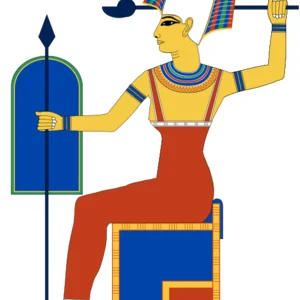

Menā is a goddess of Hindu mythology, the wife of Himavat, the personification of the Himalayas, and queen of the mountains. Mother of the great goddess Pārvatī as well as of Gangā and Mount Maināka, she is celebrated in the Purāṇas as the mind-born daughter (mānasaputrī) of the Pitṛ ancestors.
Menā
Menā (Menāvatī)
6 min read
Frequently asked questions
Key Facts
- A figure of Hindu mythology whose story is recorded in the Purāṇas (compilations dating from around 300 BCE to the first millennium CE)
- Wife of Himavat, the king of the mountains and personification of the Himalayan range
- Mother of Pārvatī, the wife of the god Śiva, which makes her the god's mother-in-law in Shaivite mythology
- Also the mother of the river goddess Gangā and of Mount Maināka according to several traditions
- Described as a “mind-born” daughter (mānasaputrī) of the divine Pitṛ ancestors
Works & Achievements
Together with Himavat, Menā performs long austerities (tapas) so that the great Goddess will consent to be born as their daughter.
Menā gives birth to Pārvatī, the future wife of Śiva, and raises her in the palace of the mountains.
Wishing to stop her daughter from inflicting too harsh penances upon herself, Menā cries out “u mā” (“oh, do not!”), hence the name Umā given to Pārvatī.
Menā is also said to be the mother of Gangā, the celestial river that would descend to earth as the Ganges.
She gives birth to Maināka, the winged mountain that escaped Indra by plunging into the ocean.
Menā and Himavat give their daughter to Śiva; the rite seals the union of the great god and the Goddess.
Anecdotes
According to the Śiva Purāṇa, Menā and her husband Himavat performed long austerities so that the great Goddess would consent to be born to them. Their wish was granted: the Goddess came into the world as their daughter Pārvatī, “she of the mountain.”
The poet Kālidāsa relates that, seeing her daughter inflict terrible penances upon herself, Menā cried out “u mā!” — “oh, do not do that!”. From this motherly cry, it is said, came Pārvatī's other name: Umā.
The Śiva Purāṇa describes Śiva's arrival at the wedding, covered in ashes, adorned with serpents and surrounded by his troop of frightening spirits (gaṇa). Horrified at the thought of giving her delicate daughter to such a husband, Menā fainted, until she was reassured when the god revealed his resplendent form.
Menā is also the mother of Mount Maināka. When Indra cut off the wings of the mountains, Maināka — says the Rāmāyaṇa — hid in the ocean; he later rose from it to offer a resting place to Hanumān as he leapt toward Laṅkā.
In the Purāṇas, Menā is no mere queen: her children are elements of the world. Besides Pārvatī, she gives birth to Gangā, the celestial Ganges, and Maināka the mountain — nature itself is her offspring.
Primary Sources
In due time Menā, the worthy wife of the king of the mountains, gave birth to a radiant daughter; and when the child wished to undertake harsh penances, her mother, to dissuade her, said to her “u mā” (“oh, no!”), whence her name Umā.
Seeing Śiva adorned with serpents, his body smeared with ashes, escorted by his hideous gaṇa, Menā was seized with terror and fell down in a swoon, moaning: “How can I give my tender daughter to such a husband?”
Mount Maināka, son of Himavat, who had once fled beneath the ocean to escape Indra's thunderbolt, rose from the waves and offered Hanumān a place of rest during his leap toward Laṅkā.
From the Pitṛ ancestors there was born, by thought alone, a daughter, Menā; she became the wife of Himavat, king of the mountains, and was the mother of Maināka, of Gangā, and of the Goddess.
Key Places
Mountain range personified by Himavat, husband of Menā; this is where she reigns and where her daughter Pārvatī is born.
Capital of the mountain kingdom according to Kālidāsa, “the plateau of luminous herbs” where Menā holds her court.
Abode of Śiva, toward which Pārvatī departs after Menā gives her in marriage to the god.
Region of the headwaters of the Ganges, the sacred river identified with Gangā, said to be the daughter of Menā and Himavat.
Her son Maināka took refuge in the Southern Sea to flee Indra, then rose from it to help Hanumān on his way to Laṅkā.
Typical Objects

Wife of the mountain king Himavat, Menā wears the crown that marks her rank as Parvata-rājñī, queen of the peaks.

Gold, crystals, and precious stones are born from the body of the Himalaya, her husband, and adorn both his dwelling and her person.

To obtain the Goddess as her daughter, Menā uses lustral water, flowers, and sacrificial fire during her austerities.

In the palace of the mountains, Menā watches over the childhood of her daughter, the future wife of Śiva.

At Pārvatī's wedding, Menā prepares vermilion powder (kumkum), garlands, and adornments for the rite of the kanyādāna.

A sacred instrument whose sound accompanies the rites and the wedding procession prepared in the house of Himavat.

Himavat's capital takes its name from the medicinal, glowing plants that light up Menā's realm.
School Curriculum
Vocabulary & Tags
Key Vocabulary
Tags
Daily Life
Morning
At dawn, in the palace of Oṣadhiprastha, capital of the mountains, **Menā** awakens among her attendants and the nymphs of the Himalaya. The morning is devoted to household rites and to the offerings (*pūjā*) made to the gods and to the ancestral *Pitṛ* from whom she descends.
Afternoon
In the afternoon, as queen of the mountains, she watches over the kingdom of **Himavat**, its forests, its springs, and its luminous herbs. She receives the sages (*ṛṣi*) who come to greet the court of the king of the peaks, and she oversees the education of her daughter **Pārvatī**.
Evening
Evening gathers the divine family around **Himavat**. There they listen to the recitation of the legends, welcome guests with deference, and **Menā** gazes upon her beloved daughter, a jewel more precious than all her ornaments.
Food
The diet is *sāttvic* and vegetarian: mountain fruits, honey, milk, and clarified butter (*ghṛta*), rice and cakes offered first to the gods. The sharing of consecrated food (*prasāda*) punctuates the rituals.
Clothing
**Menā** is dressed in a brightly colored silk *sārī*, fastened at the waist, and adorned with gold, pearls, and the gems of the Himalaya. Her forehead, marked with vermilion (*sindūra*) and sandalwood paste, signals her rank as a royal consort.
Housing
Her dwelling is a palace of crystal and gold raised upon the heights of the Himalaya, surrounded by snowy peaks, waterfalls, and gardens. The halls glitter with the minerals born of the body of her husband, the king of the mountains.
Historical Timeline
Period Vocabulary
Liens externes & ressources
Références
Œuvres
Les austérités pour obtenir la Déesse
récit puranique
La naissance et l'éducation de Pārvatī
récit puranique
Le nom d'Umā
Kumārasambhava, chant I
La maternité de Gangā
récit puranique
La maternité du mont Maināka
récit épique
Le don de Pārvatī en mariage (kanyādāna)
récit puranique