 flip
flipEmpanadas de pino
Empanadas de pino
Why this dish? The empanada de pino is THE Chilean national dish, inseparable from September 18th and large gatherings. For a president who took the oath at Palacio de La Moneda, this beef, onion, hard-boiled egg, olive, and raisin turnover is the very taste of Chilean identity shared at all tables, from the humblest to palaces.
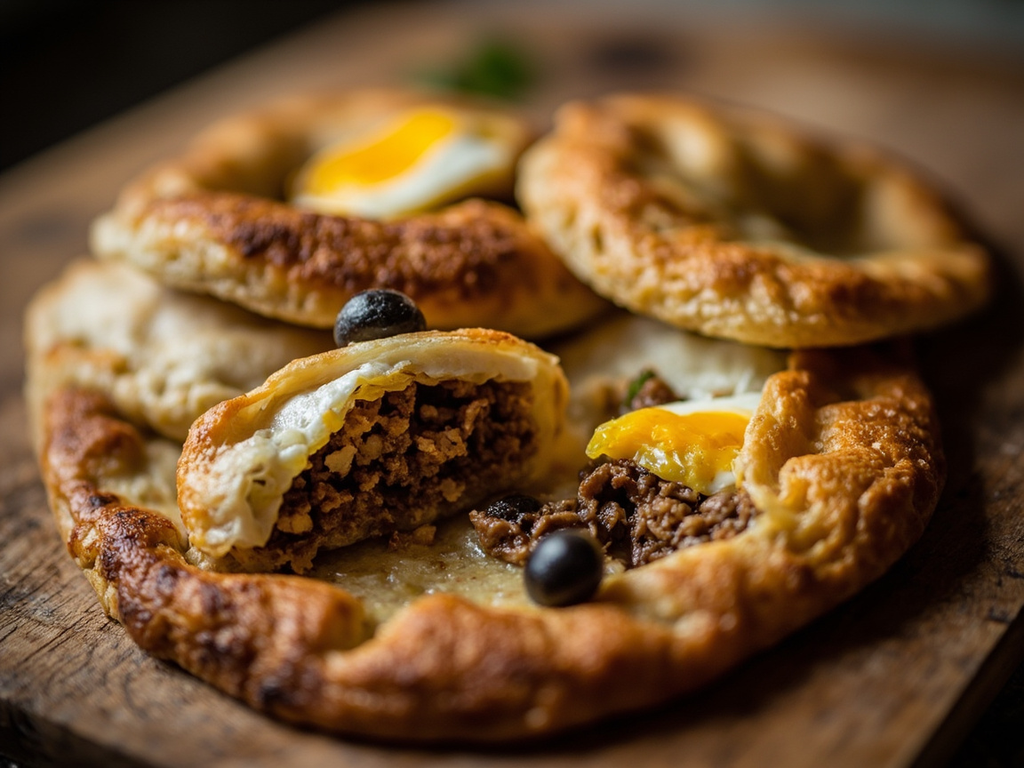
A golden pastry turnover filled with pino — a hash of beef slowly melted in a mountain of onions and cumin — enhanced with a wedge of hard-boiled egg, a black olive, and a raisin that provides the sweet touch. Eaten by hand, piping hot.
You know, in a well-made empanada, the secret is not the meat: it's the onion. You have to use almost as much as beef and let it melt very slowly until it becomes tender and sweet. At home we always slip in the olive, the egg, and a raisin — and we watch out for whoever bites too fast on the pit! When I returned from exile, it was this smell of cumin and onion that told me, more than any flag, that I was home again.
- •Lean beef, chopped by hand — a good portion (heart of the pino)
- •Onions — almost double the meat (melting sweet base)
- •Cumin and aji de color (sweet paprika) — to flavor (signature spices)
- •Hard-boiled eggs — a few (filling)
- •Whole black olives — one per empanada (briny note)
- •Raisins — a pinch per empanada (sweet touch)
- •Lard pastry dough — as needed (wrapper)
Empanadas de pino
A golden pastry turnover filled with pino — a hash of beef slowly melted in a mountain of onions and cumin — enhanced with a wedge of hard-boiled egg, a black olive, and a raisin that provides the sweet touch. Eaten by hand, piping hot.
Why this dish? The empanada de pino is THE Chilean national dish, inseparable from September 18th and large gatherings. For a president who took the oath at Palacio de La Moneda, this beef, onion, hard-boiled egg, olive, and raisin turnover is the very taste of Chilean identity shared at all tables, from the humblest to palaces.
You know, in a well-made empanada, the secret is not the meat: it's the onion. You have to use almost as much as beef and let it melt very slowly until it becomes tender and sweet. At home we always slip in the olive, the egg, and a raisin — and we watch out for whoever bites too fast on the pit! When I returned from exile, it was this smell of cumin and onion that told me, more than any flag, that I was home again.
Ingredients (period version)
- Lean beef, chopped by hand — a good portion (heart of the pino)
- Onions — almost double the meat (melting sweet base)
- Cumin and aji de color (sweet paprika) — to flavor (signature spices)
- Hard-boiled eggs — a few (filling)
- Whole black olives — one per empanada (briny note)
- Raisins — a pinch per empanada (sweet touch)
- Lard pastry dough — as needed (wrapper)
Ingredients
- Ground beef (chuck) — 500 g (heart of the pino)
- Onions — 800 g, finely diced (melting base)
- Ground cumin — 1 tsp (spice)
- Sweet paprika (aji de color) — 1 tsp (color and flavor)
- Hard-boiled eggs — 3 (filling)
- Pitted black olives — 12 (briny note)
- Raisins — 3 tbsp (sweet touch)
- Flour — 500 g (dough)
- Lard or melted butter — 120 g (dough)
- Salted warm water — about 180 ml (dough)
Method
- Melt the onions over low heat for 20-30 min until translucent and tender, without browning.
- Add the beef, cumin, and paprika; cook then let rest ideally overnight in the fridge (pino is better the next day).
- Prepare the dough: mix flour, melted lard, and salted warm water, knead, let rest 30 min.
- Roll out disks, fill with a spoonful of cold pino, a wedge of egg, an olive, and a few raisins.
- Fold, seal the edges forming the characteristic folded corners, brush with egg wash.
- Bake at 200 °C for 25-30 min until golden brown.
How it was made : The empanada arrived with Spanish colonists and became deeply Chilean over the centuries. Baked in wood-fired ovens (empanada de horno), it is prepared the day before festivities in large family batches. The word pino comes from Mapudungun 'pirun'.
The contemporary twist : Serve Chilean-style with a glass of chicha or, for children, a mote con huesillos — and the challenge of finding the olive without breaking a tooth on the pit.
Michelle Bachelet · Charactorium