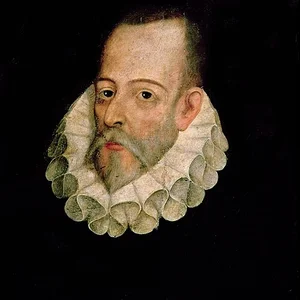

Spanish writer of the Renaissance, Cervantes is the author of Don Quixote, one of the greatest novels in world literature. Soldier, captive in the Barbary Coast, and prolific author, he embodies the humanism of his era.
Miguel de Cervantes(1547 — 1616)
Miguel de Cervantes
couronne de Castille
8 min read
Frequently asked questions
Famous Quotes
« Revenge is not always the sword of the just.»
« Freedom, Sancho, is one of the most precious gifts that heaven has bestowed upon men.»
Key Facts
- 1571: Takes part in the Battle of Lepanto, where he is wounded in his left arm
- 1575–1580: Captive on the Barbary Coast (Algiers) after being captured by corsairs
- 1605: Publication of the first part of Don Quixote, an immediate success across Europe
- 1613: Publication of his Exemplary Novels, a collection of short stories
- 1615: Publication of the second part of Don Quixote shortly before his death
Works & Achievements
Cervantes's first novel, a pastoral romance influenced by Italian literature. In it he expresses his poetic aspirations, though the work met with limited success.
A masterpiece of world literature, considered the first modern novel. It follows a hidalgo who, having read too many chivalric romances, loses his mind and sets off on adventures with his squire Sancho Panza.
A collection of twelve original short stories, the first of its kind in Spanish. Cervantes explores a range of themes: love, honor, adventure, and social criticism.
A long allegorical poem in which Cervantes offers a critical and playful panorama of the Spanish poetry of his time, mocking mediocre poets.
The authentic sequel to the novel, often considered superior to the first for its psychological depth. Cervantes responds to Avellaneda's spurious Don Quixote with irony and mastery.
Plays published shortly before his death. The interludes — brief comic sketches — are particularly praised for their liveliness and popular realism.
A Byzantine adventure novel published posthumously, which Cervantes considered his masterpiece. It reveals his narrative mastery right up to the end of his life.
Anecdotes
During the Battle of Lepanto in 1571, Cervantes fought bravely despite a severe fever. He received three arquebus shots, one of which permanently paralyzed his left hand. He took great pride in this, later declaring that he had lost the use of his hand 'for the greater glory of the right one'.
In 1575, while sailing back to Spain with a letter of recommendation from Don John of Austria, his ship was captured by Barbary pirates. Cervantes spent five years in captivity in Algiers. He attempted to escape four times without success, each time displaying a courage that earned the admiration of his captors.
Cervantes was freed from captivity in 1580 thanks to a ransom paid by Trinitarian monks, partly funded by his own family who ruined themselves to save him. Back in Spain, he found a homeland that barely recognized him and was forced to take on thankless jobs such as supply commissioner for the Armada.
Don Quixote, published in 1605, was an immediate success and was quickly translated into several languages. An unknown author hiding under the pseudonym Avellaneda published an unauthorized apocryphal sequel in 1614. Cervantes struck back by incorporating this imposture into the authentic second part of his novel, published in 1615, brilliantly ridiculing his plagiarist.
Cervantes died on April 22, 1616, the same day as William Shakespeare according to the Julian calendar, though the two men never met. This striking coincidence led UNESCO to proclaim April 23 as World Book Day.
Primary Sources
In a village of La Mancha, the name of which I have no desire to call to mind, there lived not long since one of those gentlemen that keep a lance in the lance-rack, an old buckler, a lean hack, and a greyhound for coursing.
Truth, whose mother is history, rival of time, storehouse of deeds, witness of the past, example and counsel to the present, and warning to the future.
Cervantes sets out his literary and pastoral ideals: 'Occupied and absorbed in his thoughts, he failed to notice how dearly he was experiencing that maxim that love never comes to a good end.'
I am the first to have written novellas in the Castilian tongue; for the many novellas printed in it are all translated from foreign languages, and these are my own, neither imitated nor stolen.
With one foot already in the stirrup, and in the throes of death, great lord, I write this to you... Yesterday I received last rites and today I write this.
Key Places
Cervantes's birthplace, home to a prestigious humanist university. Its intellectual atmosphere profoundly shaped his cultural development.
Site of the famous naval battle of 1571 where Cervantes fought and was wounded. He always considered that day the most glorious of his life.
The city where Cervantes was held captive from 1575 to 1580. This traumatic yet formative experience permeates several of his works, most notably the captive's tales.
Capital of the Spanish Empire and the city where Cervantes spent his final years. He published Don Quixote there and died in 1616.
The great commercial metropolis of Golden Age Spain, where Cervantes lived for several years as a commissary. Its cosmopolitan bustle fed his creative imagination.
Cervantes stayed in Italy from 1569 to 1571, discovering the Italian Renaissance, Petrarch, and Ariosto. This Italian immersion was decisive in shaping his literary formation.
Typical Objects

A portable firearm used at the Battle of Lepanto. It was an arquebus shot that maimed Cervantes's left hand, a wound he boasted of all his life as a mark of honor.

The writer's everyday tools in the 16th century. Cervantes wrote thousands of pages despite his financial hardships, often in modest lodgings in Madrid or Seville.

A symbol of his five years of captivity in Algiers. Christian slaves wore chains on their feet; for Cervantes this became a foundational experience that fed into several of his works.

Chivalric novels such as Amadis of Gaul, which fueled the imagination of the Spanish nobility. Cervantes parodies them in Don Quixote, whose hero is driven mad from reading too many of them.

Cervantes worked as a supplies commissary for the Royal Armada, keeping requisition records for grain across Andalusia. This thankless task even led him to prison over accounting irregularities.

The emblematic weapon of the soldier-writer. Cervantes embodies the humanist ideal of the man of letters and arms, a theme he develops in the famous discourse on arms and letters in Don Quixote.
School Curriculum
Vocabulary & Tags
Key Vocabulary
Tags
Époque
Mouvement
Daily Life
Morning
Cervantes rose at dawn, attended mass at a neighborhood church — a devout practice common in 16th-century Catholic Spain. He then devoted the early morning hours to writing, before the noise of the street grew too loud.
Afternoon
His afternoons were often consumed by his administrative duties: collecting provisions for the Crown, drafting registers, negotiating with uncooperative peasants and merchants. These travels through Andalusia allowed him to observe Spanish society in all its diversity.
Evening
In the evenings, Cervantes frequented the corrales de comedias, popular open-air theaters, to watch plays by Lope de Vega, his great literary rival. He also read widely the chivalric romances he would immortalize by parodying them.
Food
The Spanish diet of the Golden Age was built around bread, legumes (chickpeas, lentils), olive oil, and wine. The many fast days imposed by the Church were frequent; meat remained a luxury for the modest classes to which Cervantes often belonged.
Clothing
Cervantes wore the typical costume of the impoverished hidalgo: a black wool doublet, breeches, a cape and ruff collar, and a wide-brimmed hat. As a soldier, he donned a cuirass, morion helmet, and arquebus. His dress reflected a social dignity maintained despite precarious finances.
Housing
Cervantes lived in modest rented houses in Madrid, Seville, or Valladolid, often sharing lodgings with his extended family. In Madrid, he lived in the Barrio de las Letras — today named in his honor — in houses with patios typical of Castilian architecture.
Historical Timeline
Period Vocabulary
Visual Style
Palette chaude et dramatique de la peinture espagnole du Siècle d'or, entre ors de la Castille aride, rouges profonds et ombres contrastées d'un clair-obscur inspiré d'El Greco.
Sound Ambience
Un paysage sonore mêlant les fracas des batailles navales méditerranéennes, l'agitation des ports andalous et le silence studieux d'un humble cabinet d'écrivain madrilène.
Liens externes & ressources
Références
Œuvres
La Galatée (La Galatea)
1585
Don Quichotte, Première partie
1605
Novelas ejemplares (Nouvelles exemplaires)
1613
Voyage au Parnasse (Viaje del Parnaso)
1614
Don Quichotte, Deuxième partie
1615
Huit comédies et huit entremets (Ocho comedias y ocho entremeses)
1615
Les Travaux de Persilès et Sigismonde (Persiles y Sigismunda)
1617