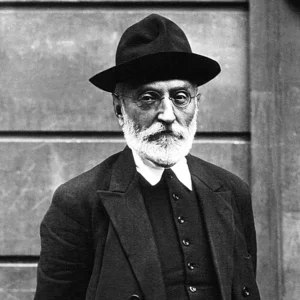

Spanish writer and philosopher, a major figure of the Generation of '98. Rector of the University of Salamanca, in his work he explores existential anguish and the “tragic sense of life.”
Miguel de Unamuno(1864 — 1936)
Miguel de Unamuno
Espagne
6 min read
Frequently asked questions
Famous Quotes
« Venceréis, pero no convenceréis»
« La fe que no duda es fe muerta»
Key Facts
- Born in 1864 in Bilbao, died in 1936 in Salamanca
- Appointed rector of the University of Salamanca in 1900
- Published “The Tragic Sense of Life” in 1913
- Published the novel “Niebla” (Mist) in 1914
- Publicly opposed the Francoists in 1936, shortly before his death
Works & Achievements
A collection of essays exploring the deep identity of Spain and introducing his notion of "intrahistory."
His first novel, drawing on his childhood memories of the siege of Bilbao during the Carlist War.
A personal and passionate rereading of Cervantes's masterpiece, a manifesto of his "Quixotism."
His major philosophical essay on the conflict between reason and the longing for immortality.
An innovative novel he called a "nivola," in which the character rebels against his author.
A long religious poem inspired by the painter's famous canvas, a meditation on death and faith.
A short, deeply moving novel about a priest who has lost his faith but feigns it for his parishioners.
Anecdotes
On 12 October 1936, at the height of the civil war, rector Unamuno presided over a ceremony at the University of Salamanca. When the Francoist general Millán-Astray shouted “Long live death!”, the old philosopher rose and replied: “You will win, but you will not convince.” Threatened at gunpoint, he was immediately placed under house arrest and died two and a half months later.
Unamuno had a surprising passion: he was forever folding “pajaritas,” those little paper birds. He would make them during conversations, turned it into almost an art, and even devoted some amusing and learned pages to them in his work.
To read his beloved Danish philosopher Søren Kierkegaard in the original, Unamuno taught himself Danish all on his own. He affectionately called him “my brother Kierkegaard,” so alike were their anxieties about faith and death.
In 1924, the dictator Primo de Rivera exiled him to the barren island of Fuerteventura, in the Canaries, for having criticized the regime. Unamuno escaped aboard a French sailing ship and spent several years in exile in Paris and then in Hendaye, just across the border, from where he could glimpse his beloved Spain.
A professor of ancient Greek, Unamuno was appointed rector of the prestigious University of Salamanca at only 36. He held and lost this post several times as political tides shifted, becoming the troubled conscience of the Spain of his day.
Primary Sources
Man of flesh and bone, he who is born, suffers and dies — above all who dies —, he who eats and drinks, who plays, sleeps, thinks and loves, that is the subject and the supreme object at once of all philosophy.
The character Augusto Pérez, on learning that he is nothing but a creature of fiction, rebels against his author: “You too shall die, Mr. de Unamuno, you too, and you shall return to the nothingness from which you came!”
A village priest, who has lost his faith but feigns it so as not to drive his parishioners to despair, confides his secret: that they should believe what he himself can no longer believe.
“You will conquer, but you will not convince. You will conquer because you have more than enough brute force; but you will not convince, for to convince means to persuade.”
Key Places
Port and industrial city in the Basque Country where Unamuno was born and where he lived through the siege during the Carlist War.
Venerable university where he was a professor of Greek and rector, and the stage of his famous confrontation of 1936. He lived and died there.
Capital where he pursued his higher studies in philosophy and letters in the 1880s.
Desert island in the Canaries where the dictatorship of Primo de Rivera exiled him in 1924, before his escape.
French town on the Basque border where Unamuno spent the end of his exile, his gaze turned toward Spain.
French capital where he stayed in exile after his escape from Fuerteventura.
Typical Objects

A small folded paper bird that Unamuno endlessly crafted, which became almost his personal emblem. He saw in it both a game and a meditation, and devoted writings to it.

His small wire-rimmed glasses gave him the air of a pensive owl and are inseparable from his face in portraits.

Solemn garments he wore as rector of the University of Salamanca during ceremonies, notably the one on 12 October 1936.

The writing instruments of an author of immense fertility: novels, essays, poems, articles and thousands of letters.

Books by the Danish philosopher that Unamuno learned to read in their original language, nourishing his reflection on anguish and faith.
School Curriculum
Vocabulary & Tags
Key Vocabulary
Daily Life
Morning
In the morning, Unamuno teaches his Ancient Greek classes at the University of Salamanca, in its venerable stone halls. Between lessons, he writes tirelessly—articles, essays, and letters.
Afternoon
The afternoon is often devoted to writing and reading in his study, cluttered with books. He also loves to walk through Salamanca and observe the simple lives of ordinary people, what he called “intrahistory.”
Evening
In the evening, he takes part in the “tertulia,” those lively café discussions where intellectuals and friends debate literature, religion, and politics for hours.
Food
His table is that of Castile and the Basque Country: bread, soups, dried pulses, fish, lamb, and sheep's cheese. Unamuno led a sober life, with no taste for excess.
Clothing
He is recognizable by his austere dark suit, his waistcoat, his small round glasses, and his trimmed beard, which give him the air of an owl. For ceremonies, he dons the rector's gown and cap.
Housing
He lives in Salamanca, a university town of golden stone, in a home full of books, near the university whose fortunes he long directed.
Historical Timeline
Period Vocabulary
Liens externes & ressources
Références
Œuvres
En torno al casticismo
1895
Paz en la guerra (Paix dans la guerre)
1897
La Vie de Don Quichotte et Sancho
1905
Du sentiment tragique de la vie
1913
Brouillard (Niebla)
1914
Le Christ de Velázquez
1920
Saint Manuel Bueno, martyr
1930