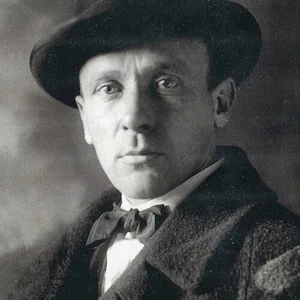

A Soviet writer and playwright of Ukrainian origin, originally trained as a doctor. Censored under Stalin, he is famous for his satirical and fantastical novel *The Master and Margarita*, published only after his death.
Mikhail Bulgakov(1891 — 1940)
Mikhail Bulgakov
Union soviétique, Empire russe
6 min read
Frequently asked questions
Famous Quotes
« Manuscripts don't burn.»
Key Facts
- Born in 1891 in Kiev, he worked as a doctor during the First World War and the Russian Civil War.
- Abandoned medicine around 1920 to devote himself to writing and the theater.
- Published *The White Guard* (1925), adapted for the stage under the title *The Days of the Turbins*.
- Wrote *The Master and Margarita* from 1928 until his death; the novel was not published until 1966-1967, long after he was gone.
- Censored and banned from publishing under Stalin, he died in Moscow in 1940.
Works & Achievements
A collection of short stories inspired by his years as a rural doctor, blending humor, anguish, and clinical observation.
A novel about a Kiev family caught in the turmoil of the civil war, Bulgakov's first major work.
A biting satire about a scientist who transforms a dog into a man; deemed too critical of the regime, it was not published in the U.S.S.R. until 1987.
A satirical science-fiction tale in which a scientific invention turns into a catastrophe, mocking Soviet bureaucracy.
A stage adaptation of The White Guard, a huge success at the Moscow Art Theatre, admired even by Stalin.
A play about the exile of the White Russians, banned before it could even be staged during the author's lifetime.
A satirical and fantastical novel in which the devil visits Stalinist Moscow; a masterpiece published only after his death.
Anecdotes
In 1930, in despair at seeing all his plays banned, Bulgakov threw the first manuscript of his great novel into the fire. He later rewrote it from memory, and it was from this experience that the famous line in The Master and Margarita was born: “Manuscripts don't burn.”
That same year, after the writer had sent a letter to the government demanding the right to emigrate or to be allowed to work, Stalin telephoned him personally. Caught off guard, Bulgakov replied that a Russian writer could not live far from his homeland. Soon afterwards, he was offered a position at the Moscow Art Theatre.
Stalin loathed Bulgakov's ideology but adored his play The Days of the Turbins, which portrayed White officers sympathetically: he is said to have seen it some fifteen times, which long shielded the author from outright arrest.
A doctor before he became a writer, Bulgakov was sent as a young man to a country hospital lost in the snow, an experience he recounted in A Country Doctor's Notebook. There he also went through a period of morphine addiction, which he managed to overcome and later transposed into his short story Morphine.
Nearly blind and dying of a hereditary kidney disease in 1940, he kept dictating the final corrections to The Master and Margarita to his wife Elena. The novel was not published until 1966-1967, more than twenty-five years after his death.
Primary Sources
I ask the Soviet Government to order me to leave the borders of the U.S.S.R. without delay. And if what I write is not convincing and I am condemned to remain silent until the end of my days in the U.S.S.R., I ask the Government to give me work.
Manuscripts don't burn.
Forty versts from any railway line, the young doctor finds himself alone, at night, facing cases he has never treated, with only his textbooks and his fear for company.
Key Places
Bulgakov's native city, then part of the Russian Empire, where he grew up and studied medicine. It serves as the backdrop for his novel *The White Guard* during the civil war.
Bulgakov worked here as an isolated zemstvo doctor, far from everything. This experience fed into his *A Country Doctor's Notebook*.
In the Caucasus, during the civil war, Bulgakov gave up medicine and took his first steps in theatre and journalism.
Communal housing (kommunalka) where Bulgakov lived upon arriving in Moscow. The “bad apartment” in *The Master and Margarita* is inspired by it; today it is a museum.
Prestigious stage where *The Days of the Turbins* triumphed and where Bulgakov worked as an assistant director and playwright after Stalin's phone call.
Soviet capital where Bulgakov spent most of his career and died on 10 March 1940. He is buried at Novodevichy Cemetery.
Typical Objects

The manuscript of his masterpiece, which he partly burned and then rewrote, and revised until his death. Left unpublished, it circulated in secret for a long time before its belated publication.

The case of the young country doctor, holding instruments, vials and medicines. It accompanied Bulgakov through his zemstvo years, the source of his earliest stories.

The daily working tool of the Soviet writer and playwright. It was used to type plays, novels and numerous copies, many of which were seized or rejected by the censors.

The device through which Stalin personally called Bulgakov in April 1930. This ordinary object became the symbol of the chilling link between the writer and those in power.

Bulgakov took care over his appearance, with a suit, bow tie and sometimes a monocle. This “bourgeois” elegance stood out in the proletarian Soviet society of the 1920s and 1930s.
School Curriculum
Vocabulary & Tags
Key Vocabulary
Daily Life
Morning
Often writing at night, Bulgakov would rise late. His morning was devoted to correspondence, reading and writing, in the relative quiet of his lodgings before the bustle of the day.
Afternoon
The afternoon took him to the Moscow Art Theatre for rehearsals, the adaptation of plays and his work as a playwright—an activity that became his livelihood after his own works were banned.
Evening
In the evening, he attended performances and met up with writer and actor friends. He would sometimes read his banned works privately, within small, trusted circles.
Food
His diet followed the shortages of the Soviet era: black bread, soups, tea, and occasionally rarer foods obtained through his theatre connections. His table remained plain and irregular.
Clothing
Bulgakov insisted on a neat, old-fashioned appearance: a suit, a bow tie, sometimes a monocle. This elegance of “the old days” was a deliberate contrast to the surrounding proletarian austerity.
Housing
He first lived in an overcrowded kommunalka on Bolshaya Sadovaya, sharing kitchen and hallways with other families, before later obtaining a more comfortable apartment in Moscow.
Historical Timeline
Period Vocabulary
Liens externes & ressources
Références
Œuvres
Récits d'un jeune médecin
1925-1926
La Garde blanche
1925
Cœur de chien
1925
Les Œufs fatidiques
1925
Les Jours des Tourbine
1926
La Fuite
1928
Le Maître et Marguerite
1928-1940 (publié 1966-1967)