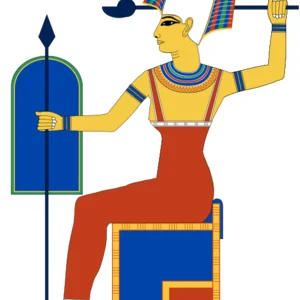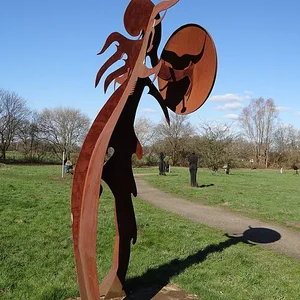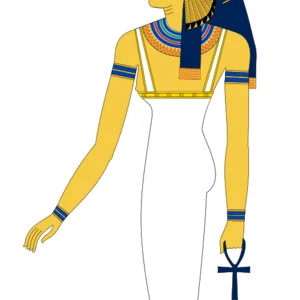

Mut is a goddess of Egyptian mythology, venerated as a mother goddess and queen of the deities. Wife of the god Amun and mother of Khonsu, she forms the Theban triad with them. Her cult was centered in Thebes, in the temple of Karnak.
Mut
Mut
5 min read
Frequently asked questions
Key Facts
- Forms the Theban triad with her husband Amun and their son Khonsu
- Her name means “mother” in ancient Egyptian
- Venerated mainly in Thebes, her temple was located at Karnak (precinct of Mut)
- Often depicted wearing the double crown of Egypt or associated with the vulture
- Her cult reached its peak during the New Kingdom (around 1550-1070 BCE)
Works & Achievements
Divine family worshipped at Thebes, of which Mut is the mother. This triad shaped the entire cult of Karnak for over a thousand years.
Great sanctuary enlarged by Amenhotep III, the centre of the goddess's cult. It testifies to Mut's importance in Egyptian religion.
Several hundred statues of the lion-headed goddess installed in the Temple of Mut. They were meant to protect Egypt from epidemics and dangers.
Great annual celebration linking Karnak and Luxor, during which Mut accompanied Amun. It renewed the divine power of the pharaoh.
Mut, crowned with the double crown, protected the pharaoh and legitimised his power. She embodied the divine mother of kings.
Anecdotes
The name Mut literally means “mother” in ancient Egyptian, and it was written with the hieroglyph of the vulture. The Egyptians saw in this bird the perfect image of motherhood, because it was believed that only female vultures existed.
At Karnak, Mut had her own temple surrounded by a crescent-shaped sacred lake called the Isheru. Every year, during the Opet festival, the statue of Amun left its sanctuary to join that of Mut in a great procession on the Nile.
Mut was often confused or associated with the fearsome and dangerous lioness-goddess Sekhmet. She was then depicted with the head of a lioness, able to protect the king but also to unleash her fury.
The female pharaoh Hatshepsut and later Amenhotep III had hundreds of statues of the goddess Sekhmet-Mut erected in the temple of Mut at Karnak, to appease the goddess and ward off epidemics.
Mut often wore the double crown of Upper and Lower Egypt, an attribute usually reserved for the pharaoh. This showed her role as “queen of the goddesses” and sovereign of all Egypt.
Primary Sources
Hail to you, Amun-Ra... lord of Karnak, who dwells in Thebes, husband of Mut, father of Khonsu.
Mut the great, mistress of the Isheru, lady of heaven, sovereign of all the gods.
He had erected for his mother Mut, lady of the Isheru, statues as numerous as the stars of heaven.
Mut spreads her wings over the deceased and protects him as a mother protects her child.
Key Places
The goddess's main sanctuary, located south of the great Temple of Amun at Thebes. It was surrounded by a crescent-shaped sacred lake, the Isheru.
A vast group of temples dedicated to the Theban triad Amun-Mut-Khonsu. It was one of the largest religious centers of ancient Egypt.
Egypt's religious capital during the New Kingdom and the heart of Mut's cult. Each year the Opet Festival linked the temples of Karnak and Luxor.
A sanctuary connected to Karnak by an avenue of sphinxes, where the procession of the Opet Festival came to an end. There Mut accompanied Amun during these celebrations.
A crescent-shaped lake surrounding the Temple of Mut at Karnak. Its waters were used for purification rites and symbolized the origins of life.
Typical Objects

Headdress combining the White Crown of Upper Egypt and the Red Crown of Lower Egypt. Mut wears it to signify her sovereignty over the whole country.

Ornament covering the head in the likeness of a vulture with outstretched wings. It evokes the goddess's maternal protection.

Sacred percussion instrument shaken during rituals in honour of the goddesses. Its jingling was believed to soothe the deities.

Staff adorned with a papyrus umbel, an attribute of the goddesses. It symbolises prosperity and the freshness of life.

Granite effigy representing the fearsome facet of Mut. Hundreds of them were erected in her temple to ward off illness and danger.

Hieroglyphic sign shaped like a looped cross, held by the deities. It represents the eternal life granted by the gods.
School Curriculum
Vocabulary & Tags
Key Vocabulary
Daily Life
Morning
As a goddess, Mut had no human daily life, but her statue was treated like a living person. Each morning, the priests opened the sanctuary, purified the effigy, dressed it, and presented it with offerings of food and incense.
Afternoon
During the day, the temple buzzed with the activity of the priests, scribes, and craftsmen who maintained the cult. Hymns were recited and fresh offerings placed before the goddess.
Evening
At dusk, the statue was purified once more, then the sanctuary was closed and sealed for the night. It was believed that the goddess rested until the next day, watching over Thebes.
Food
The offerings intended for Mut included bread, beer, wine, meats, fruits, and vegetables. After the ritual, these foods, “spiritually consumed” by the goddess, were redistributed to the priests and temple staff.
Clothing
Mut was depicted wearing a long, close-fitting robe, often red in color and sometimes adorned with feather patterns. She wore the vulture-shaped headdress and the royal double crown.
Housing
Mut's “dwelling” was her temple at Karnak, surrounded by the sacred lake of the Isheru. The holy of holies housed her statue in a stone naos, accessible to priests alone.
Historical Timeline
Period Vocabulary
Visual Style
Style des reliefs et peintures de temples du Nouvel Empire : figure hiératique en couleurs minérales, or et lapis-lazuli, avec couronne double et coiffe-vautour.
Sound Ambience
Une ambiance de temple égyptien : chants de prêtres, sistres, procession festive et clapotis du lac sacré sous le ciel de Thèbes.
Liens externes & ressources
Références
Œuvres
Triade thébaine (Amon, Mout, Khonsou)
Nouvel Empire
Temple de Mout à Karnak
vers 1390 av. J.-C.
Ensemble des statues de Sekhmet
vers 1380 av. J.-C.
Fête d'Opet
Nouvel Empire
Rôle de protectrice royale
Égypte antique