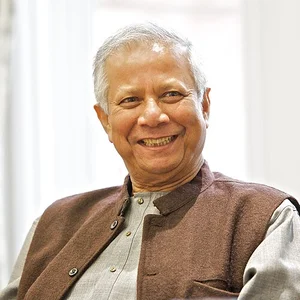

Bangladeshi economist and social entrepreneur, founder of the Grameen Bank and a pioneer of microcredit. He received the Nobel Peace Prize in 2006 for his work against poverty.
Muhammad Yunus(1940 — ?)
Muhammad Yunus
Bangladesh
5 min read
Frequently asked questions
Famous Quotes
« Poverty does not belong in civilized human society. Its proper place is in a museum.»
Key Facts
- Born in 1940 in Chittagong, in what was then British Bengal (present-day Bangladesh)
- Founds the Grameen Bank in 1983 to provide microcredit to the poorest populations, especially women
- Receives the Nobel Peace Prize in 2006, jointly with the Grameen Bank
- Becomes head of Bangladesh's interim government in 2024 after the fall of Sheikh Hasina's government
Works & Achievements
The pioneering loans of a few dollars to poor villagers, which proved that the destitute repay their debts and launched the idea of microcredit.
Creation of the “village bank,” the first institution dedicated to microcredit, lending without material collateral, mainly to women.
An autobiography translated all over the world, in which Yunus recounts his approach and defends his vision of an economy in the service of the poor.
A program that brought mobile telephony to the Bangladeshi countryside and allowed women to become entrepreneurs.
Theorized in his book Creating a World Without Poverty, this business model aims to solve social problems without seeking personal profit.
An award crowning decades of action against poverty “from the ground up,” establishing microcredit as a tool for development.
Anecdotes
In 1974, Bangladesh was going through a terrible famine. **Muhammad Yunus**, then an economics professor, discovered that a bamboo craftswoman earned almost nothing because she had to borrow from a loan shark. Out of his own pocket, he lent 27 dollars to 42 villagers: they all paid him back. This tiny experiment gave birth to the idea of microcredit.
Traditional banks refused to lend to the poor, deemed “not creditworthy.” Yunus then offered to guarantee the loans himself. Noticing that his borrowers repaid better than wealthy clients, he eventually founded his own bank, the **Grameen Bank**, in 1983.
The Grameen Bank lends overwhelmingly to women: they make up more than 90% of its borrowers. Yunus observed that once they earned money, women invested it more in their children's health and education, which transformed entire villages.
In December 2006, **Muhammad Yunus** received the **Nobel Peace Prize** in Oslo, shared with the Grameen Bank. In his speech, he said he dreamed of a world where poverty would exist only in museums, so that future generations could barely believe it had ever existed.
The Grameen system relies on “solidarity groups”: five borrowers come together and support one another. If one struggles to repay, the others encourage them. This collective trust, without any material collateral, is the key to a very high repayment rate.
Primary Sources
One day our grandchildren will go to museums to see what poverty was like. They will wonder how humanity could have tolerated such a condition for so many people, for so long.
I lent the 27 dollars to the forty-two people in the village. I told them they could repay the bank whenever they were able to. There was no interest.
The Peace Prize for 2006 is to be divided into two equal parts between Muhammad Yunus and the Grameen Bank for their efforts to create economic and social development from below.
Key Places
Large port city in the southeast where Muhammad Yunus was born in 1940 and where he taught economics after his return.
Village near the University of Chittagong where Yunus made his first micro-loans in 1974-1976. The birthplace of microcredit.
University where Yunus earned his doctorate in economics thanks to a Fulbright scholarship in the 1960s.
Capital of Bangladesh, home of the Grameen Bank and center of the country's political life.
Site where the Nobel Peace Prize was awarded to Muhammad Yunus and the Grameen Bank in December 2006.
Typical Objects

Small sums in taka, the Bangladeshi currency, lent to villagers. A few dozen dollars were enough to start up a business.

The craftswomen made bamboo stools and objects, a typical activity of the first borrowers in Jobra. Bamboo is emblematic of rural Bangladeshi craftsmanship.

The notebook where Grameen agents recorded the loans and weekly repayments of each solidarity group. A simple tool at the heart of the system.

The medal awarded in Oslo in 2006, struck with the effigy of Alfred Nobel. It honours Yunus's fight against poverty.

Thanks to Grameen Phone, women known as “telephone ladies” bought a mobile on credit and rented out calls to the whole village. An object that became a tool of development.

Traditional garment worn by the vast majority of the Grameen Bank's borrowers, women from Bangladeshi villages.
School Curriculum
Vocabulary & Tags
Key Vocabulary
Tags
Lieu
Daily Life
Morning
Yunus starts early, often by reading newspapers and the bank's figures. As a teacher and then a leader, he devotes his mornings to meetings and to planning the Grameen programs.
Afternoon
His afternoons are paced by field visits to the villages, where he meets the women borrowers and listens to their difficulties. He places great importance on direct contact with the poorest.
Evening
In the evening, he prepares lectures and writings, or meets political and economic leaders who have come to draw inspiration from the microcredit model. International travel takes up a growing share of his schedule.
Food
Bangladeshi cuisine is based on rice, fish, lentils (dal) and vegetables, seasoned with spices. Yunus, a man of simple tastes, shares the plain food of his country.
Clothing
He often wears a sleeveless vest over a traditional tunic (kurta or panjabi) made of local fabric, a sign of his closeness to Bangladeshi culture. At international ceremonies, he sometimes dons Western dress.
Housing
He lives in Dhaka, the capital, in modest housing for a man of his renown. His working world remains turned toward the villages of bamboo and mud where the borrowers live.
Historical Timeline
Period Vocabulary
Liens externes & ressources
Références
Œuvres
Premiers micro-prêts de Jobra
1974-1976
Fondation de la Grameen Bank
1983
Vers un monde sans pauvreté
1997
Grameen Phone et le "village phone"
1997
Le concept de "social business"
2007
Prix Nobel de la paix
2006