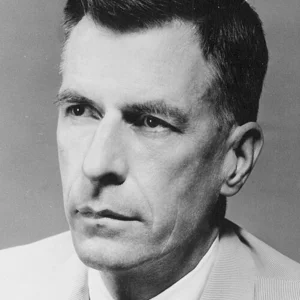

John Kenneth Galbraith was an American-Canadian economist, a major figure of twentieth-century institutionalism and Keynesianism. A critic of consumer society, he shaped public debate through his books written for a general audience.
John Kenneth Galbraith(1908 — 2006)
John Kenneth Galbraith
Canada, États-Unis
6 min read
Frequently asked questions
Key Facts
- Born in 1908 in Ontario (Canada), naturalized American, died in 2006
- Published 'The Affluent Society' in 1958, a worldwide success
- Theorized the 'reverse sequence' and the power of large firms in 'The New Industrial State' (1967)
- Adviser to Democratic presidents (Roosevelt, Kennedy) and United States Ambassador to India (1961-1963)
- Professor of economics at Harvard University for several decades
Works & Achievements
Galbraith argues that the power of large corporations is held in check by 'countervailing powers' (unions, retailers, the State).
A now-classic account of the 1929 stock market crash, praised for its clarity and wit; it has never gone out of print.
His most famous work, which criticizes private abundance set against the poverty of public services in wealthy societies.
His theory of the 'technostructure': in the large corporation, power belongs to the experts and technicians, no longer to the shareholders.
A hit book and television series tracing the history of economic ideas for a broad global audience.
A synthesis of his thinking on the role of the State and the need to steer the economy toward the general interest.
A diplomatic posting during which he strengthened ties between Washington and New Delhi during the Cold War.
Anecdotes
Galbraith stood about 2.03 metres tall: his great height had become a famous trait, and he gladly joked about it, saying it helped him dominate debates. During the Second World War, he was put in charge of price control in the United States, which earned him as many admirers as enemies.
In 1958, his book *The Affluent Society* made famous the idea of the contrast between private wealth and public squalor: gleaming cars driving on poorly maintained roads, near run-down schools. The phrase left a lasting mark on the debate over public spending.
A close adviser to President John F. Kennedy, Galbraith was appointed United States Ambassador to India from 1961 to 1963. He became friends with Prime Minister Nehru and wrote Kennedy many letters full of humour.
Galbraith was one of the few economists to write for the general public rather than only for his colleagues. His books sold millions of copies, which irritated some academics who found his style too literary and not mathematical enough.
An early opponent of the Vietnam War, he also advised President Lyndon Johnson before breaking with his military policy. He received the Presidential Medal of Freedom twice, in 1946 and in 2000.
Primary Sources
The family that takes a drive in its air-conditioned car, with power steering and powerful brakes, passes through badly paved cities littered with rubbish, ramshackle buildings, billboards, and posts that should long ago have been buried underground.
In the great modern corporation, power has passed from shareholders and managers to what I call the technostructure — that is, all those who bring their specialized knowledge to decision-making.
Speculation becomes widespread when people imagine they can grow rich without working. The crash of 1929 was the consequence of this shared illusion.
The most dangerous mistake in foreign policy is to believe that one can solve, by military force, problems that are fundamentally political and economic.
Key Places
Rural village in Ontario where Galbraith was born in 1908 into a family of farmers of Scottish descent. His childhood on the farm shaped his outlook on the world.
Galbraith taught economics here for decades and wrote his major works here. Harvard was the heart of his academic career.
Capital where Galbraith served as United States ambassador from 1961 to 1963. There he struck up a friendship with Prime Minister Nehru.
Galbraith earned his doctorate in agricultural economics at the University of California here in 1934. These studies shaped his earliest work.
Hub of American power where Galbraith led price controls during the war and advised Presidents Kennedy and Johnson.
Typical Objects

Galbraith was a prolific writer who composed his books and speeches on a typewriter. He revised his texts tirelessly to make them clear and elegant.

His books, which sold millions of copies, made economics accessible to everyone. They transformed the way the public viewed the discipline.

With his series 'The Age of Uncertainty' in 1977, Galbraith was one of the first economists to teach his ideas on television. He became a media figure.

During the war, Galbraith set the official prices of thousands of products to prevent inflation. These administrative schedules governed the entire American economy.

Galbraith annotated his manuscripts and signed his diplomatic correspondence with care. His pen served as much for economic analysis as for the witty letters he sent to Kennedy.
School Curriculum
Vocabulary & Tags
Key Vocabulary
Tags
Daily Life
Morning
Galbraith rose early and devoted his mornings to writing, his favorite task. He imposed strict discipline on himself, drafting several pages before any other activity, convinced that inspiration came from regular work.
Afternoon
In the afternoon, he taught at Harvard, met with students and colleagues, or took part in political meetings in Washington. During his ambassadorship, he juggled diplomatic audiences and travels across India.
Evening
In the evening, Galbraith enjoyed dinners and conversations with intellectuals, politicians, and journalists. There he sharpened his caustic wit and maintained his vast network of influential friendships.
Food
A man of his time and of his well-to-do milieu, he appreciated fine cuisine and receptions. In India, he discovered the local cuisines with curiosity while keeping his Western habits.
Clothing
Galbraith wore the sober, elegant suits of the American academic and diplomat. His towering frame made his attire instantly recognizable in any gathering.
Housing
He lived for a long time in Cambridge, Massachusetts, near Harvard, as well as on a farm in Vermont where he loved to write. In New Delhi, he occupied the official residence of the ambassador.
Historical Timeline
Period Vocabulary
Liens externes & ressources
Références
Œuvres
American Capitalism: The Concept of Countervailing Power
1952
The Great Crash, 1929
1955
The Affluent Society (L'Ère de l'opulence)
1958
The New Industrial State (Le Nouvel État industriel)
1967
The Age of Uncertainty (L'Ère de l'incertitude)
1977
Economics and the Public Purpose
1973
Ambassade des États-Unis en Inde
1961-1963