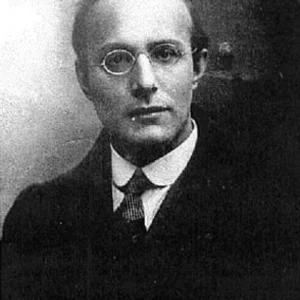

Karl Polanyi (1886-1964) was an Austro-Hungarian economist and economic anthropologist. A critic of economic liberalism, he analyzed the rise of the market economy and its grip on society in his major work, *The Great Transformation* (1944).
Karl Polanyi(1886 — 1964)
Karl Polanyi
Hongrie
5 min read
Frequently asked questions
Key Facts
- Born in 1886 in Vienna into a Jewish family of the intellectual middle class of the Austro-Hungarian Empire
- Fled Nazism and emigrated to England in the 1930s, then to the United States
- Published *The Great Transformation* in 1944, his landmark work on the rise of the market economy
- Developed the concept of the *embeddedness* of the economy within social relations
- Died in 1964 in Canada
Works & Achievements
A major work analyzing the birth of the market economy in the 19th century and its destructive grip on society. A founding classic of economic sociology.
A collective work he co-edited, comparing the economic systems of ancient societies. In it he develops the concept of an economy “embedded” in social relations.
A posthumous study of the economy of an African kingdom, illustrating his economic-anthropology theories about non-capitalist markets.
A posthumous collection synthesizing his thinking on the place of the economy in human societies throughout history.
Economic columns written in Vienna that established his reputation as an analyst of the crisis of liberalism and the rise of fascism.
Anecdotes
Karl Polanyi grew up in Budapest in a cultured and brilliant Jewish family: his younger brother Michael Polanyi would become a world-renowned chemist and philosopher of science. The two brothers would clash all their lives over the question of the market economy, with Michael defending the liberalism that Karl criticized.
During the First World War, Polanyi served as a cavalry officer in the Austro-Hungarian army on the Russian front. He returned gravely ill, scarred both physically and morally by this experience of Europe's collapse.
Having taken refuge in Vienna after the war, he became a renowned economic journalist at the prestigious weekly *Der Österreichische Volkswirt*. The rise of fascism drove him to flee to London in 1933, and then to the United States.
It was in exile, drawing on English and American libraries, that he wrote *The Great Transformation*, published in 1944 in the midst of the world war. The book appeared at the very moment when the liberal order it analyzed was collapsing.
Toward the end of his life, Polanyi taught at Columbia University in New York, but his wife Ilona Duczynska, a former communist militant, was refused an American visa. The couple then settled in Canada, in Pickering near Toronto, from where Karl commuted for his classes.
Primary Sources
The idea of a self-adjusting market implied a stark utopia. Such an institution could not exist for any length of time without annihilating the human and natural substance of society.
What we call land is an element of nature inextricably interwoven with man's institutions. Labor, land, and money are fictitious commodities.
Man's economy, as a rule, is submerged in his social relationships. He does not act so as to safeguard his individual interest in the possession of material goods.
Key Places
Polanyi's birthplace and an intellectual capital where he became an economic journalist in the 1920s.
The city of his childhood and youth, where he founded the Galileo Circle and was active in radical circles.
A refuge after he fled Vienna in 1933; there he taught evening classes and conceived The Great Transformation.
The institution where Polanyi was a professor of economic history from 1947 and conducted his research in economic anthropology.
A town near Toronto where he settled with his wife after being denied a U.S. visa, and where he died in 1964.
Typical Objects

The daily tool of the journalist and academic, on which Polanyi wrote his articles and manuscripts. It symbolizes the intellectual labor of exile.

Polanyi's major work, published in 1944. Having become a classic of the social sciences, it embodies his critique of the self-regulating market economy.

The leading Viennese weekly for which Polanyi wrote in the 1920s. A medium for spreading economic analysis among the educated public.

Military attire worn by Polanyi during his service in the Austro-Hungarian army during the Great War. A witness to his traumatic experience on the Russian front.

Notebooks and index cards accumulated in the libraries of London to prepare his works on economic history and anthropology. The material foundation of his scholarship.

A teaching tool used by Polanyi for his economic history courses at Columbia. He passed on his ideas to a new generation of American students.
School Curriculum
Vocabulary & Tags
Key Vocabulary
Daily Life
Morning
In London or New York, Polanyi often began his day early by reading the newspapers and going through his notes. In exile, access to libraries set the rhythm of his research mornings.
Afternoon
His afternoons were devoted to writing, to preparing evening classes for adults in England, and later to university teaching at Columbia. He exchanged ideas extensively with other exiled intellectuals.
Evening
In the evening, he discussed the political and economic ideas of his time with his wife Ilona Duczynska, herself an activist and intellectual. Family debates and correspondence nourished his thinking.
Food
Polanyi shared the diet of the cultivated middle class of Central Europe, and later the more modest fare of exile: bread, soups, simple dishes. Periods as a refugee often imposed frugality.
Clothing
He wore the sober attire of the twentieth-century academic and journalist: jacket, shirt, and tie. During the war, he had worn the uniform of an Austro-Hungarian officer.
Housing
His life in exile took him from Viennese apartments to modest London lodgings, then to a house in Pickering, Canada, from which he commuted to New York. Geographic wandering marked his existence.
Historical Timeline
Period Vocabulary
Liens externes & ressources
Références
Œuvres
La Grande Transformation
1944
Trade and Market in the Early Empires
1957
Dahomey and the Slave Trade
1966
The Livelihood of Man
1977
Articles du Der Österreichische Volkswirt
1924-1933