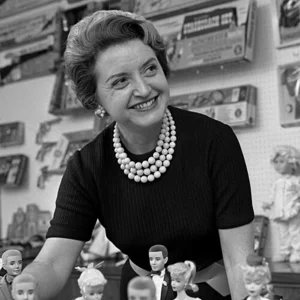

American businesswoman, co-founder of the toy company Mattel. In 1959 she designed the Barbie doll, which became one of the best-selling toys in the world.
Ruth Handler(1916 — 2002)
Ruth Handler
États-Unis
5 min read
Frequently asked questions
Key Facts
- Co-founds the company Mattel with her husband Elliot Handler in 1945
- Launches the Barbie doll in 1959, inspired by her daughter Barbara
- Creates the Ken doll in 1961, named after her son
- Leaves Mattel in 1975 after financial and legal difficulties
- Later develops breast prostheses (Nearly Me) after her breast cancer, dies in 2002
Works & Achievements
Creation of one of the largest toy companies in the world, starting out in a California garage.
Design of the best-selling toy in history, which transformed the industry and children's culture.
Expansion of the Barbie universe with a male character and a complementary product line.
First advertiser to target children directly through television, during the Mickey Mouse Club.
A company making realistic breast prostheses for women who had undergone breast cancer surgery.
An account of her life, from the founding of Mattel to the creation of Barbie and Nearly Me.
Anecdotes
The name Mattel is a portmanteau: it combines the first name of Elliot Handler, Ruth's husband, with the nickname of their business partner Harold "Matt" Matson. Founded in 1945 in a California garage, the company first made picture frames, then dollhouses using the wood scraps.
The idea for Barbie came to Ruth while watching her daughter Barbara play with paper dolls that she dressed as adults. She noticed that little girls liked to imagine their grown-up lives, whereas the dolls of the time almost always represented babies.
Barbie owes her name to Ruth's daughter, Barbara, and her famous companion Ken to the first name of her son, Kenneth. The doll was unveiled for the first time at the American International Toy Fair in New York on March 9, 1959, a date regarded as her birthday.
During a trip to Europe, Ruth discovered in Germany an adult doll named Bild Lilli, sold mainly to men as a gag gift. She drew inspiration from it to design Barbie, and Mattel later bought the rights to Lilli in 1964.
After undergoing a mastectomy in 1970 because of breast cancer, Ruth founded the company Nearly Me in 1975, which made realistic breast prostheses. She turned it into a public cause at a time when the subject remained taboo.
Primary Sources
I realized that if a little girl could imagine her future through a doll, then that doll had to be an adult.
Patent filed describing the articulated construction of a fashion doll, the technical foundation of Barbie.
Someday I'm gonna be exactly like you, till then I know just what I'll do, Barbie, beautiful Barbie.
Key Places
City where Ruth Mosko was born in 1916, into a family of Polish Jewish immigrants.
City in the Los Angeles suburbs where Mattel grew its business and designed Barbie.
Site of Barbie's first public presentation on March 9, 1959.
City where Ruth Handler lived, ran her companies, and died in 2002.
Typical Objects

A fashion mannequin doll modeled on a young adult woman, sold with an interchangeable wardrobe. It revolutionized toys by letting little girls picture themselves in adult roles.

Barbie's male companion, launched in 1961 and named after Ruth Handler's son. He rounds out the doll's narrative world.

A German adult doll from the 1950s that directly inspired the design of Barbie. Mattel bought the rights to it in 1964.

A realistic silicone prosthesis designed by Ruth after her mastectomy, intended for women who had undergone breast cancer surgery. It helped break a medical and social taboo.

A television set that entered American homes in the 1950s and which Mattel used for the first toy advertisement aimed directly at children.

A booklet showcasing the outfits and accessories sold separately for the doll. It embodies the business model of spin-off merchandise and children's consumer culture.
School Curriculum
Vocabulary & Tags
Key Vocabulary
Tags
Daily Life
Morning
An active businesswoman, Ruth started her days early, balancing her family and the Mattel office. She closely followed the development of new toys and the sales figures.
Afternoon
Her afternoons were paced by meetings with designers, marketing departments, and manufacturing workshops. She was personally involved in the design and promotion of the products.
Evening
In the evening, she would reunite with her husband Elliot, also an executive at Mattel, and their two children, Barbara and Kenneth. Professional life and family life remained closely intertwined.
Food
Like the postwar American middle class, she experienced the rise of supermarkets, canned foods, and ready-made meals, symbols of consumer society.
Clothing
She wore the polished outfits of a businesswoman of the 1950s and 1960s: structured suits, fitted dresses, and elegant accessories, reflecting a carefully managed public image.
Housing
She lived in the Los Angeles area, in the comfort of the typical Californian residential suburbs of postwar American prosperity.
Historical Timeline
Period Vocabulary
Liens externes & ressources
Références
Œuvres
Cofondation de Mattel
1945
Création de la poupée Barbie
1959
Lancement de Ken
1961
Stratégie publicitaire télévisée
1955
Fondation de Nearly Me
1975
Autobiographie « Dream Doll »
1994